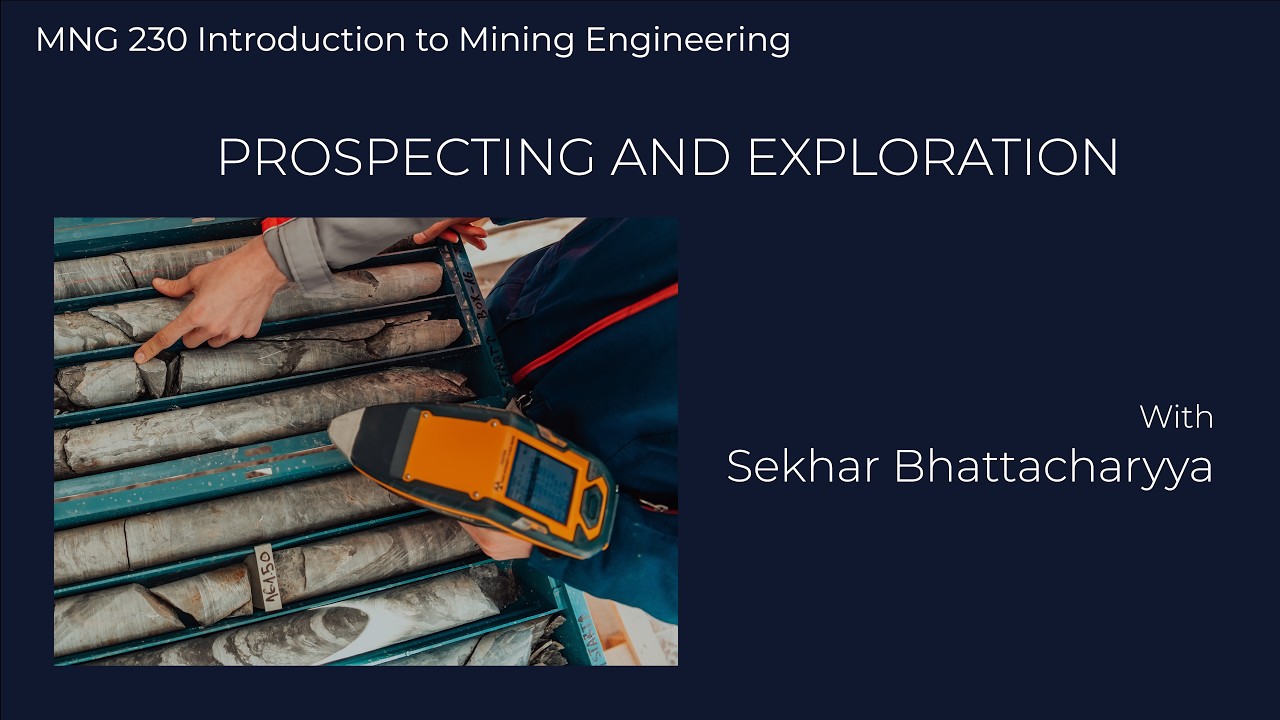
📘 Prospecting & Exploration in Mining — MNG 230 | Penn State Mining Engineering
Автор: Dutton Institute
Загружено: 2026-02-20
Просмотров: 58
Описание:
Welcome to another module of MNG 230: Introduction to Mining Engineering, taught through the Penn State Department of Energy & Mineral Engineering (EME). In this lesson, Dr. Shekhar Bhattacharyya guides you through the earliest and most crucial stage of the mining life cycle: identifying, sampling, and evaluating mineral deposits.
If you’ve ever wondered how mining companies know where valuable minerals are hiding underground, this module explains the science and engineering behind it.
⭐ Prospecting vs. Exploration
Before a mine can exist, we must first find and then define the deposit.
🔹 Prospecting
Performed mainly by geoscientists
Uses geologic mapping, geophysical surveys, geochemical sampling
Goal: locate potential mineral concentrations
🔹 Exploration
Led by mining engineers
Defines the deposit’s shape, size, depth, grade, and geotechnical properties
Includes drilling, sampling, and testing
Determines whether a deposit is economically mineable
These stages provide the foundation for resource estimation and mine design.
⭐ Drilling & Sampling Methods
Accurate sampling is at the heart of evaluating a mineral deposit.
🔹 Core Drilling
Produces intact cylinders of rock
Preserves structure for geotechnical analysis
More expensive, but gives highest-quality data
🔹 Rotary/Reverse Circulation Drilling
Produces chips (cuttings), not solid core
Faster and more cost‑effective
Useful for early‑stage grade estimation
A well‑designed drilling pattern reduces risk and ensures reliable grade continuity.
⭐ How We Classify Resources & Reserves
Understanding these terms is essential in mining, finance, and regulation.
🔹 Mineral Resources
Deposits with potential economic extraction:
Measured — highest confidence
Indicated — moderate confidence
Inferred — lowest confidence
🔹 Mineral Reserves
The economically mineable portion of the resource:
Proved — high certainty; from measured resources
Probable — moderate certainty; from indicated resources
These classifications drive investment decisions, feasibility studies, and long‑term mine planning.
⭐ Reserve Estimation Methods
Engineers use spatial modeling to estimate quantity and grade:
Polygonal Method
Triangular (Triangulation) Method
Inverse Distance Weighting (IDW)
These techniques calculate weighted averages and account for each drill hole’s area of influence.
⭐ Cut‑Off Grade & Stripping Ratio
Economic evaluation determines what portion of the deposit should be mined.
🔹 Cut‑Off Grade
The minimum grade needed for the ore to be profitable.
Material below this value becomes waste.
🔹 Stripping Ratio (SR)
The amount of waste that must be removed for each unit of ore.
Higher SR = higher cost
Determines surface mining limits and pit economics
These calculations indicate where mining should stop and whether deeper zones remain profitable.
⭐ Why This Matters
Prospecting and exploration determine:
Whether a deposit has value
How it should be mined
What risks exist
Whether a project can attract investment
How engineers design safe, efficient, and sustainable mines
It’s the foundation of every successful mining operation.
🎓 Why Study Mining at Penn State?
Penn State’s Department of Energy & Mineral Engineering prepares students to lead in:
Mineral exploration & resource evaluation
Sampling design & drilling programs
Geostatistics and reserve modeling
Mining feasibility analysis
Responsible resource development
Students graduate ready to work in exploration, consulting, operations, technology development, and georesource engineering.
Повторяем попытку...
Доступные форматы для скачивания:
Скачать видео
-
Информация по загрузке:







![🔴NOCNA ZMIANA | KAMILA BIEDRZYCKA & DR MIROSŁAW OCZKOŚ [NA ŻYWO]](https://imager.clipsaver.ru/UcvJzaQ2TYA/max.jpg)