Karlheinz Meier - Neuromorphic Computing - Extreme Approaches to weak and strong scaling
Автор: EPiGRAM-HS Project
Загружено: 2016-05-13
Просмотров: 12911
Описание:
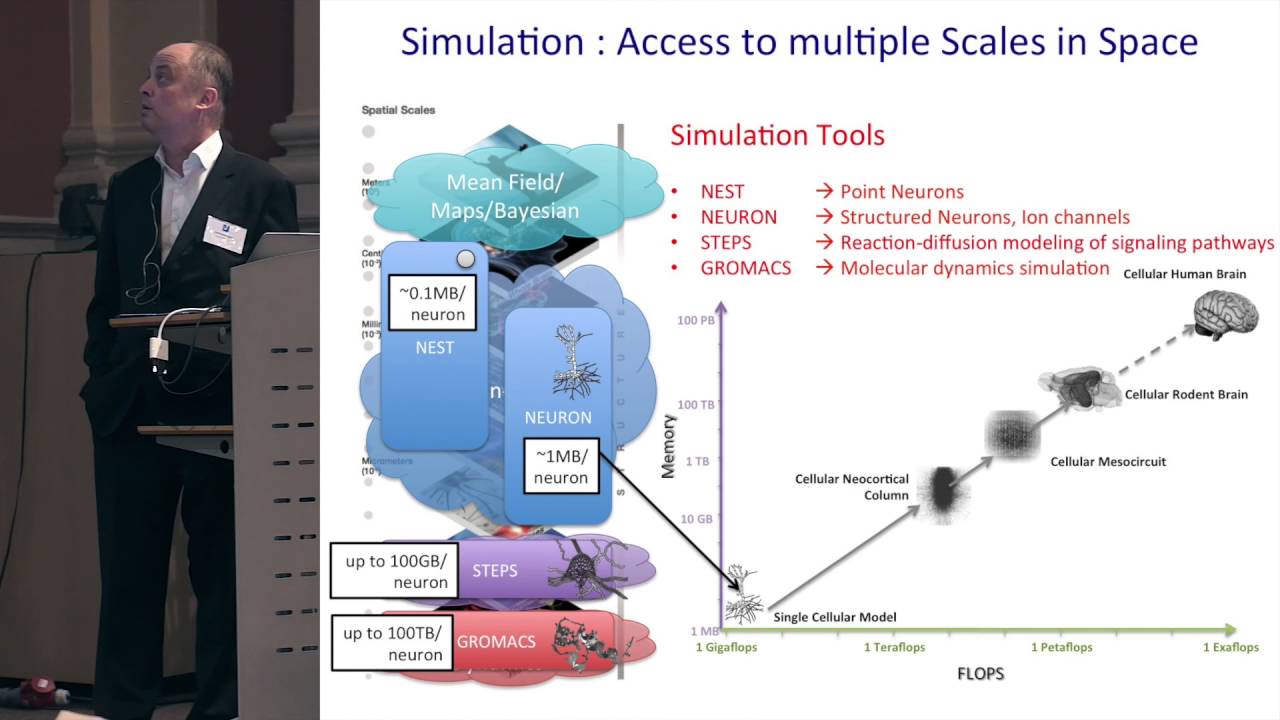
Computer simulations of complex systems provide an opportunity to study their time evolution under user control. Simulations of neural circuits are an established tool in computational neuroscience. Through systematic simplification on spatial and temporal scales they provide important insights in the time evolution of networks which in turn leads to an improved understanding of brain functions like learning, memory or behavior. Simulations of large networks are exploiting the concept of weak scaling where the massively parallel biological network structure is naturally mapped on computers with very large numbers of compute nodes. However, this approach is suffering from fundamental limitations. The power consumption is approaching prohibitive levels and, more seriously, the bridging of time-scales from millisecond to years, present in the neurobiology of plasticity, learning and development is inaccessible to classical computers. In the keynote I will argue that these limitations can be overcome by extreme approaches to weak and strong scaling based on brain-inspired computing architectures.
Bio: Karlheinz Meier received his PhD in physics in 1984 from Hamburg University in Germany. He has more than 25years of experience in experimental particle physics with contributions to 4 major experiments at particle colliders at DESY in Hamburg and CERN in Geneva. For the ATLAS experiment at the Large Hadron Collider (LHC) he led a 15 year effort to design, build and operate an electronics data processing system providing on-the-fly data reduction by 3 orders of magnitude enabling among other achievements the discovery of the Higgs Boson. Following scientific staff positions at DESY and CERN he was appointed full professor of physics at Heidelberg university in 1992. In Heidelberg he co-founded the Kirchhoff-Institute for Physics and a laboratory for the development of microelectronic circuits for science experiments. In particle physics he took a leading international role in shaping the future of the field as president of the European Committee for Future Accelerators (ECFA). Around 2005 he gradually shifted his scientific interests towards large-scale electronic implementations of brain-inspired computer architectures. His group pioneered several innovations in the field like the conception of a description language for neural circuits (PyNN), time-compressed mixed-signal neuromorphic computing systems and wafer-scale integration for their implementation. He led 2 major European initiatives, FACETS and BrainScaleS, that both demonstrated the rewarding interdisciplinary collaboration of neuroscience and information science. In 2009 he was one of the initiators of the European Human Brain Project (HBP) that was approved in 2013. In the HBP he leads the subproject on neuromorphic computing with the goal of establishing brain-inspired computing paradigms as tools for neuroscience and generic methods for inference from large data volumes.
Повторяем попытку...
Доступные форматы для скачивания:
Скачать видео
-
Информация по загрузке:




![Вселенная против компьютеров [Veritasium]](https://image.4k-video.ru/id-video/jOTM9T59IX4)




![Shih-Chii Liu - Neuromorphic engineering [2014]](https://image.4k-video.ru/id-video/tZM49YjUVDk)
