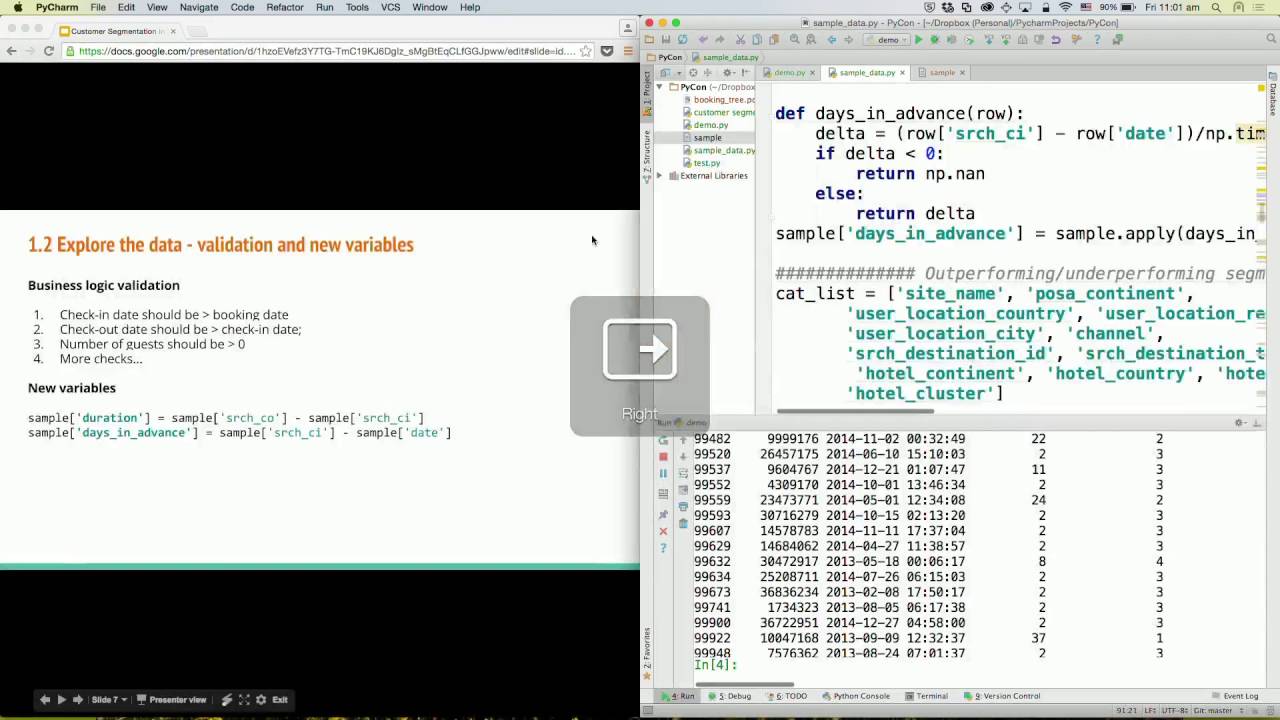
Customer Analysis in Python | A Brief Marketing Introduction
Автор: Data Ranger
Загружено: 2020-06-04
Просмотров: 4163
Описание:
Data science and Marketing are two of the key driving forces that help companies create value and stay on top in today’s fast-paced economy.
Welcome to…
Customer Analytics in Python – the place where marketing and data science meet!
This course is the best way to distinguish yourself with a very rare and extremely valuable skillset.
What will you learn in this course?
This course is packed with knowledge, covering some of the most exciting methods used by companies, all implemented in Python.
Since Customer Analytics is a broad topic, we have created 5 different parts to explore various sides of the analytical process. Each of them will have their strong sides and shortcomings. We will explore both sides of the coin for each part, while making sure to provide you with nothing but the most important and relevant information!
Here are the 5 major parts:
1. We will introduce you to the relevant theory that you need to start performing customer analytics
We have kept this part as short as possible in order to provide you with more practical experience. Nonetheless, this is the place where marketing beginners will learn about the marketing fundamentals and the reasons why we take advantage of certain models throughout the course.
2. Then we will perform cluster analysis and dimensionality reduction to help you segment your customers
Because this course is based in Python, we will be working with several popular packages - NumPy, SciPy, and scikit-learn. In terms of clustering, we will show both hierarchical and flat clustering techniques, ultimately focusing on the K-means algorithm. Along the way, we will visualize the data appropriately to build your understanding of the methods even further. When it comes to dimensionality reduction, we will employ Principal Components Analysis (PCA) once more through the scikit-learn (sklearn) package. Finally, we’ll combine the two models to reach an even better insight about our customers. And, of course, we won’t forget about model deployment which we’ll implement through the pickle package.
3. The third step consists in applying Descriptive statistics as the exploratory part of your analysis
Once segmented, customers’ behavior will require some interpretation. And there is nothing more intuitive than obtaining the descriptive statistics by brand and by segment and visualizing the findings. It is that part of the course, where you will have the ‘Aha!’ effect. Through the descriptive analysis, we will form our hypotheses about our segments, thus ultimately setting the ground for the subsequent modeling.
4. After that, we will be ready to engage with elasticity modeling for purchase probability, brand choice, and purchase quantity
In most textbooks, you will find elasticities calculated as static metrics depending on price and quantity. But the concept of elasticity is in fact much broader. We will explore it in detail by calculating purchase probability elasticity, brand choice own price elasticity, brand choice cross-price elasticity, and purchase quantity elasticity. We will employ linear regressions and logistic regressions, once again implemented through the sklearn library. We implement state-of-the-art research on the topic to make sure that you have an edge over your peers. While we focus on about 20 different models, you will have the chance to practice with more than 100 different variations of them, all providing you with additional insights!
5. Finally, we’ll leverage the power of Deep Learning to predict future behavior
Machine learning and artificial intelligence are at the forefront of the data science revolution. That’s why we could not help but include it in this course. We will take advantage of the TensorFlow 2.0 framework to create a feedforward neural network (also known as artificial neural network). This is the part where we will build a black-box model, essentially helping us reach 90%+ accuracy in our predictions about the future behavior of our customers.
Повторяем попытку...

Доступные форматы для скачивания:
Скачать видео
-
Информация по загрузке: