Hans Pfitzner: Violin Sonata in E minor, Op. 27 (1918)
Автор: Guillermo Buendía - Composer
Загружено: 2020-05-18
Просмотров: 2608
Описание:
Performers: Benjamin Schmid (violin) Claudius Tanski (piano)
00:00 I. Movement: Bewegt, mit Empfindung – Allegro espressivo
11:48 II. Movement: Sehr breit und ausdrucksvoll – Adagio, quasi fantasia
20:48 III. Movement: Äußerst schwungvoll und feurig
The most challenging factor for the violinist who ventures to play the Pfitzner Sonata is probably finding a pianist who’s crazy enough to join him – I mean just look at the nasty stuff Pfitzner writes pretty much on every page.
All jokes aside, the e minor sonata, written in 1918, is a testament to Pfitzner’s fully mature style, a true monster written by a bizarre yet fresh genius. The work is unashamedly tonal in a period that had already seen the premieres of works such as Strauss’ Elektra, Stravinsky’s Rite and Schönberg’s 5 Orchestral Pieces: the more the tendencies of music led to the dissolution of tonality, the stronger Pfitzner’s works seem to rely on it as their basis.
The opening is desperate: a crying melody on the violin, under a mesmerizing accompaniment in the piano, a very original opening indeed. Throughout the piece, the general mood seems to be that of longing, of yearning. The poignant theme turns lyrical as it is taken over by the piano, yet the toiling sextuplets keep returning, maintaining the motion. The second theme is brighter, with the sextuplets now in higher registers, and an insistent dotted rhythm. The development is broad: the themes are presented in all sorts of colors and moods. Towards the middle, the piece seems to halt, and we get a glimpse of what the second movement has in store for us. The piano and the violin, that up until this point had gone hand in hand with each other, complimenting themselves on their themes, seem now to argue over who can outshine the other. The reexposition creeps in almost unexpectedly. Pfitzner finished with an extended coda passage that includes yet another, now fully-fledged, presentation of the main theme full of pathos. The work dies off in a miserly manner.
The stage is set for the beautiful 2nd movement. There’s a broad lyrical melody on the violin, with a rather simple yet thick accompaniment of the piano. If you were expecting Brahms’ richly saturated accompaniments over a soaring melody, perhaps this opening may initially disappoint you but fear not, it gets (much) better. A new passage, more free and improvisatory starts in Ab major and both players engage in a more intimate conversation. The piano ushers in the main theme in F major over some impressively extended chords (15:40). That whole passage just sounds more like Ravel: stunning. There is a buildup of tension and it all explodes in a heart-wrenching passage. The rest of the movement feels like a great fire dying off slowly. From the ashes of the movement, high in the violin we hear a ghostly tune…
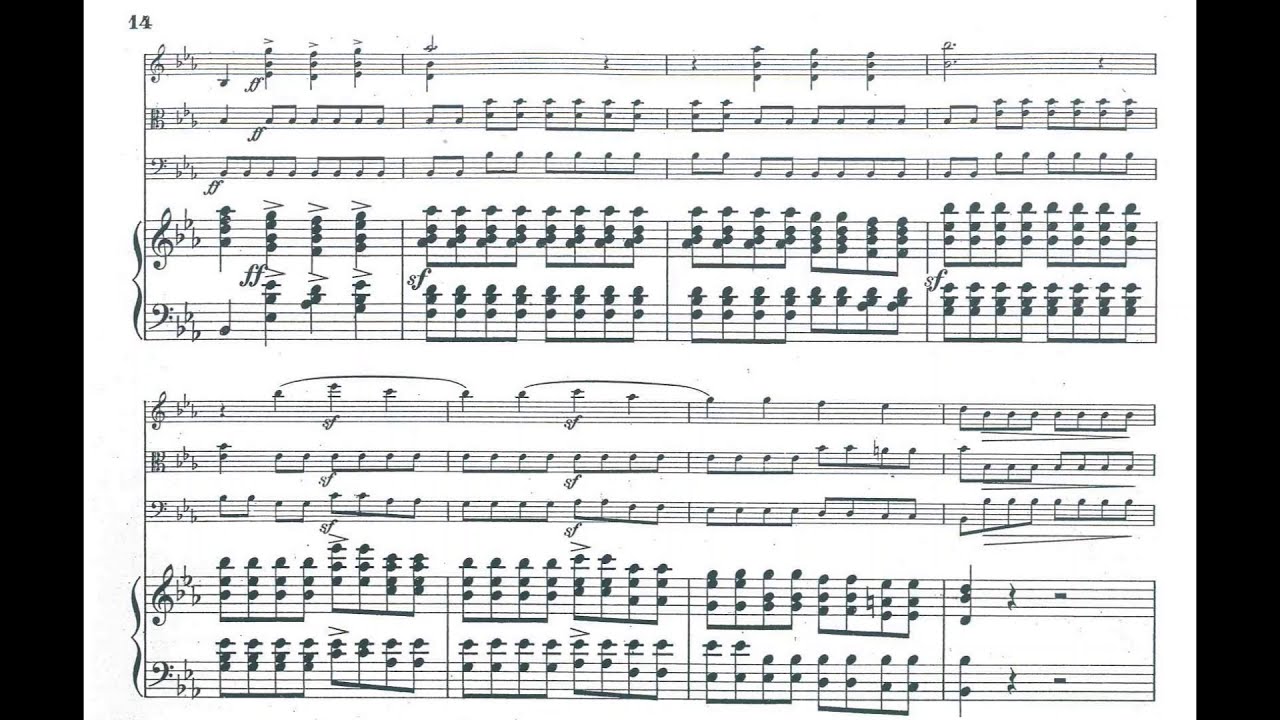
The final movement offers us a well-deserved outburst of joy and sunlight. The main theme is full of thrust: surprising to think just how original it sounds despite its most characteristic feature being a simple arpeggiated chord, which in turn allows Pfitzner to use it as the figuration of his accompaniment later on, an effect which, at least for me, is very satisfying. The lush undulating accompaniment of the main theme seems to recall the ominous one of the first movement. A second theme, with a hefty chord accompaniment and broad triplet rhythm, ushers passage of more fluid harmonies and development in C major, at least nominally: ascribing tonality is almost pointless in much of Pfitzner, but the man goes through the effort of changing the key signature so we give him at least some credit. As is characteristic with Pfitzner, the melody feels like a never-ending rhapsody of the soloist, and, with the freshness of improvisation, new motives seem to emerge from nowhere. The main theme appears again and leads to yet another development section, now in A major. This whole passage is rather lovely, very calm, and well established in the key and its relative minor. Particularly haunting is the passage around 24:03. After an extensive chromatic passage, we arrive once more to the triumphant and shiny theme in E major but, surprisingly (and charmingly), Pfitzner indicates a sub. p and places the sextuplets in the higher registers of the piano, creating a gleaming effect which is simply haunting; reminds one of certain passages of Brahms’ 1st Piano Concerto. From here onwards things get crazy: Pfitzner recycles some themes from the first section, but then just keeps on adding new material, like the unexpected and yet delightfully jovial G major theme at 26:37, which sounds like rodeo music (please take this as a compliment). We reach the big finale. Extended dominant passages, stretti, crazy runs on the piano, long notes on the violin reaching the skies. One final presentation of the theme and it all explodes.
That was one rocky trip.
No copyright infringement intended. Video made for educational purposes.
Повторяем попытку...

Доступные форматы для скачивания:
Скачать видео
-
Информация по загрузке: