Protein chromatography - an overview of affinity, ion exchange, and size exclusion chromatography
Автор: the bumbling biochemist
Загружено: 2023-01-18
Просмотров: 3836
Описание:
My main go-to protein cleaning tool is protein chromatography, a way to separate proteins based on differences in their properties by sending solutions of them traveling through columns filled with little beads (resin) and taking advantage of how different proteins interact differently with them.
blog form (also has static graphics): http://bit.ly/bbproteinchromatography
First off - something that’s always confused me - why’s it called chromatography? When I hear “chromatography” my mind jumps to “colors” - that’s what “chrom-“ means, right? And this always made sense to me because I would think back to those early paper chromatography experiments I did as a kid where you separate the different colored inks in a marker using paper chromatography. But I’m not separating proteins by their colors, so why’s it called chromatography?
The term “chromatography” did in fact come from its original uses separating colored compounds. In particular, Russian botanist Mikhail Tswett in 1903 used it to separate colored plant pigments. Etymology-wise, chromatography means “writing in color” which I think is so poetically beautiful!
But the important part - that which makes chromatography chromatography - is the separation part, not the colors part. You have 2 phases - in protein chromatography you have a solid phase which is the resin (little beads) in the column (glass or plastic cylinder) and a liquid phase which is the buffer (pH-stabilized salt water) running through. And you separate components based on which phase they’d rather hang out with.
A few common types used for proteins are affinity chromatography (AC), ion exchange chromatography (IEX) & size exclusion chromatography (SEC) and they use different resins. If the protein likes the resin (solid phase) more than it likes the liquid it came in with it’ll stick to the column. It might like the column because it’s oppositely-charged (this is the basis behind ION EXCHANGE CHROMATOGRAPHY (IEX)). The protein might also like the column more because it has some, more specific, special feature (like an engineered tag) that matches a special feature sticking off of the resin beads. This is how AFFINITY CHROMATOGRAPHY works. (note: the beads are usually porous - they have little tunnels running through them - and the affinity groups can stick out into these tunnels as well so you have more binding opportunities)
Both IEX & AC rely on the protein you want sticking to the column, while the other proteins flow through, then competing your protein off with salts and/or mimics or changing the pH to change the charge. But In SIZE EXCLUSION CHROMATOGRAPHY (SEC) you don’t want the protein to stick to the resin. Instead, you separate proteins by making smaller ones travel further because they can enter secret tunnels in the resin beads that big proteins can’t get into.
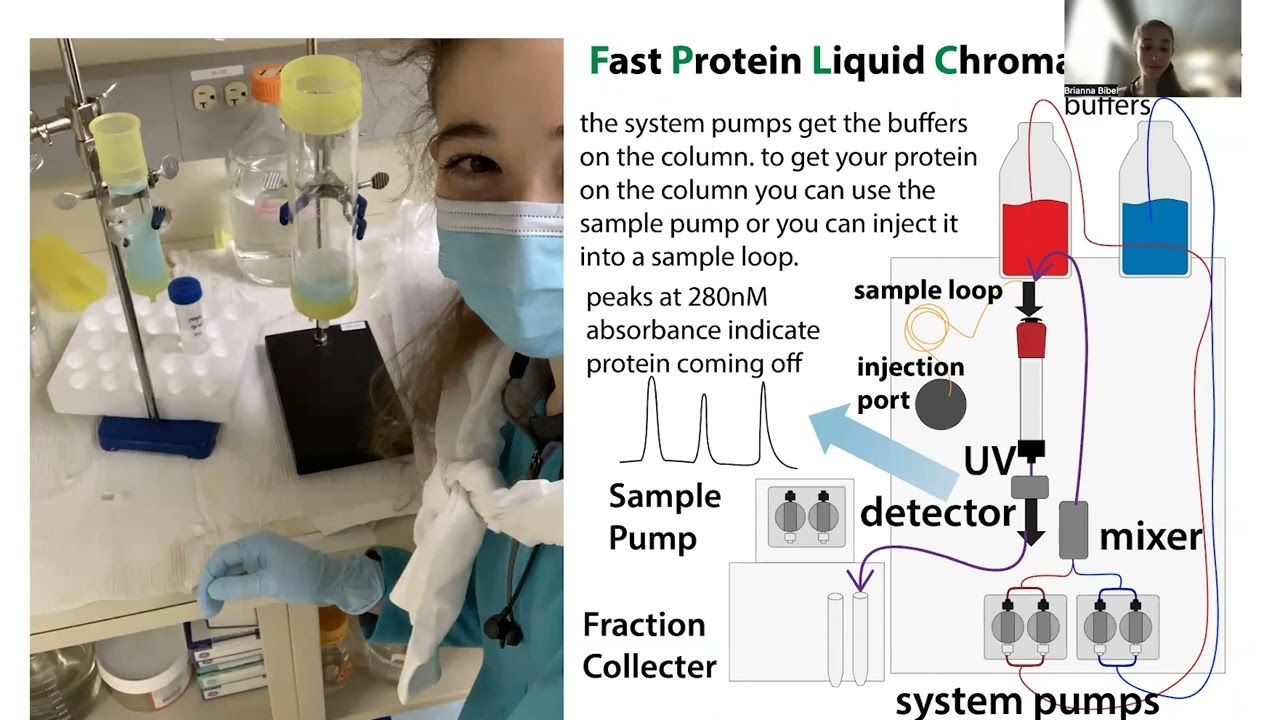
The theory behind these methods is the same whether you’re doing it with self-packed columns and gravity flow (which we still use all the time - more on this at the bottom) or the higher tech way with this fancy-dancey Fast Protein Liquid Chromatography (FPLC) machine. Ours is an AKTA, and AKTA’s kinda like the “Google” of the protein chromatography world in that it basically dominates the market and if you say AKTA other protein-purifiers know what you mean (not to make anyone feel bad if they don’t! I didn’t know until I joined the hard-core chromatography crew - and I still get confused all the time by lingo from other fields!)
The AKTA takes our protein sample and pumps it onto a column (which it’s gotten ready by flowing a bunch of buffer (pH-stable salt water) to “equilibrate” it. It then washes the column with the buffers we tell it to. We have 2 system pumps so you can use 2 different buffers that send liquid first into a mixing chamber so you can mix them if you want to make a gradient for a gradient elution to introduce the “competitor” that will push your protein off the column (e.g. have a no salt & a high salt or a no imidazole & high imidazole (for His tags) you can mix). Or you can just use 1 for an “isocratic elution” like for SEC when you don’t need to change the buffer.
The AKTA also allows us to control the flow rate (much easier than trying to twiddle with the stopcock in gravity flow). As the name implies, it can go fast, but you don’t always want it to or you’ll crush the resin in the column! Each column has different maximum flow rates. For the SEC columns I use, I typically run at ~0.7mL/min, which is actually pretty slow… And the fastest columns I run are only ~4mL/min. The times when the pumps are working their hardest is when doing pump washes. During those it’s pumping at 20mL/min, but it’s not going through any columns so you don’t have to worry about hurting them.
finished in comments
Повторяем попытку...
Доступные форматы для скачивания:
Скачать видео
-
Информация по загрузке: