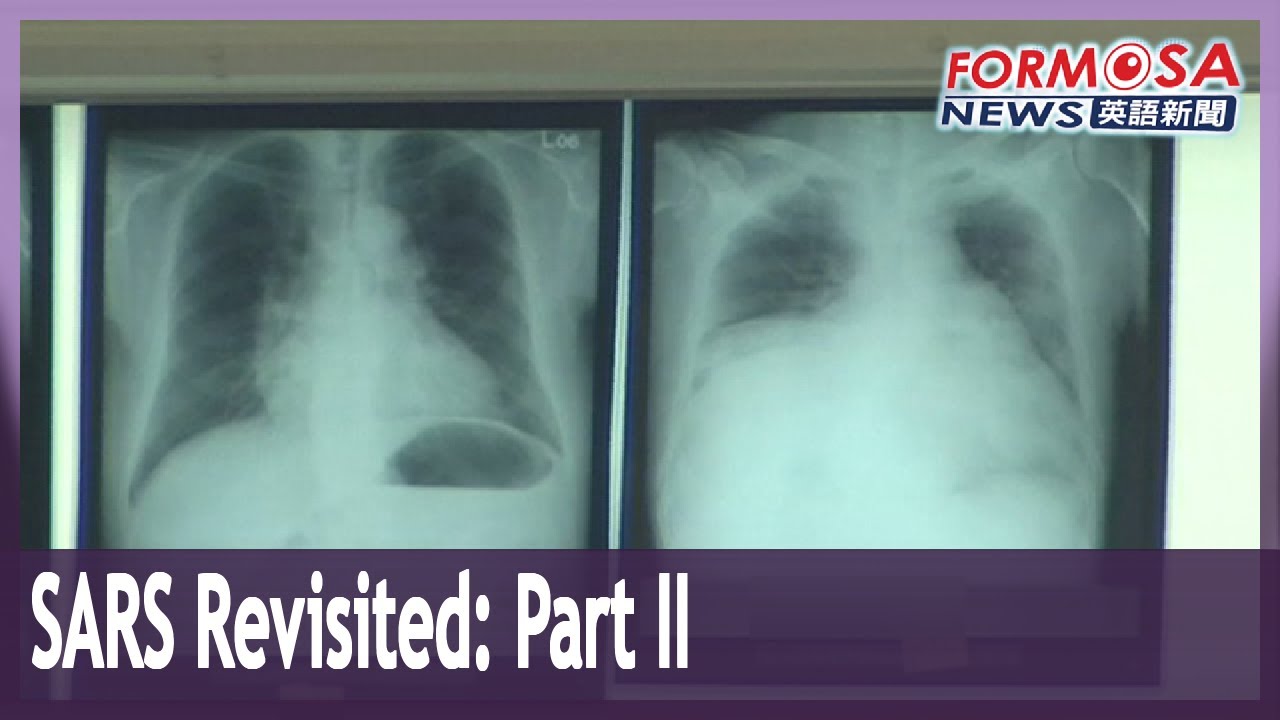
Looking back on the 2003 SARS crisis: Part 2
Автор: Formosa News (民視英語新聞)
Загружено: 2020-06-07
Просмотров: 1789
Описание:
Last Sunday we went back to 2003 and saw how a mysterious infectious disease broke out and became a full-blown crisis in Taiwan. Today, in Part 2 of our special report on SARS, we learn how experts and policymakers coped with this grave public health challenge. As SARS spread from one hospital to the next, Taiwan began testing an arsenal of strategies, such as creating an epidemic command center and a designated SARS hospital. Through trial and error, Taiwan eventually came to grips with SARS, learning policy lessons that informed its approach to the novel coronavirus 17 years later. We look back in our Sunday special report.
By the end of April 2003, Taipei’s Hoping Hospital and Jen Chi Hospital were both grappling with a SARS outbreak under lockdown. Several health care workers became infected, prompting then-Premier You Si-kun to turn to former health director and medical professional Lee Ming-liang for help. Lee was asked to take charge of a disease prevention command center that would coordinate central and local efforts.
Lee Ming-liang
Then-SARS command center chief
At the time, I had only one request for Premier You. I said, “I want there to be just one system, one person who talks, one commander.” I said, “If you want two, then get the other person to do it, I’m out.” What I meant was I wanted Taipei City to follow orders. If their policies differed from the command center’s policies, then they had to be the one to change. All decisions had to be made based on the interests of the group. And the interests of the group had to be based on the policies of the WHO.
You Si-kun
Then-premier
At the time, the central government’s health ministry and Taipei City government’s department of health were locked in major disagreements. Their communication was poor. After the return of former health chief Lee Ming-liang, that problem largely went away, particularly because of his character and prestige. For someone like him it was easier to coordinate professionals at facilities including the seven major medical centers and health and sanitation research institutions.
But immediately upon taking the post, Lee was faced with one piece of bad news after another. The WHO hit Taipei with a travel advisory. The American Institute in Taiwan announced plans to evacuate its staff.
Lee Ming-liang
Then-SARS command center chief
The U.S. sent a team to investigate our situation. The team determined that the situation was out of order, out of control. After I took the position, they reached a decision on the Taiwan situation. The following day AIT Director Douglas Paal came to see me and said the U.S. was going to withdraw from Taiwan. This bombshell hit hard. I asked him if the decision could be changed. He said the decision was made and there was nothing to be done. I said, “Do me a favor. Make it easier for us to deal with. Don’t issue an announcement. Please just leave quietly.”
Soon afterward, Lee found himself too busy to follow up on the withdrawal of the U.S. staffers. After the crisis at Hoping Hospital was brought to an end, Lee found himself dealing with new problems.
On May 10, news emerged that at the Huachang public housing complex near Hoping Hospital, three people may have been infected with SARS. One of them had died.
Fearing community spread, the government ordered that the 140 residents of the housing complex complete a two-week home quarantine. To prevent residents from leaving, military police were stationed at the complex. Lee ordered that violators be severely punished.
When it rains, it pours. The following day, an outbreak was reported at the Kaohsiung branch of Chang Gung Memorial Hospital.
The source of the outbreak was found to be an elderly woman who was previously treated at Jen Chi Hospital.
Su Ih-jen
Medical researcher
Neither Ms. Lee nor her family told the doctor that she had been transferred from Jen Chi Hospital. So basically none of the doctors took measures to protect themselves when they were intubating her or when they were performing a bronchoscopy on her. When she coughed, a huge amount of water droplets was expelled. They sprayed onto the doctor’s face, and on the face of the nurses standing next to her. All of them became infected. Roughly three or four days, later they began to experience fevers.
The SARS epidemic in Taiwan exploded, and one hospital after another fell victim. Acting preemptively, National Taiwan University Hospital announced on May 12 that it would close its emergency room for 14 days.
Lee Yuan-teh
Then-NTU Hospital director
We shut down the emergency room because several of our medical staff had fevers. Then we received a report that the emergency room door handles, the door surfaces, desks all had the virus on them. Well, I co
Повторяем попытку...
Доступные форматы для скачивания:
Скачать видео
-
Информация по загрузке: