Hydrogen bonds, glutamine, Huntington's disease, dominant vs recessive genetic diseases, etc.
Автор: the bumbling biochemist
Загружено: 2021-12-18
Просмотров: 286
Описание:
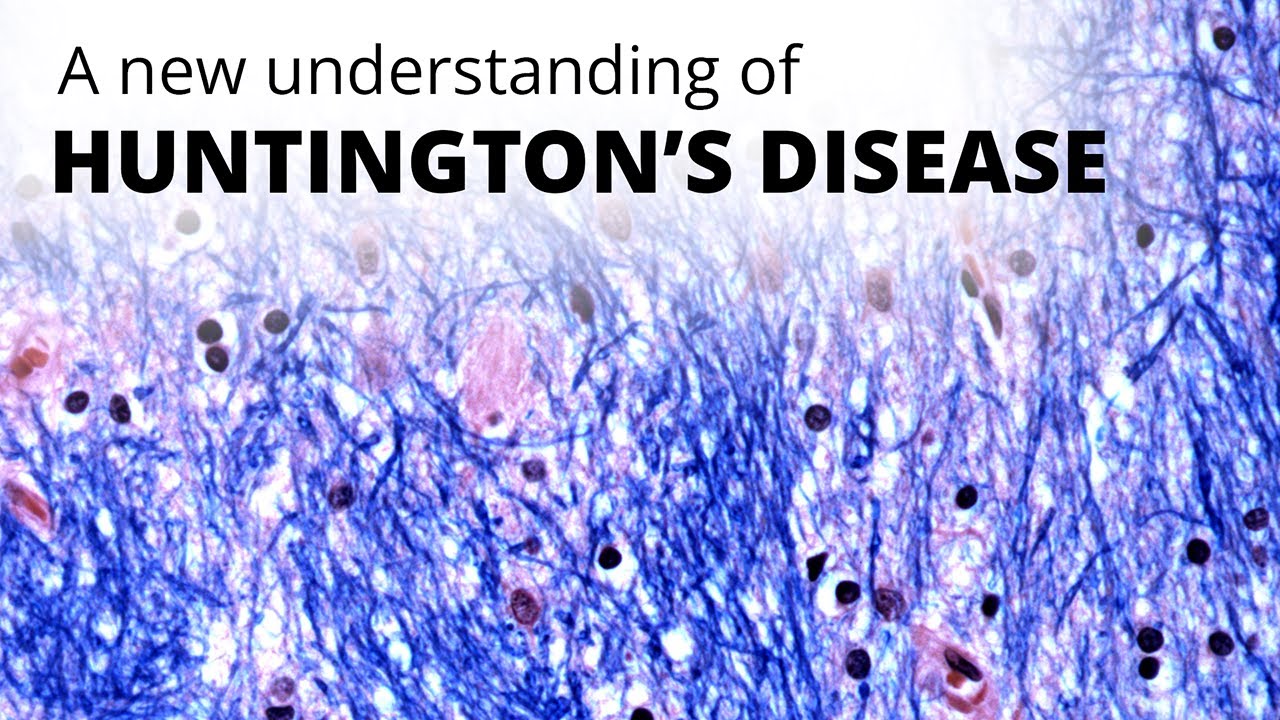
Huntington’s disease is an autosomal dominant disease. The type of mutation that causes HD is a “trinucleotide repeat expansion” - “tri” for 3, “nucleotide” for DNA/RNA letters, so this means that in these mutations, multiple copies of a 3-letter sequence get added in, so you don’t change your reading frame but, if these letters are part of a protein-coding region of a gene (a part that “spells” for amino acids as opposed to one of the regulatory regions) you’ll end up with extra protein letters. blog: http://bit.ly/glutaminehd
⠀
In HD, the affected gene is the HTT gene with the recipe for the huntingtin protein (Htt), which is a big protein with lots of functions including helping transport things within cells, regulating gene expression, etc. & the codon that gets repeated is “CAG” which spells for glutamine (Gln, Q). So you end up with a ton of Qs in a row - a so-called “expanded polyQ” tract. This type of mutation is thought to occur due to slip-ups during DNA replication and/or repair - basically, during copying, the copier slips off, then loses track of where it was because it’s surrounded by a sea of CAG on either side of it, so it adds more. Or when it goes to stitch together broken DNA in that region it ends up adding in even more. If this happens in germline cells (ones that get passed down to children) it can cause children to inherit longer expansions than their parents (this is called genetic anticipation). And if it happens in somatic (non-germline) cells, even though it can’t get passed down to future people, it can get passed down to future cells within the person’s body so it can cause the repeat to expand in certain cell lineages and potentially contribute to disease progress. note: there is still a LOT that is not known about HD and the more scientists find out, the more complex it seems to be.
⠀
Why am I focusing so much on repeat length? Having a polyQ tract isn’t “abnormal” - in fact, the normal huntingtin protein has one - as do lots of other proteins. It’s only when it gets too long that problems arise - people normally have CAG tract lengths of 6-35 repeats in their HTT gene. But above 40 repeats leads to symptom development if the patient lives long enough for symptoms to occur - the age of onset is inversely related to the repeat length.⠀
⠀
Lots of proteins - “normal ones” - have polyQ tracts. Why do proteins have them if they’re so prone to problems? When they’re a reasonable length, they can actually be really useful because of glutamine’s “stickiness” (though it’s this same stickiness that, when in excess, causes problems - you know what they say about too much of a good thing). ⠀
⠀
Glutamine & Asparagine (Asn, N) both have amide (-(C=O)-NH₂) groups capping off their side chain, but Gln has a longer linker (2 methylene (CH₂) groups versus Asn’s single one). Whereas Asn is the amide version of aspartate, Gln is the amide version of glutamate. The longer linker (compared to Asn) gives Gln more flexibility, in both the side chain & the backbone, which now has less bulkiness near it so it doesn’t have to worry as much about steric hindrance (molecules competing for space). This flexibility, combined with the amide’s properties has important consequences because it makes Gln “sticky.” ⠀
⠀
The particular amide properties in play here are the ability to form hydrogen bonds (H-bonds), which are a special type of bond between an H attached to an electronegative atom (often N or O) that acts as a DONOR & a lone pair of e⁻ on another electronegative atom (again, often N or O) which acts as an ACCEPTOR. Atoms bond through strong covalent bonds by sharing pairs of electrons and electronegative atoms hog e⁻ in the share, making them partially ➖ & the thing they’re attached to partially ➕. Opposites attract and voila you’ve got yourself an H bond. ⠀
⠀
Gln is great at forming H-bonds because it has both DONORS (amide groups’ H’s) & ACCEPTORS (carbonyl Os) in both its backbone & its side chain and can thus form sidechain-sidechain, backbone-sidechain, & backbone-backbone interactions as well as H-bonds to water & other molecules. Asn has those too, but, with its shorter linker its harder for the molecular lovers to meet up - but Gln’s flexibility helps donors & acceptors meet.⠀
⠀
Poly-Q tracts are usually flexible & don’t take a defined “shape” until they bind something else. This allows them to bind lots of different things & act as molecular “scaffolds.” So, by having a reasonable-length poly-Q tract, proteins like huntingtin are able to bring together and regulate lots of different things (and if problems arise they can thus have wide-reaching consequences). These problems can arise when the tract gets too long - instead of staying limber, the region “collapses” & sticks to itself instead of other things. And it can stick to polyQ tracts of another molecule of the protein, causing that one to “misfold” too & then another binds that one etc., leading to AGGREGATION.⠀
Повторяем попытку...

Доступные форматы для скачивания:
Скачать видео
-
Информация по загрузке: