Plyometric Exercise to Increase Service Power
Автор: Tennis Prehab Lab
Загружено: 2017-12-24
Просмотров: 301
Описание:
In an efficiently functioning kinetic chain, the legs & trunk segments are the engine for the development of force and the stable proximal base for distal mobility.1,2
This link develops greater than 50% of the kinetic energy & force delivered to the hand.2 In other words, in order for the limbs to do their specific function, the core must work properly.
Kibler et al found that the spine & pelvis help the function & transfer of energy from large to small body parts during many sport activities.3 If the core is not working properly, adjustments will be made in the UE.
An analysis of the kinetic chain revealed that a decrease of 20% at the hip/trunk requires a 34% increase in rotational velocity in the shoulder.2 Over time, excessive shoulder rotation could result in injury. Therefore, it is important to have a strong core to keep extremities working properly.
Although the shoulder plays a significant role in service velocity, the legs/core musculature play an even larger role.
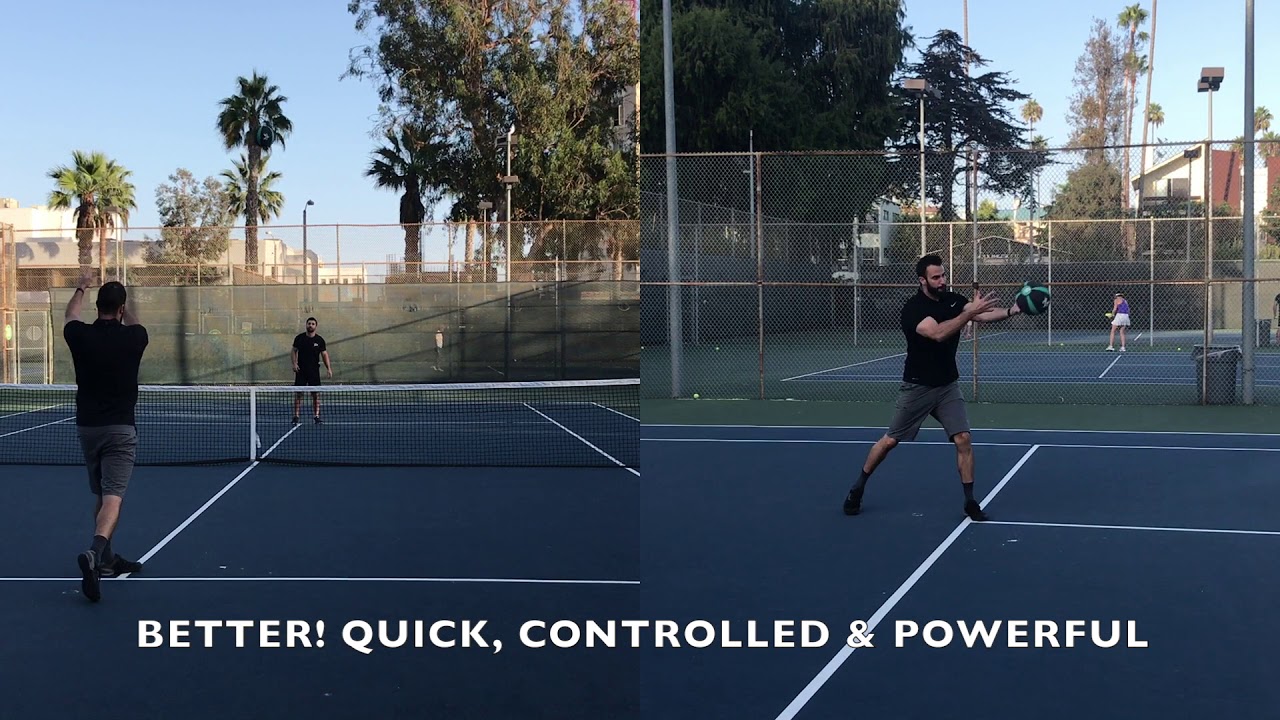
Bahamonde el al found, service velocity correlates w/ greater muscle force during the loading phase.4 The loading phase positions the body segments of the legs & torso to generate potential energy via plyometric stretch-shortening cycle. This stored energy travels up the chain and out to the ball via concentric contraction.
When comparing novice players, elite players demonstrate w/ larger abdominal cross-sectional area & increase trunk muscle activation during loading phase.5
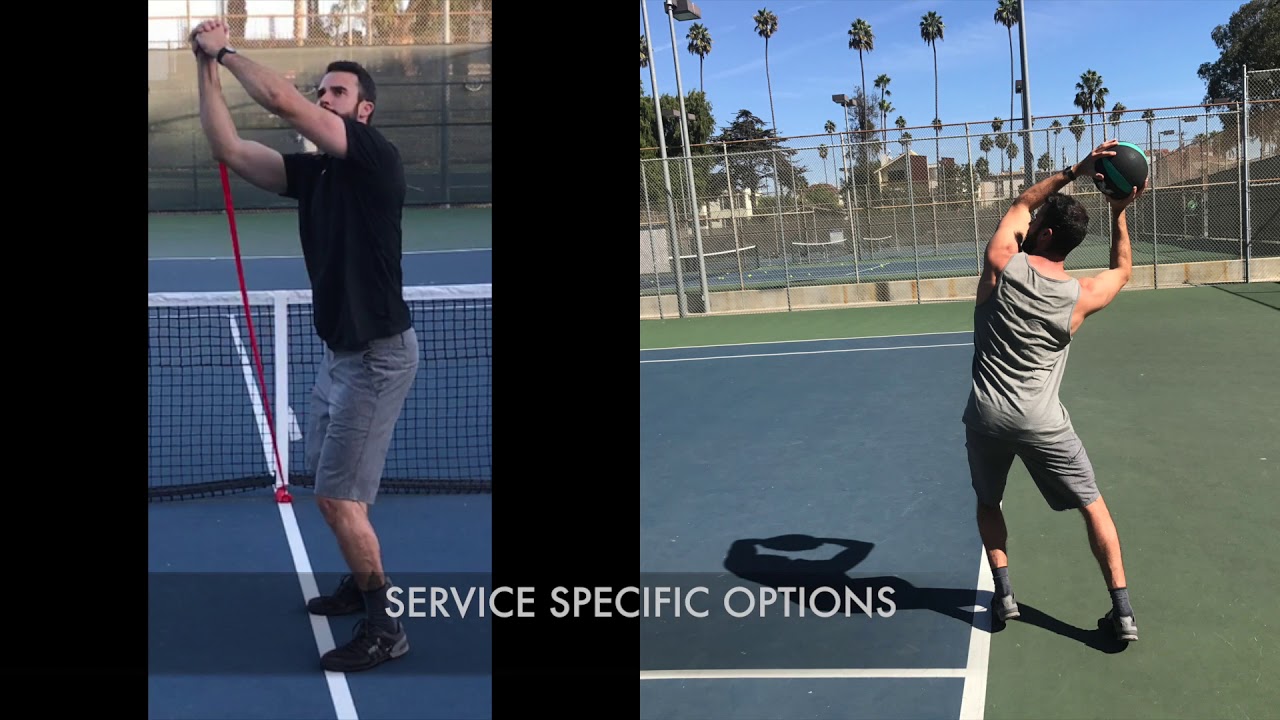
Furthermore, compared w/ beginner servers, elite servers have greater vertical and horizontal force production & earlier activation of the major lower body muscle.6 The ability to serve w/ increase velocities is largely dependent on the ability to use the plyometric stretch-shortening cycle. It has been found that greater than 75 % increase in concentric force (acceleration phase) is due to the stretch-shortening cycle thus, making plyometric training a must in the development of a safe/powerful serve.7
Gelen & Fernandez-Fernandez et al demonstrated that utilizing an UE plyometric training program service speed & velocity.8,9
Part-task the plyo movement if too difficult.
Phase Execution:
1. Eccentric pre-stretch: Fast
2. Amortization: Short Duration
3. Concentric phase: Powerful
1. Elliott, B. C., Marshall, R. N., & Noffal, G. J. 1995. Contributions of upper limb segment rotations during the power serve in tennis. Journal of Applied Biomechanics, 11 ., 433-442.
2. Kibler, W. B. 1995. Biomechanical analysis of the shoulder during tennis activities. Clinics in sports medicine, 14 1, 79-85.
3. Kibler, W. B., Press, J., & Sciascia, A. 2006. The role of core stability in athletic function. Sports medicine, 36 3, 189-198.
4. Bahamonde, R. 1997. Joint power production during flat and slice tennis serves. In ISBS-Conference Proceedings Archive Vol. 1, No. 1.
5. Chow, J. W., Park, S. A., & Tillman, M. D. 2009. Lower trunk kinematics and muscle activity during different types of tennis serves. BMC Sports Science, Medicine and Rehabilitation, 1 1, 24.
6. Girard, O., Micallef, J. P., & Millet, G. P. 2005. Lower-limb activity during the power serve in tennis: effects of performance level. Medicine & Science in Sports & Exercise, 37 6, 1021-1029.
7. Albert, M. 1995. Eccentric muscle training in sports and orthopaedics. Churchill Livingstone.
8. Gelen, E., Dede, M., Bergun Meric Bingul, C. B., & Aydin, M. 2012. Acute effects of static stretching, dynamic exercises, and high volume upper extremity plyometric activity on tennis serve performance. Journal of sports science & medicine, 11 4, 600.
9. Fernandez-Fernandez, J., & Ellenbecker, T. 2013. Effects of a 6-week junior tennis conditioning program on service velocity. Journal of sports science & medicine, 12 2, 232.
Повторяем попытку...
Доступные форматы для скачивания:
Скачать видео
-
Информация по загрузке: