I Bought an Aerospace Thermal Vacuum Chamber from a Denver Lab — Can Anyone Identify It?
Автор: Gristle King
Загружено: 2026-03-05
Просмотров: 205
Описание:
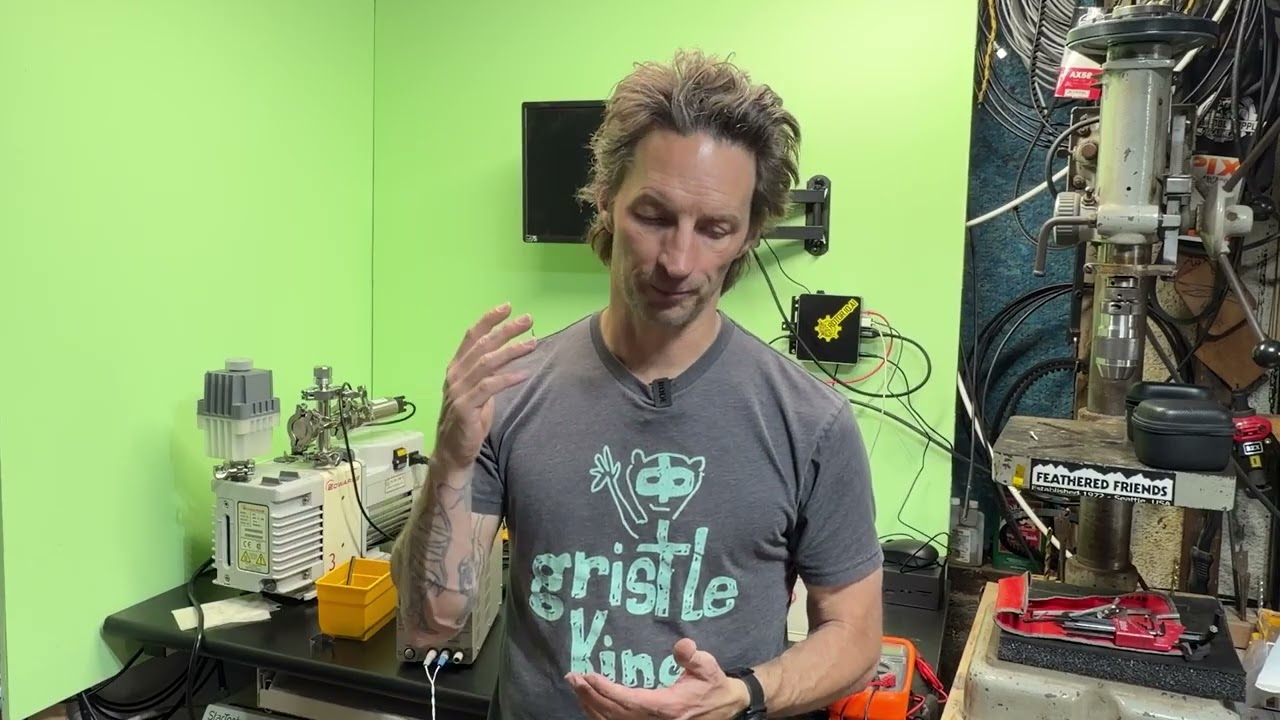
I recently acquired a thermal vacuum chamber designed for aerospace testing, and in this video I walk through the hardware and let you know what I know (and don't know) about how it works.
This chamber allows me to simulate the low pressure and extreme temperatures found in the upper troposphere and lower stratosphere, which is critical for developing electronics and sensors that need to operate reliably in these environments (12-20 km altitude). The goal is to test real flight hardware before it ever goes on a balloon.
If you’ve ever wondered:
How do you test electronics for high altitude balloons?
What does a near space vacuum chamber look like?
How do engineers simulate stratospheric pressure and temperature on the ground?
What equipment is used for vacuum chamber testing of balloon payloads?
This is the kind of system that makes that possible.
The chamber will be used for testing MeteoSonde and other ultra-light research payloads, including:
• Pico-balloon telemetry systems
• Low-temperature battery performance
• Sensor calibration in low-pressure environments
• Thermal behavior of electronics in near-space conditions (I mean, might as well go higher and colder, right?)
The system already pulls down to 8 Torr using an Edwards RV3 vacuum pump, which is well within the pressure range needed to simulate conditions at my altitudes of interest. The next challenge is adding liquid nitrogen cooling so the chamber can reproduce the −60 °C to −70 °C temperatures typical of upper tropo/lower strat.
The chamber itself has a large number of feedthroughs and ports that make it ideal for instrumentation work, including multiple KF-25 vacuum ports and six 61-pin aerospace connectors, allowing a large number of sensors to be monitored during experiments.
GK-TVAC-specs
Lid: 1" thick AL
Lid Ports
7 x KF25
6 capped off
one has a 4 way tee
in lid
capped
Wallace & Tiernan Absolute Pressure gauge reading mm mercury from 1-100, with a "not calibrated" sticker on it
yellow knob with a 4 pin connector, labeled Varian ConvecTorr vacuum gauge, call 1-800-8-VARIAN"
1 x KF40
6 x 61 pin bayonet SEALTRON M83723/81H2461N 9623
unknown pipe tapped in. Has a valve on it: Robbins Aviation Inc. INSG103-2P. VAC 3500 PSI. PAT 2994344. CAN 634960z. Looks like 1/2" NPT fittings.
Monitoring
see 4-way tee above for absolute pressure gauge and convectron gauge
1 thermocouple taped on with metallic tape
Chamber: 20.75" ID, ~15.5" high
⅛” thick aluminum
Circular chamber with 12 securing bolts that screw in through the lid.
Chamber Ports
Port 1
8 1/16" OD port cover
8 bolt, ~29 cm CTC
6 ⅛” ID port
O-ring, black, and 3.1mm thick
O-ring groove ID 6 5/16”
O-ring groove radial width: 4.5mm
Port 2
#### 4.5" / 115mm OD port cover,
102 mm CTC bolt pattern. 6 bolts.
Outer flange diameter: 114.41mm
62 mm ID port
brown o-ring 3.5 mm thick
O-ring ID ~ 2 ⅝”
O ring groove radial width: 4mm
Port 3
#### 4” OD 2 piece plate
9.78mm thick, inner circle is 3” plate 6.41mm thick. Held in by flange 59.64mm wide
5/32” Allen key bolts
6 bolt pattern
~88 mm CTC bolt pattern
threaded port, ~50.29mm ID, 37mm deep
Bronze/brown o-ring, ~2.44 mm thick
O-ring ID: 2.5”
O-ring groove radial width: 3mm
Port 4
#### 2.25” diameter plate
threaded for 4 bolts, 48 mm CTC, 9/16 Allen key heads
2 piece port. Outer ring is 2.25”, inner port is 1” diameter. Inner/insert plate is 1.5” diameter and ¼” thick
O ring, 1.62 mm thick
O-ring ID ~28.78
O-ring groove radial width: 2.13mm
ID: ~25.26 mm
Heating
4 copper colored pads, ea 12" x 5", labeled "MINCO 0103 HK5516R20.4L12E", wired in parallel. 20.4 Ω per pad, and 20.4/4 ≈ 5.1 Ω total.
This type of thermal vacuum testing is commonly used in aerospace engineering and satellite development, but it’s also extremely useful for high-altitude balloon research and near-space experiments, where the combination of low pressure, intense solar radiation, and extreme cold can break hardware that works perfectly at ground level.
If you work on weather balloons, pico balloons, or near-space payloads, I’d love to hear how you approach testing.
And if this chamber looks familiar — apparently it came from an aerospace company in Denver — definitely reach out. I’d love to learn more about its original use.
Chapters
00:00 Introduction to the thermal vacuum chamber
00:40 Chamber overview and ports
01:20 Sensors and vacuum gauges
01:55 Testing electronics for high altitude balloons
02:20 Liquid nitrogen cooling plan
02:50 Why vacuum testing matters for high altitude hardware
Повторяем попытку...

Доступные форматы для скачивания:
Скачать видео
-
Информация по загрузке: