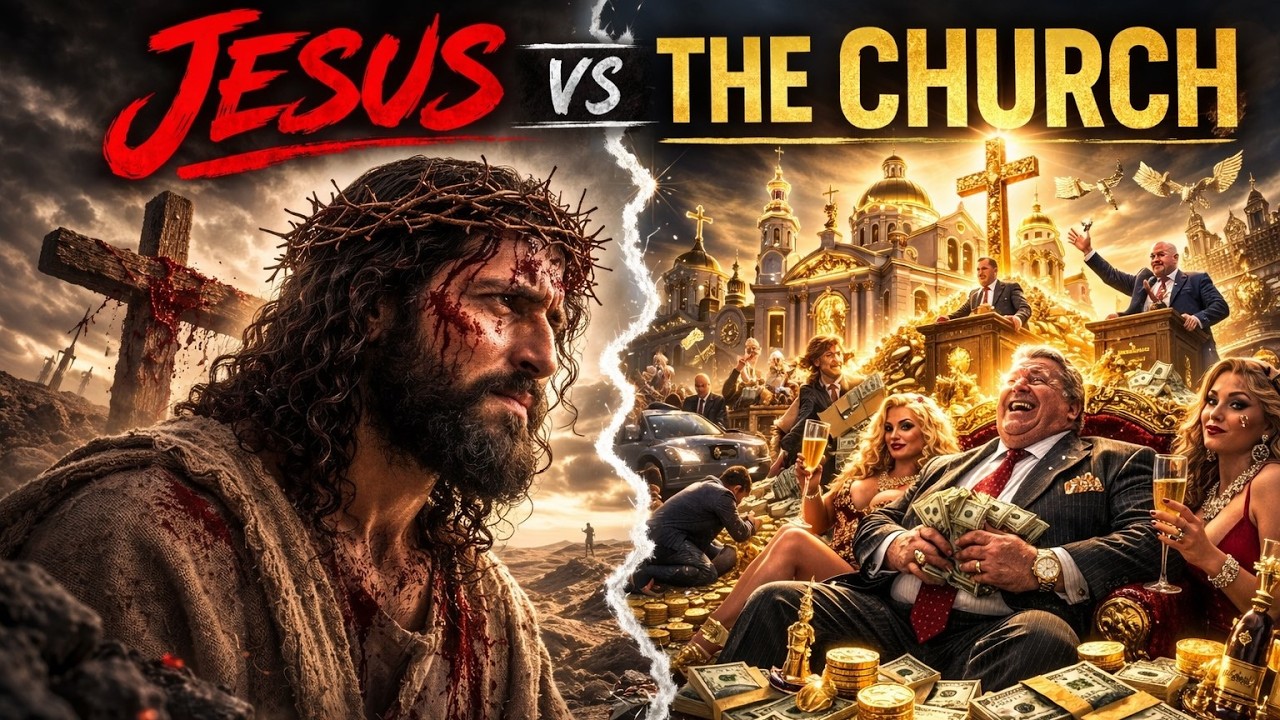
Jesus vs Christians | The Church Abandoned the Original Christ
Автор: Wrestling with God
Загружено: 2026-02-20
Просмотров: 74
Описание:
Jesus, Judaism, and the Politics of Theology - The American Jesus vs The Historical Jesus
Jesus was not a Catholic. He was not a Protestant. He was a devout Jew living in first-century Roman-occupied Judea. That historical fact is simple, yet it carries implications that continue to unsettle Christian theology.
Christianity has long wrestled with anxiety over its Jewish roots. From its earliest centuries, the movement that began within Judaism gradually distanced itself from the people and context that gave it birth. This tension has only intensified in the modern era, particularly since the establishment of the State of Israel in 1948, which re-centered Jewish identity in global politics and theology.
War, Empire, and Theological Development
Theology is not formed in a vacuum. It is shaped by history—by wars, politics, power struggles, and cultural shifts. In particular, the Jewish–Roman wars of the first and second centuries were pivotal in shaping early Christian theology.
After Rome crushed Jewish revolts and destroyed Jerusalem in 70 CE, the political and religious landscape changed dramatically. The original Jesus movement, which began as a Jewish messianic movement within Judaism, found itself navigating a new imperial reality. As the Roman Empire emerged victorious and Christianity gradually expanded among Gentiles, the incentive to distance the movement from rebellious Judaism grew stronger.
This process contributed to what can be described as a “Judeophobia Christianity”—a theological trajectory that minimized or rejected Jesus’s Jewish identity in order to survive and flourish within a Roman world.
The Separation of Jesus from His Context
Certain strands of Christianity separate Jesus from “his people, his place, his time, and his politics.” In doing so, Jesus becomes increasingly mystical, abstract, and detached from history.
This separation functions as a form of theological self-preservation. If Jesus remains firmly rooted in first-century Judaism—if he is understood as a Jewish teacher operating within Jewish debates about Torah, Temple, and empire—then Christianity must confront its dependence on and indebtedness to Judaism. For some, that dependence creates discomfort or insecurity.
The result is a version of Jesus reshaped for theological centrality and exaltation—one that downplays his Jewish identity and the political realities of Roman occupation. The historical Jesus, who was executed by Rome, becomes spiritualized in ways that make him less threatening and more universally palatable.
For anti-Semitic forms of Christianity to grow, the Jewish roots of the faith must shrink. This requires denying or minimizing obvious historical realities of the first century. In this view, popular theology often prioritizes existential comfort over historical truth.
The Roman crucifixion itself identifies Jesus as a Jewish martyr and, in some sense, an insurrectionist against Roman rule. Crucifixion was a Roman punishment for political rebellion. To detach Jesus’s death from its political and Jewish context is to obscure the reasons Rome found him dangerous.
The true betrayal of Jesus is not simply moral failure among Christians but theological insecurity that distorts his historical identity and passion. When Christians proclaim the copyright of Jesus they may be proclaiming a version of Jesus constructed in their own image—one shaped more by cultural taste and political preference than by historical reality.
Truth, Popularity, and Responsibility
Popular theology is often dictated by taste, not truth. Narratives that provide comfort, clarity, or cultural dominance spread more easily than those that demand complexity and humility. Yet historical honesty requires acknowledging that Jesus was inseparable from his Jewish identity and first-century context.
The broader claim is not merely historical but ethical. Ignorance, distortion, and obfuscation are enemies of authentic faith. If theology is shaped by wars and politics, then believers bear responsibility for examining how contemporary fears and insecurities may still be reshaping Jesus in their own image.
The central challenge remains: any serious engagement with Jesus must grapple with his Jewish identity, his historical setting under Roman rule, and the complex ways power and politics have shaped Christian theology from the beginning.
Повторяем попытку...
Доступные форматы для скачивания:
Скачать видео
-
Информация по загрузке: