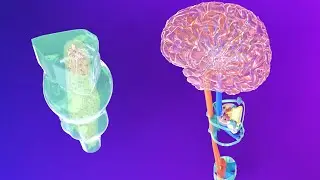
3D Rhombencephalon Embryology Part 1: (Basic Concepts) - Tela Choroidea - Neuroembryology Part 4
Автор: MedicoVisual - Visual Medical Lectures
Загружено: 2024-07-28
Просмотров: 7967
Описание:
In this visual medical lecture, Dr. Aizaz from MedicoVisual talks about Rhombencephalon's Basic concepts.
Nerve Fibers Classification Part 1: GVA, GSA, GVE, GSE, SVA, SSA, SVE, SSE: • Nerve Fibers Classification Part 1: GVA, G...
The rhombencephalon, or hindbrain, is a crucial developmental region that gives rise to the pons, medulla oblongata, and cerebellum. Its development begins with the neural tube, which undergoes regionalization into three primary vesicles: the prosencephalon (forebrain), mesencephalon (midbrain), and rhombencephalon. The rhombencephalon further differentiates into the metencephalon (cranial to pontine flexure) and myelencephalon (caudal to pontine flexure).
A key event in rhombencephalon development is the formation of the pontine flexure. This bend in the neural tube leads to the widening of the roof plate, creating a diamond-shaped cavity known as the fourth ventricle. This widening contrasts with the narrow central canal in the spinal cord and the central aqueduct in the mesencephalon.
As the roof plate expands, the alar and basal plates, responsible for sensory and motor functions respectively, undergo spatial rearrangement. The basal plates remain centrally organized, while the alar plates shift laterally. The sulcus limitans, a groove demarcating the boundary between alar and basal plates, persists in the rhombencephalon.
The metencephalon gives rise to the pons, while the myelencephalon develops into the medulla oblongata. The alar plate in the metencephalon region thickens to form the rhombic lip, which plays a crucial role in cerebellum formation.
To understand the neuronal composition of the pons and medulla, it's helpful to first review the neuronal types present in the spinal cord. The spinal cord contains four basic neuronal types: General Somatic Efferent (GSE), General Somatic Afferent (GSA), General Visceral Efferent (GVE), and General Visceral Afferent (GVA).
As the rhombencephalon develops, these neuronal groups are reorganized and further differentiated. The roof plate's widening leads to a shift in their location, with efferent neurons positioned medially and afferent neurons laterally.
In addition to the four basic neuronal types, the brainstem also contains specialized neuronal groups: Special Visceral Efferent (SVE), Special Visceral Afferent (SVA), and Special Somatic Afferent (SSA). These neurons control specific functions like muscle movement derived from pharyngeal arches, taste sensation, and sensory information from the ear.
In the brainstem, the neuronal columns are further subdivided into smaller aggregates of neuronal cell bodies called nuclei. These nuclei retain a columnar organization, reflecting their developmental origin and functional relationships.
In conclusion, the rhombencephalon's embryological development is a complex process involving intricate transformations. Understanding these processes is crucial for appreciating the structure and function of the pons, medulla oblongata, and cerebellum, structures essential for motor control, sensory processing, and overall brain function.
Повторяем попытку...

Доступные форматы для скачивания:
Скачать видео
-
Информация по загрузке: