Stimming, fidgeting, tics, psychomotor agitation
Автор: Bipolar Courage
Загружено: 2019-09-19
Просмотров: 5867
Описание:
2022 update: psychiatrist did an assessment and confirmed I meet criteria for bipolar 1 disorder, PTSD and also said I have clinically significant autism spectrum features, below threshold for Autism Spectrum Disorder (ASD) under DSM-V but fit PDD-NOS under DSM-IV. New Zealand uses both DSM-IV and DSM-V to diagnose.
Video has edited captions in English. Speaking fast (pressure of speech with bipolar hypomania). Say 'um' a lot, when I start to dissociate. Movement helps ground me to keep me present to keep talking.
My name is Xanthe Wyse. I have been diagnosed with bipolar 1 disorder, social anxiety and PTSD. A lot of viewers assume I am autistic. I do not meet criteria for diagnosis in New Zealand for Autism Spectrum Disorder (ASD). I have subclinical traits only for ASD and ADHD, not requiring a diagnosis.
In this video, I talk about some of the movements that I do subconsciously, which some people call 'stimming.' Everybody stims if you take a broader interpretation. In most cases not to a degree where it is clinically significant. In online communities, people often say that stimming means autism, which is not true.
I fidget a lot, especially when my mood is elevated and/or when I feel anxious. Such as jiggling my leg. Clinicians call fidgeting and pacing 'psychomotor agitation' and say it serves no purpose. Clinicians call particular repetitive movements such as rocking 'stereotypies'. I think there is overlap.
Repetitive movements, sounds, sensory-motor activities can also be called 'stimming' (for self-stimulatory behaviour).
For me, it serves many purposes. It helps me to focus to speak or listen, helps discharge excess energy, helps discharge anxious & manic & hyperarousal energy, can help me relax & express myself (eg if I redirect it into some form of creative expression such as humming a tune or dance-walking or visual art). It can also help me process trauma and to express emotion that has been shut-down. Humming long extended notes can help calm and ground me when in a panic attack.
Everybody stims at least sometimes in some way (eg some people smoke, tap their fingers, chew gum, chew their fingernails).
Some people just stim a lot more and in a variety of ways eg people on the autistic spectrum, people with bipolar disorder, people with ADHD.
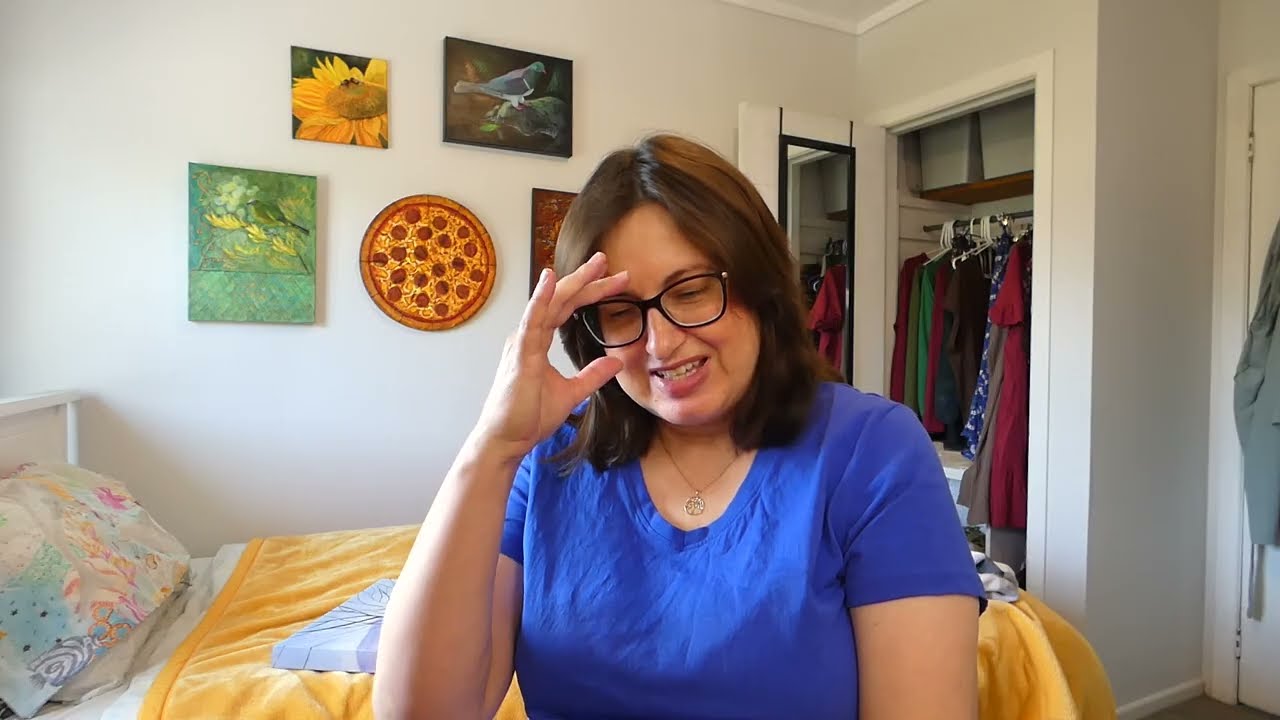
In this video, I discuss some of the ways I stim and tic. For me, tics are more involuntary - I can't control them. Whereas I can become aware of a stim (if someone has pointed it out to me or if I have watched myself back on video for example and being more observant or things that I do without thinking about them). I can redirect a stim to something else but when I have a lot of energy, it is hard for me to be still.
I don't do some stereotypical stimming associated with Autism Spectrum Disorder (ASD) such as hand flapping.
Stimming can give me a break from anxiety. It can be soothing and even feel euphoric at times. When I express myself in a creative way (by doing an improvised dance or dance-walk or humming/singing or abstract painting), it gives me an expression to emotions that get 'stuck' for me.
When my mood is elevated with bipolar disorder, I tend to be more sensory seeking. This can include sniffing perfumes and essential oils when I usually avoid them because of my sensitivity to smell. Most of the time, I find fragrances to be overwhelming and annoying.
I record videos when my mood is somewhat elevated, which helps over-ride some of my social anxiety. I tic and stim when I am talking. Some of it I may hide from the camera (eg moving my foot). Moving in some way helps keep me more present when my mind is partially dissociating while I am trying to speak (which is why I keep saying 'um'). I don't choose the movements but I can become aware of them and can usually redirect them to something else. I can do it more discreetly for short periods of time but I need to release the energy otherwise it builds up and becomes distressing. I have had the energy (combination of bipolar mania, PTSD hyperarousal and anxiety) build up so extremely that I have had seizures.
Stimming doesn't need to be controlled unless it's causing a problem. Some stims may involve self-harm and/or may annoy others.
Повторяем попытку...

Доступные форматы для скачивания:
Скачать видео
-
Информация по загрузке: