Lupus Nephritis Clinical Trials, Lupus Nephritis: Diagnosis and Management, Glomerulonephritis: Caus
Автор: EndlessMedical.Academy
Загружено: 2026-02-05
Просмотров: 3
Описание:
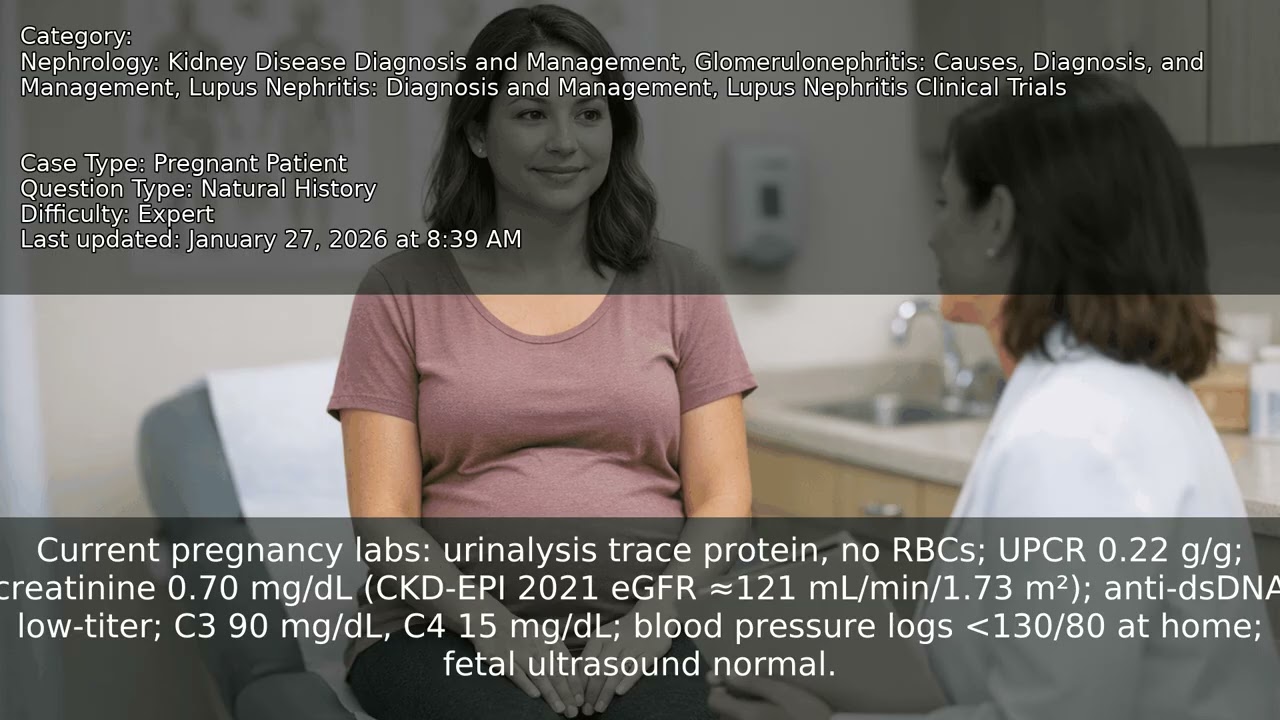
A 28-year-old pregnant woman with a history of lupus nephritis, previously in remission but now experiencing morning nausea, increased urinary frequency, mild proteinuria, and stable vital signs at 14 weeks gestation, presents for evaluation. How should her clinical features, past disease activity, and current laboratory findings inform your management approach during pregnancy and postpartum? What considerations are key in distinguishing physiologic gestational changes from lupus flare in this scenario?
VIDEO INFO
Category: Lupus Nephritis Clinical Trials, Lupus Nephritis: Diagnosis and Management, Glomerulonephritis: Causes, Diagnosis, and Management, Nephrology: Kidney Disease Diagnosis and Management
Difficulty: Expert - Expert level - For those seeking deep understanding
Question Type: Natural History
Case Type: Pregnant Patient
Explore more ways to learn on this and other topics by going to https://endlessmedical.academy/auth?h...
QUESTION
A 28-year-old pregnant woman at 14 weeks gestation (G1P0) with SLE and prior class IV-S LN achieved complete renal response 18 months ago on mycophenolate mofetil 1 g twice daily and hydroxychloroquine 200 mg twice daily. Planning conception, she switched 3 months prior to azathioprine 2 mg/kg/day and continued hydroxychloroquine; ACE inhibitor was stopped. She now reports morning nausea, stable weight, and increased urinary frequency without dysuria....
OPTIONS
A. Continue hydroxychloroquine and switch mycophenolate to azathioprine preconception or early in pregnancy; avoid initiating belimumab or voclosporin; monitor UPCR and eGFR each trimester and postpartum, with flare risk highest in the first 3-6 months after delivery.
B. Start belimumab IV 10 mg/kg in the second trimester for steroid-sparing control and resume mycophenolate 1 g twice daily in the third trimester to reduce proteinuria prior to delivery; discontinue hydroxychloroquine and ACE inhibitors to avoid fetal complications. Immediately.
C. Add voclosporin 23.7 mg twice daily in the first trimester for rapid proteinuria reduction, targeting UPCR =0.5 g/g by week 24, and continue ACE inhibitor therapy at a reduced dose to preserve eGFR during gestation.
D. Stop all immunosuppression at confirmation of pregnancy to minimize fetal exposure, manage with sodium restriction alone, and plan to reintroduce therapy only after delivery if proteinuria exceeds 3.5 g/day or complements fall.
CORRECT ANSWER
A. Continue hydroxychloroquine and switch mycophenolate to azathioprine preconception or early in pregnancy; avoid initiating belimumab or voclosporin; monitor UPCR and eGFR each trimester and postpartum, with flare risk highest in the first 3-6 months after delivery.
EXPLANATION
This pregnant patient with prior class IV-S LN is in remission on azathioprine and hydroxychloroquine with UPCR 0.22 g/g and eGFR 121 mL/min/1.73 m2, consistent with gestational hyperfiltration. KDIGO 2024 and ACR 2024 recommend continuing hydroxychloroquine and using azathioprine rather than mycophenolate during pregnancy, with trimester and postpartum monitoring. Initiating belimumab or voclosporin in pregnancy lacks robust randomized safety data for LN; ACE inhibitors/ARBs remain contraindicated.
Incorrect choices either start teratogenic/insufficiently studied agents or withdraw essential therapy. Starting belimumab and resuming mycophenolate in late pregnancy is inappropriate and discontinuing hydroxychloroquine increases flare risk; ACE inhibitors are contraindicated....
Further reading:
Links to sources are provided for optional further reading only. The questions and explanations are independently authored and do not reproduce or adapt any specific third-party text or content.
---------------------------------------------------
Our cases and questions come from the https://EndlessMedical.Academy quiz engine - multi-model platform. Each question and explanation is forged by consensus between multiple top AI models (i.e. Open AI GPT, Claude, Grok, etc.), with automated web searches for the latest research and verified references. Calculations (e.g. eGFR, dosages) are checked via code execution to eliminate errors, and all references are reviewed by several AIs to minimize hallucinations.
Important note: This material is entirely AI-generated and has not been verified by human experts; despite stringent consensus checks, perfect accuracy cannot be guaranteed. Exercise caution - always corroborate the content with trusted references or qualified professionals, and never apply information from this content to patient care or clinical decisions without independent verification.
Clinicians already rely on AI and online tools - myself included - so treat this content as an additional focused aid, not a replacement for proper medical education. Visit https://endlessmedical.academy for more AI-supported resources and cases.
This material can not be treated as medical advice. May contain errors.
------------
Повторяем попытку...
Доступные форматы для скачивания:
Скачать видео
-
Информация по загрузке: