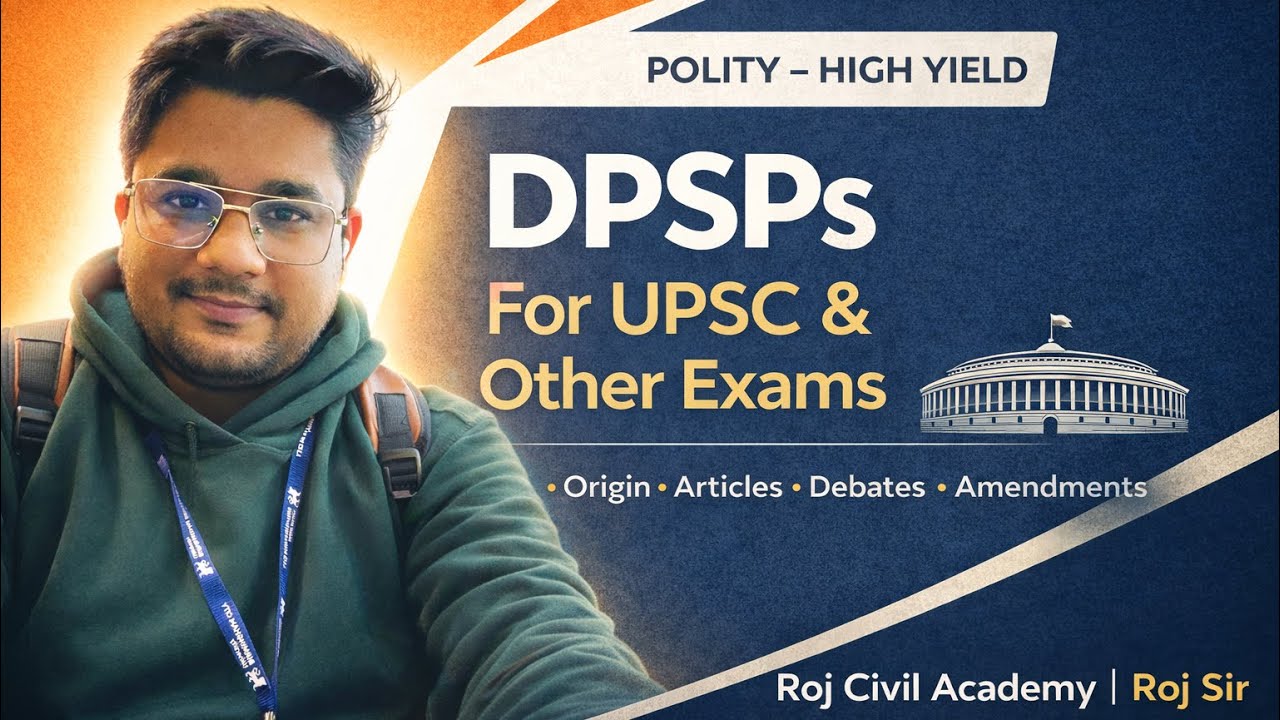
DPSPs for UPSC CSE 2026 | Directive Principles of State Policy | Articles 36–51 Explained | Roj Sir
Автор: Roj Civil Academy
Загружено: 2026-02-08
Просмотров: 61
Описание:
DPSPs #IndianPolity #UPSCCSE
DPSPs Complete Masterclass for UPSC CSE 2026 & State PCS – learn Directive Principles of State Policy (Part IV, Articles 36–51) in one detailed Indian Polity lecture. In this 52‑minute session, Roj Sir explains the origin, history, articles, debates, case laws and amendments related to DPSPs in a clear, exam‑oriented way.
Perfect for UPSC beginners and serious aspirants who want conceptual clarity + Mains answer‑writing depth on Directive Principles of State Policy.
This is a complete masterclass on Directive Principles of State Policy (DPSPs) for UPSC CSE, State PCS, Judiciary and other competitive exams.
In this Indian Polity lecture, Roj Civil Academy covers Part IV of the Constitution of India (Articles 36–51) in a structured way that helps you in both Prelims and Mains.
✅ What we cover in this video:
1. Basic concepts of DPSPs
• Meaning of Directive Principles of State Policy
• Location in Constitution: Part IV, Articles 36–51
• Article 36 (definition of State)
• Article 37 (non‑justiciable but fundamental in governance; duty of the State)
2. Historical background & need for DPSPs
• Socio‑economic conditions in colonial India
• Demand for social and economic justice in the freedom struggle
• Nehru Report (1928) and Karachi Resolution (1931)
• Labour and peasant movements and their impact on the Constitution
3. Constituent Assembly committees & debates
• Advisory Committee on Fundamental Rights (Sardar Patel)
• Sub‑Committee on Fundamental Rights (J.B. Kripalani)
• Drafting Committee (B.R. Ambedkar)
• Why DPSPs were kept non‑justiciable
• Balance between Gandhian and socialist ideas
• Ambedkar’s defence of DPSPs as “instruments of instruction”
4. Sources & comparative perspective
• Inspiration from the Irish Constitution (Directive Principles of Social Policy)
• Indian innovation: Gandhian, socialist and liberal‑intellectual mix
• Basic comparison with the UK, USA, South Africa and other transformative constitutions
5. Article‑wise conceptual overview of DPSPs
• Socialist principles: Articles 38, 39, 39A, 41, 42, 43, 43A, 47
• Gandhian principles: Articles 40, 43, 46, 47, 48
• Liberal–intellectual principles: Articles 44, 45, 48, 49, 50, 51
• Focus on the welfare state, social justice, labour rights, health, education, UCC, Panchayati Raj, and international peace
6. DPSPs vs Fundamental Rights (FR–DPSP relationship)
• Fundamental Rights: justiciable, negative obligations
• Directive Principles: non‑justiciable, positive obligations
• Champakam Dorairajan (1951) – FRs vs DPSPs
• Later harmony and basic structure (brief introduction to Kesavananda Bharati and Minerva Mills)
7. Scholars’ views, amendments and debates
• DPSPs as “conscience of the Constitution” and “instrument of social revolution”
• Major constitutional amendments affecting DPSPs:
• 1st, 42nd, 44th, 86th Amendments
• Debated areas: Uniform Civil Code, prohibition, cow protection, socialism vs market reforms
8. UPSC Mains & Prelims perspective
• How to use DPSPs in GS‑II answers
• Linkages with GS‑I (Society), GS‑III (Economy), GS‑IV (Ethics)
• Key phrases and frameworks to write high‑quality answers
🎯 Who should watch this video?
• UPSC CSE aspirants (Prelims + Mains)
• State PCS / State Civil Services aspirants
• Judiciary, Law entrance, Defence exams aspirants
• Any student of Indian Polity / Constitution of India
📌 How to use this lecture:
• Keep your Laxmikanth / D.D. Basu / M.P. Jain / Subhash Kashyap book with you and mark important points.
• Pause and make short notes from each section (definition, history, articles, case laws, amendments).
• Revise quickly before attempting PYQs and MCQs on DPSPs.
📚 Related topics to watch next (playlist idea):
• Fundamental Rights (Part III) – complete lecture
• DPSPs classification with schemes and case laws (Part 2)
• Fundamental Duties & Basic Structure Doctrine
• Indian Polity full course for UPSC CSE / State PCS
👨🏫 About Roj Civil Academy Roj Civil Academy is dedicated to UPSC CSE, State PCS and other competitive exams preparation with high‑quality, concept‑oriented lectures. The focus is on clear explanations, constitutional depth and exam relevance.
Subscribe for more lectures on Indian Polity, History, Economy, Geography, Current Affairs and integrated GS preparation.
👍 If this lecture helps you, please LIKE, SHARE with your UPSC / PCS friends, and SUBSCRIBE to the channel.
✍️ Comment below: “DPSPs Mastered” if you watched till the end!
`#DPSPs` `#DirectivePrinciplesOfStatePolicy` `#IndianPolity` `#UPSC` `#UPSCCSE` `#UPSC2025` `#UPSC2026` `#UPSCPreparation` `#StatePCS` `#JudiciaryExam` `#IndianConstitution` `#GS2` `#WelfareState` `#PolityLecture` `#RojCivilAcademy` `#RojSir
Повторяем попытку...
Доступные форматы для скачивания:
Скачать видео
-
Информация по загрузке: