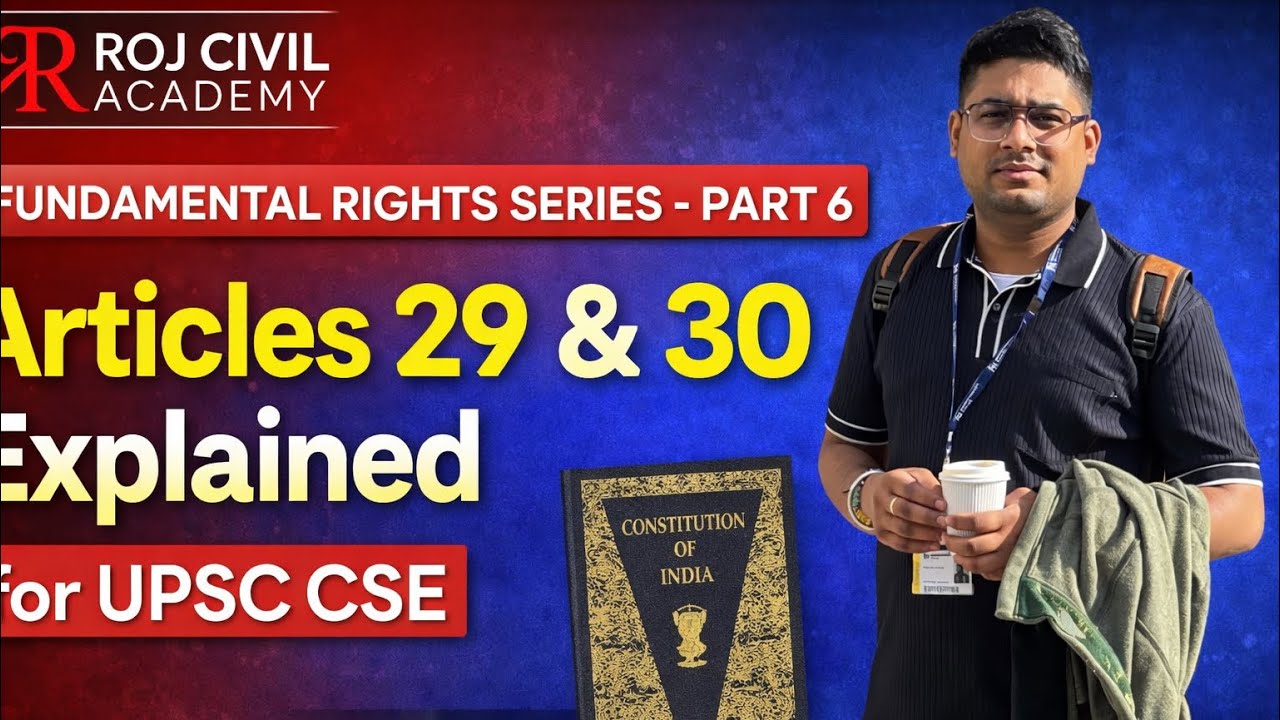
Articles 29 & 30 Explained for UPSC CSE|Cultural & Educational Rights | Roj Civil Academy by Roj Sir
Автор: Roj Civil Academy
Загружено: 2026-01-28
Просмотров: 55
Описание:
Hello students, welcome to Roj Civil Academy — think deeper, serve better.
This is Episode 6 of our Fundamental Rights Series for UPSC CSE and PSIR Optional, taught by Roj Sir.
In this 25-30 minute class, we cover Cultural & Educational Rights – Articles 29 & 30 – in a way that is fully aligned with UPSC CSE (Prelims & Mains), PSIR optional, EPFO, CDS, and State PCS.
🔍 What we cover in this lecture
1. Historical Background & Constitutional Debates
• Pre‑Independence context: linguistic & cultural diversity, identity anxieties.
• Nehru Report (1928) and early demands for cultural & educational safeguards.
• Constituent Assembly debates: Nehru, Ambedkar, Sardar Patel, H.C. Mookherjee, Maulana Azad – why Articles 29 & 30 were created.
2. Article 29 – Protection of Interests of Sections of Citizens
• Article 29(1): Right of any section of citizens (not only minorities) with distinct language, script or culture to conserve it.
• Article 29(2): Prohibition on denial of admission to State / State-aided educational institutions only on grounds of religion, race, caste, language.
• Relationship with equality & non-discrimination (Articles 14, 15, 16).
• Champakam Dorairajan (1951) case and how it led to the First Constitutional Amendment (Article 15(4)) and the shift towards affirmative action.
3. Article 30 – Rights of Minorities to Establish & Administer Educational Institutions
• Article 30(1): Religious & linguistic minorities → right to establish and administer educational institutions of their choice.
• Article 30(1A): Inserted by the 44th Amendment – protection of minority institutions in case of property acquisition.
• Article 30(2): No discrimination in granting aid because institution is minority‑run.
• Who is a “minority”? – clarification from T.M.A. Pai Foundation (2002) – State-wise, based on religion or language.
4. Key Case Laws & Doctrinal Developments
• T.M.A. Pai Foundation v. State of Karnataka (2002) – autonomy vs regulation; rights of minority and non-minority institutions.
• P.A. Inamdar v. State of Maharashtra (2005) – admissions & fees in unaided minority institutions; fair, transparent, non-exploitative procedures.
• Modern Dental College v. State of MP (2016) – application of the proportionality doctrine to education regulation.
• Linkages of Articles 29–30 with 19(1)(g) (profession), 21A (Right to Education), and equality provisions.
5. Scholars’ Views & Textbook Mapping
• Insights from D.D. Basu, M.P. Jain, Subhash Kashyap (as commonly read in UPSC preparation):
• Article 29(1) as a broad cultural right for any section of citizens.
• Article 30 as a targeted protection for religious & linguistic minorities.
• How these rights fit within Indian secularism and multiculturalism.
6. Current Affairs (2023–2026) & Policy Debates
• Implementation of NEP 2020 and implications for minority‑run institutions.
• Disputes over management & regulation of minority schools and colleges.
• Demands for language & cultural protection in State curricula.
• Contemporary issues around status & recognition of specific institutions as minorities.
7. UPSC Prelims & Mains / PSIR Optional Angle
• Prelims:
• Article–subject mapping,
• Who is covered by Article 29(1) vs 30(1),
• State‑wise concept of “minority” (TMA Pai).
• GS-II/GS-I:
• Minority rights, secularism, national integration, education policy.
• Essay:
• Unity in diversity, education & identity, multiculturalism in India.
• PSIR Optional:
• Case study for “constitutional multiculturalism” and “minority accommodation”.
🎯 Who should watch this video?
• UPSC CSE beginners & advanced aspirants – General Studies & Essay.
• PSIR optional students – for Indian constitutionalism & multiculturalism topics.
• EPFO, CDS, CAPF, State PCS aspirants – for Polity & Fundamental Rights.
• Anyone interested in understanding how the Constitution protects culture, language, and minority education.
📌 How to use this lecture in your preparation
• For Prelims: note down brief points on Articles 29(1), 29(2), 30(1), 30(1A), 30(2) + 4–5 major case names.
• For Mains: use these Articles as examples whenever you write on:
• Indian secularism,
• minority rights,
• education & reservation,
• multiculturalism & national integration.
• For PSIR: integrate these as Indian case studies while writing on liberal democracy & group rights.
If you find this lecture helpful, do like, share, and subscribe to Roj Civil Academy – by Roj Sir for more UPSC CSE Polity, Fundamental Rights series, and PSIR optional content.
`#RojCivilAcademy #RojSir #UPSC #UPSCPreparation #UPSC2025 #UPSC2026 #IndianPolity #FundamentalRights #Articles29and30 #CulturalRights #MinorityRights #PSIR #UPSCMains #UPSCPrelims #StatePCS`
Повторяем попытку...
Доступные форматы для скачивания:
Скачать видео
-
Информация по загрузке: