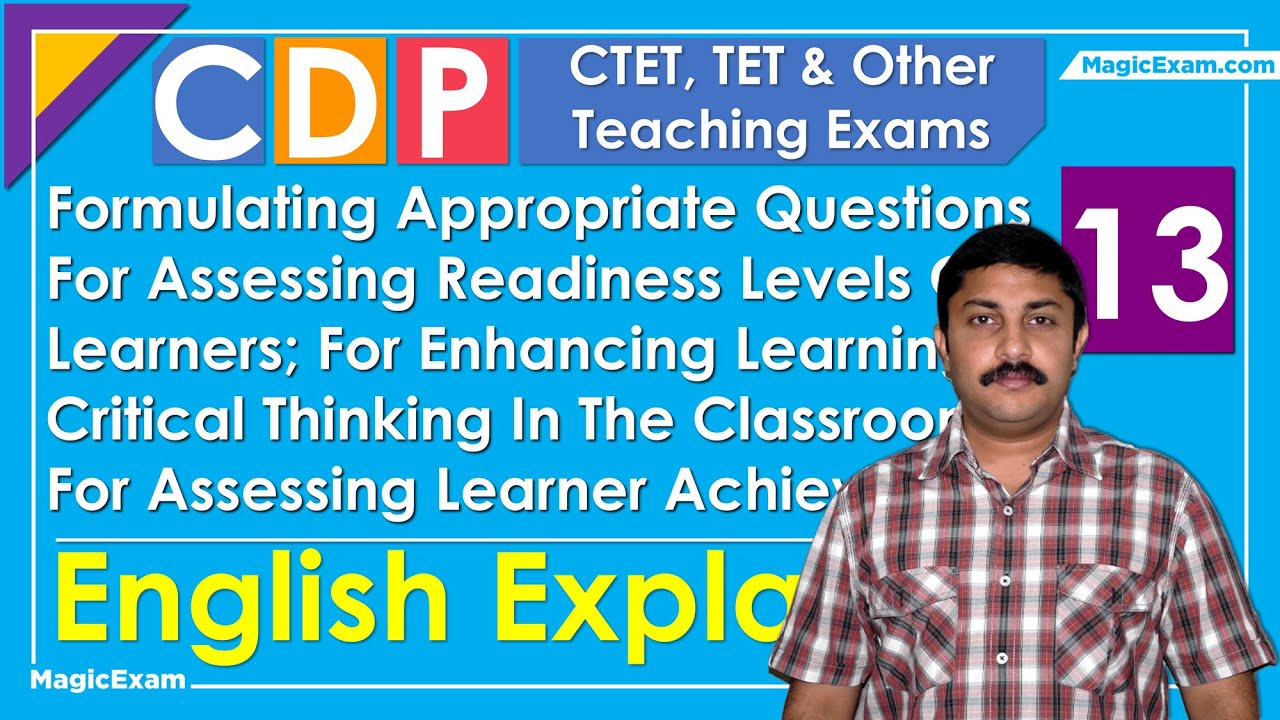
Formulating Appropriate Questions Assessing Readiness Learning Critical Thinking CTET CDP 13 English
Автор: MagicExam
Загружено: 2022-09-13
Просмотров: 7704
Описание:
00:00 Formulating Appropriate Questions For Assessing Readiness Levels Of Learners; For Enhancing Learning & Critical Thinking In The Classroom & For Assessing Learner Achievement
00:30 Important Topics
Formulating Appropriate Questions Context
Assessing Readiness Levels
Enhancing Learning
Enhancing Critical Thinking
Assessing Learner Achievement
Basic Rules for Any Assessment
Basic Types of Questions
Basic Principles for Creating Good Test Items
01:07 Context For Formulating Appropriate Questions
Formative
Assessing Readiness Levels
Enhancing Learning
Enhancing Critical Thinking
Summative
Assessing Learner Achievement
Does Learner understand basic characteristics of a Triangle? Does Learner need a refresher or revision
How can I help the Learner to remember, understand and apply the formulas to calculate the area of a Triangle
Can Learner calculate the area of Triangle if essential info is given
04:17 Qs For Assessing Readiness Level
Learning Readiness level refers to how well equipped a child is to learn
It is affected by Personal, Environmental, Circumstantial & other factors
Readiness Level Assessment
Prognostic Is the Child Ready to learn
Diagnostic If Child is not ready, why
Different Types of Tests & Questions
Academic, Cognitive, Mental or Physical Readiness
06:43 Qs For Enhancing Learning & Critical Thinking
Must guide learners to higher levels of the Pyramid
Assessment As For Learning
Blooms Taxonomy
Create Generating New & Original work
Evaluate Able to justify or defend a decision or view
Analyze Comparing, Organizing, Experimenting
Apply Using the information in new situations
Understand Explaining Concepts & Ideas
Remember Facts & Concepts
10:41 Qs For Assessing Learner Achievement
Achievement Test
Teacher Made Test
Unit Test
Monthly
Semi-Annual
Annual
Oral
Written
Performance
Objective
13:20 Basic Rules for Any Assessment
Valid Validity refers to the accuracy of an assessment whether or not it measures what it is supposed to measure
Reliable Reliability refers to the extent to which assessments are consistent whether the test gives same results on different days, for different assessors
Objectivity Assessments should be based on facts and not influenced by personal feelings, emotions, or judgments
Relevant Results of the Assessment are meaningful and useful to the intended audience
Adequate Results are sufficient for the intended purpose
16:44 Basic Types of Questions
Closed Ended Only one possible correct answer How many prime numbers can be found between 1 and 10
Open Ended Can have multiple answers & require more thought Name two shapes which have four sides
Probing Typically, follow up questions to get a deeper understanding
Leading Aimed at 'leading' learners to give a desired answer Isn't this an interesting class
Loaded Show an assumption about the learner Have you stopped copying homework
Funnel Start with closed ended, leading towards broad open-ended questions
Process Aimed at understanding the learner's thought process How should we choose the class leader
Rhetorical Question that includes an answer A Statement that looks like a question
21:08 Important question types to remember
Closed Open Ended
21:31 Basic Principles for Creating Good Test Items
Essay or Descriptive
Specify the length of response
Provide guidelines such as points to focus on
Prior information regarding the weight to different aspects
Objective
Clearly presented Proper Directions
Is main problem clear in the question
Avoid irrelevant material
Answer options clear & concise
Only one correct or clearly best answer
Question free of clues to the answers
Ex 1. Ram had a meeting at 11.45 am. He reached his office at 12.45 pm. He was late by an
30 mins
Hour
45 mins
Two hours
Ex 2. The average rainfall of India in the month of July is
less than 120 mm
less than 140 mm
between 140 mm and 150 mm
more than 150 mm
more than 155 mm
26:04 Which type of evaluation focuses on the identification of deficiencies and difficulties of the learner
Summative
Follow up
Diagnostic
Criterion-referenced
27:16 A teacher goes through the student’s notebooks and gives remarks. This is called as
Notebook checking
Daily Remarks
Evaluation
Assessment
28:54 The performance of a student is compared with another student in which type of testing
Criterion-referenced
Diagnostic
Summative
Norm-referenced
30:14 Which one of the following types of evaluation assesses the learning progress to provide continuous feedback to both teachers and students during instruction
Placement
Formative
Diagnostic
Summative
31:16 Which of the characteristics in classroom teaching behavior as given below will be classified as a part of formative assessment. The teacher
asks questions to elicit classification from students
specifies the level of mastery attained by students
prompts and probes the students while making a presentation
pauses for a few seconds, looks at students, and asks questions
indicates performance criteria and given judgmental values
Повторяем попытку...
Доступные форматы для скачивания:
Скачать видео
-
Информация по загрузке: