Module 26.3 - Cyanide - Lecture
Автор: Craig Cocchio
Загружено: 2026-02-01
Просмотров: 4
Описание:
Welcome to Nexus Clinical!
Before diving into this lecture, I want to ensure we're all on the same page.
This is for general informational purposes only and does not constitute the practice of medicine, nursing, or other professional healthcare services, including the giving of medical advice. No doctor-patient or pharmacist-patient relationship is formed. Using this information and the materials linked to this content is at the user's risk. This is not intended to substitute for professional medical advice, diagnosis, or treatment. Users should not disregard or delay seeking medical advice for any medical condition they have, and they should consult their healthcare professionals for any such conditions.
Clinical experts created the references, content, and clinical insight. NotebookLM, a Google AI tool, created the content, which I extensively reviewed before release.
Finally, the host states that he takes all conflicts of interest seriously. Currently, there are no conflicts to disclose. For all of his disclosures and the companies he invests in or advises, he directs users to reach out independently, where he keeps an up-to-date and active list of all disclosures.
Cyanide poisoning is a severe, rapidly progressing toxicological emergency that demands prompt recognition for life-saving intervention. In this educational module, we equip clinicians to tackle this critical challenge by mastering its core principles.
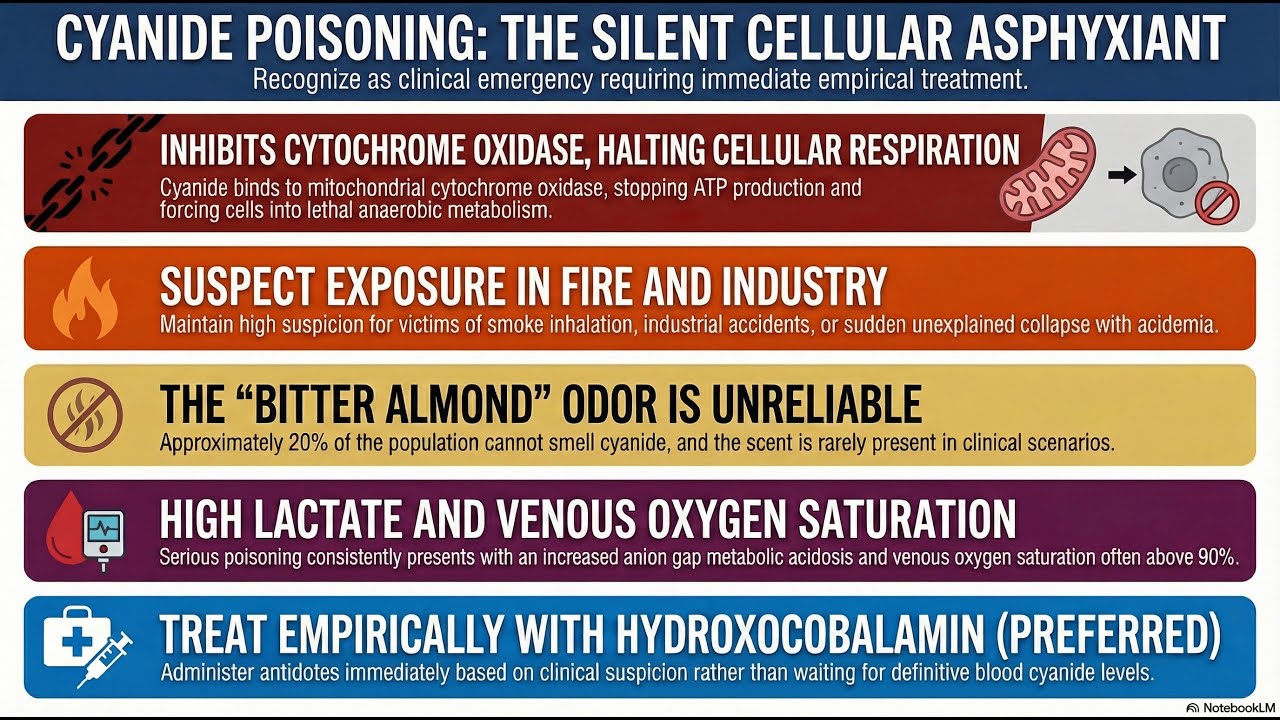
We trace cyanide’s tragic history—from its early isolation in 1782 to its use in warfare and contemporary sources like industrial settings (metallurgy, mining), fire smoke inhalation, and natural cyanogenic glycosides found in plants like cassava and apricots. Crucially, we detail the core pathophysiology: cyanide disrupts cellular respiration by binding to mitochondrial cytochrome oxidase, causing profound cellular hypoxia and leading to a rapid spike in lactate and severe anion gap metabolic acidosis.
Diagnosis is often challenging because symptoms are non-specific (CNS and CV dysfunction). We emphasize why relying on the alleged "bitter almond odor" is a critical error, as approximately 20% of the population cannot detect it. Instead, clinicians must utilize suggestive lab findings such as an increased anion gap metabolic acidosis, elevated lactate concentration, and elevated venous oxygen saturation (reflecting decreased tissue oxygen use).
Given the rapid lethality, immediate empirical antidotal therapy is essential. We differentiate the two primary antidotal strategies:
Hydroxocobalamin (Preferred): This agent directly binds cyanide and is favored in smoke inhalation or severe anemia because it does not induce methemoglobinemia.
Sodium Nitrite and Sodium Thiosulfate: Nitrite creates a methemoglobin sink, while thiosulfate provides the sulfur donor necessary for the natural detoxification pathway catalyzed by rhodanese.
Understanding high-risk contexts and prioritizing aggressive supportive care alongside rapid antidote administration are the cornerstones of effective management for this high-acuity toxicologic scenario.
Повторяем попытку...
Доступные форматы для скачивания:
Скачать видео
-
Информация по загрузке: