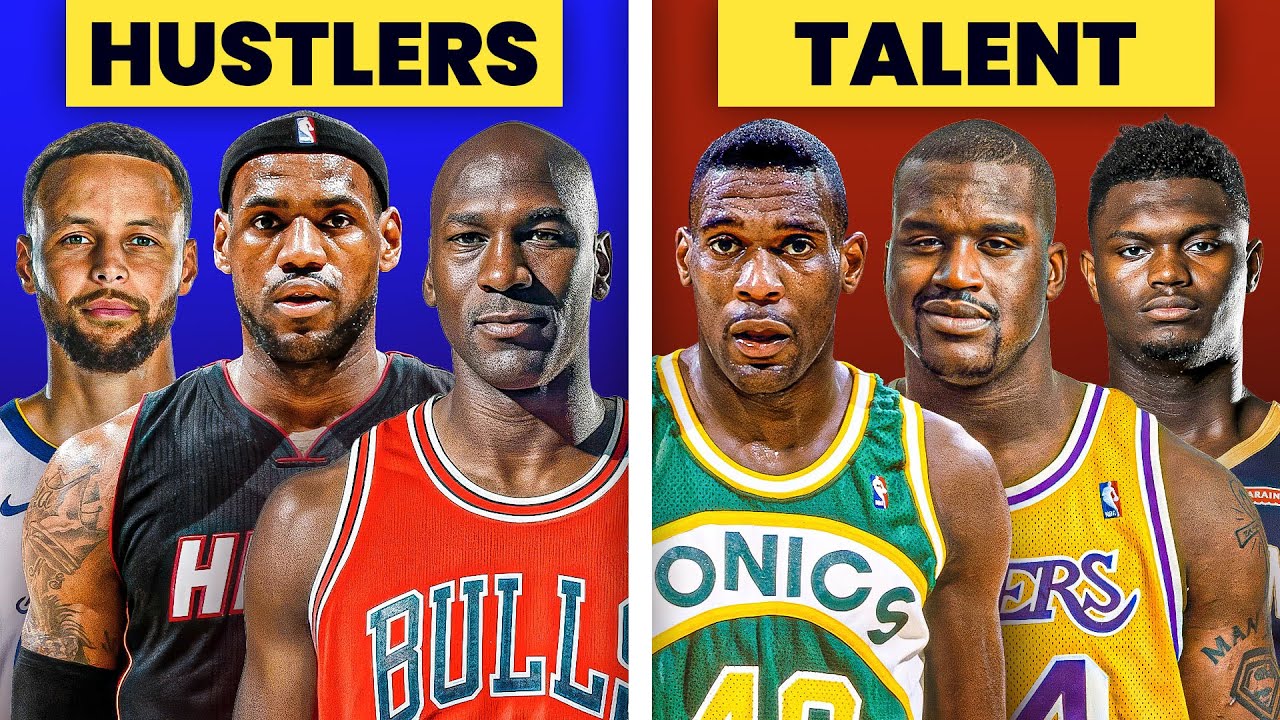
Hardest Workers Vs Natural NBA Talents
Автор: Swish Roll
Загружено: 2025-10-10
Просмотров: 928
Описание:
The debate continues: Is it raw talent or relentless hard work that defines a player's legacy? From Michael Jordan to Lebron James, we explore how hard work beats talent and the different paths to greatness. Discover what set these nba legends and other nba stars apart.
Greatness doesn’t look the same for everyone.
For some, it’s sweat, obsession, and years of shaping every weakness into strength.
For others, it’s a gift — a combination of size, speed, and touch that no defense can solve.
Today, we’re exploring basketball’s ultimate clash: workers who willed themselves into icons, versus naturals who made dominance look effortless.
Two very different paths. One stage.
The real question is… when pressure peaks, whose path actually wins?
Michael Jordan didn’t become “Air Jordan” by accident. After being knocked down by the “Bad Boy” Pistons year after year, he realized pure talent wasn’t enough. He needed a body and mindset that could survive playoff warfare.
Enter trainer Tim Grover. Jordan formed what became known as the “Breakfast Club.” At 5 a.m., before practice, he lifted. By 7 a.m., he was working through on-court drills—fadeaways, footwork, defensive slides. By mid-morning, conditioning and recovery. This was daily, not seasonal. Teammates Pippen and Harper joined, but Jordan was the one demanding every ounce of intensity.
Grover recalls Jordan insisting on shooting through exhaustion—putting up jumpers after sprinting until his legs wobbled, simulating fourth-quarter fatigue. Every rep mirrored a game scenario.
The results were obvious. He developed one of the most polished midrange arsenals in history: turnarounds, inside pivots, baseline fades, all rehearsed thousands of times. His defensive presence—steals, blocks, help rotations—came from hours of studying tendencies and building stamina to sustain full-court pressure.
Even iconic moments like the 1997 “flu game” were built on years of conditioning. He wasn’t superhuman; he was prepared for chaos when it arrived.
Jordan’s six titles, five MVPs, and ten scoring crowns weren’t a gift. They were the product of structure and obsession. Every weakness became a new project.
👉 Jordan’s work ethic created the modern blueprint. But how does someone else carry the weight of global hype for twenty years without breaking? That brings us to LeBron James.
At 16, LeBron was already billed as “The Chosen One.” His games sold out gyms, ESPN broadcast his high school matchups, and Nike handed him $90 million before he played an NBA game. That spotlight destroys most players. LeBron thrived—and then evolved.
His body was built like a freight train: 6’8”, 240 pounds, with speed rivaling guards. But his greatness came from constant reinvention. Early in Cleveland, he was dared to shoot. He spent offseasons reworking mechanics until his jumper became reliable in big moments. In Miami, he added a refined post game, learning footwork from Hakeem Olajuwon. When defenses crowded the paint, he punished with fadeaways and kick-outs.
Longevity didn’t happen by chance. LeBron invests over $1.5 million per year into recovery—private chefs, dietitians, massage therapists, cryotherapy, hyperbaric chambers, sleep tracking, and strength coaches. Every in-season day follows the same rhythm: cold tub, lift, mobility, film, hydration. Even travel schedules are optimized to reduce swelling and fatigue.
He isn’t just physically prepared—he’s mentally loaded with film study. Teammates and coaches call him a “walking database,” able to recall opponents’ plays from years earlier. During playoff runs, he organizes “LeBron camps” before official training camp, ensuring teammates know spacing, timing, and schemes.
Steph Curry, Shawn Kemp, Shaquille O'neal, Zion Williamson
Повторяем попытку...
Доступные форматы для скачивания:
Скачать видео
-
Информация по загрузке: