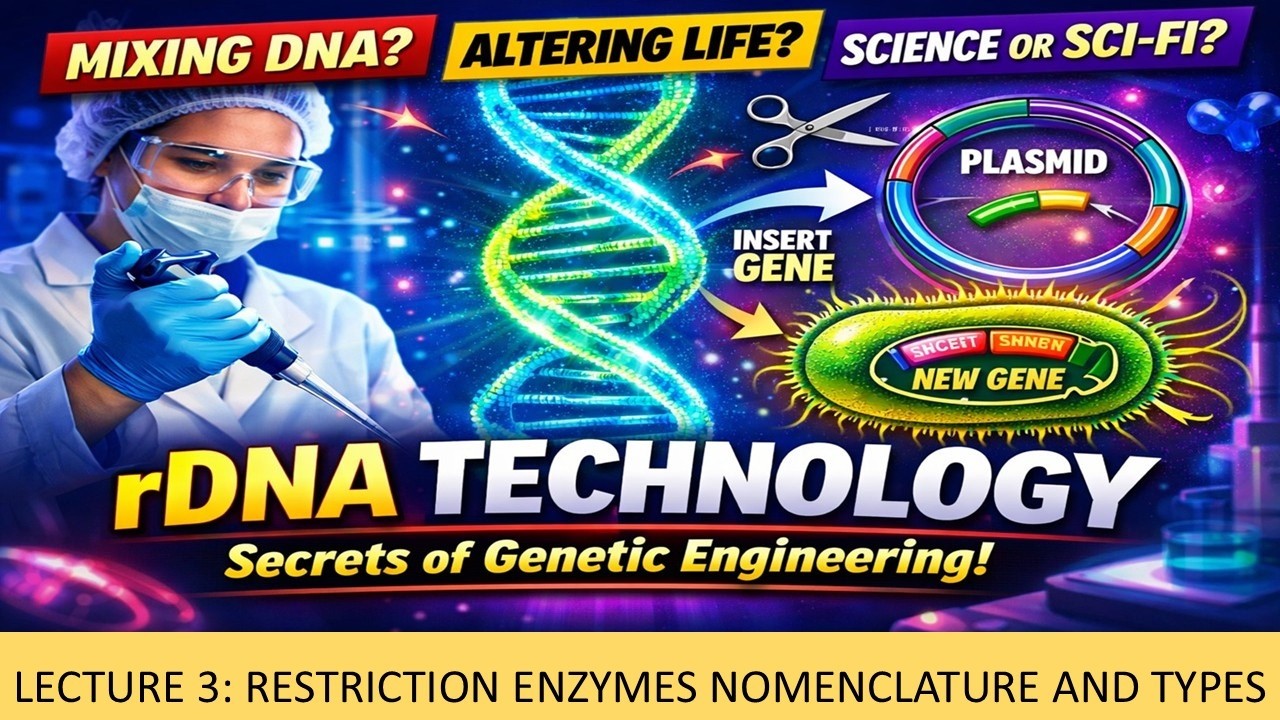
RECOMBINANT DNA TECHNOLOGY ||Nomenclature and Classification of RE || Lecture 3||
Автор: Grow With Biology By Dr. Arpita
Загружено: 2026-03-13
Просмотров: 28
Описание: Restriction enzymes (restriction endonucleases) are enzymes that recognize specific DNA sequences and cut the DNA at or near those sites. They are mainly classified into three types: Type I, Type II, and Type III based on their structure, cleavage position, and cofactor requirements. Type I restriction enzymes recognize specific DNA sequences but cleave DNA at random sites far from the recognition sequence and require ATP, Mg²⁺, and S-adenosyl methionine for activity. Type II restriction enzymes are the most widely used in molecular biology because they cut DNA at specific positions within or very close to the recognition site and require only Mg²⁺ as a cofactor (e.g., EcoRI, HindIII). Type III restriction enzymes recognize specific sequences but cleave DNA a short distance away from the recognition site and require ATP and Mg²⁺ for activity. The nomenclature of restriction enzymes is based on the bacterial species from which they are isolated. The first letter represents the genus, the next two letters represent the species, the following letter indicates the strain, and the Roman numeral shows the order of discovery in that organism. For example, EcoRI is derived from Escherichia coli strain RY13, where E stands for Escherichia, co for coli, R for the strain, and I indicates that it is the first restriction enzyme isolated from that strain.
Повторяем попытку...
Доступные форматы для скачивания:
Скачать видео
-
Информация по загрузке: