Yellow-lipped Banded Sea Krait Snake: Pulau Hantu: Singapore Nature 2020
Автор: Christian Bassett
Загружено: 2020-08-20
Просмотров: 2760
Описание:
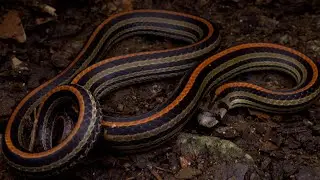
Filmed this Banded Sea Krait snake at Pulau Hantu Pier Singapore, mid-August. It was a pity the visibility was so poor and the water laden with silt, which resulted in the poor quality footage. It seems to be a female getting on for 1.5 meters. It was one of the largest sea kraits i have seen on my travels. The species is one of the most dangerously venomous snakes found.
Yellow-lipped sea krait
Laticauda colubrina
Family Elapidae
This beautiful snake is sometimes seen on Singapore's Southern shores especially at night, hunting among reefs and coral rubble. The snake is typically found in shallow seas around coral reefs and rocky shores. Some place them in Family Hydrophiidae.
According to Baker, in Singapore, it is only found on our Southern Islands. It can crawl about on land (not helpless like other sea snakes). It is widely distributed in the Indo-Pacific.
The snake has a highly toxic venom that can be fatal to humans. But it is a gentle and docile snake with tiny fangs. It will not bite unless provoked. It is best to leave it alone, although it is curious and may investigate you!
Features: To about 1.4m long. Males are smaller (rarely more than 1m in length) while females are heavier bodied and longer. Bluish-grey with distinct smooth scales and regularly spaced, equal-sized black bands that circle the entire body. Its upper lips are distinctly yellow, thus its common name. Head slightly distinct from the body, but no obvious 'neck'. Its tail is flattened sideways into a paddle-like shape and used like an oar to swim with. At first glance, the tail and the head of this snake look very similar. A study suggests this may help protect the snake from its predators.
Singapore's sea snakes are listed as 'Endangered' on the Red List of threatened animals of Singapore. Like other creatures of the intertidal zone, they are affected by human activities such as reclamation and pollution.
It has very potent neurotoxic venom which it uses to prey on eels and small fish. Because of their affinity to land, yellow-lipped sea kraits often encounter humans, but the snakes are not aggressive and only attack when feeling threatened. The venom of this elapid, Laticauda colubrina, is a very powerful neurotoxic protein, with a subcutaneous LD50 in mice of 0.45 mg/kg body weight. The venom is an α-neurotoxin that disrupts synapses by competing with acetylcholine for receptors on the postsynaptic membrane, similar to erabutoxins and α-bungarotoxins. In mice, lethal venom doses cause lethargy, flaccid paralysis, and convulsions in quick succession before death. Dogs injected with lethal doses produced symptoms consistent with fatal hypertension and cyanosis observed in human sea snake bite victims.
When hunting, yellow-lipped sea kraits frequently head into deep water far from land, but return to land in order to digest, shed skin, and reproduce. Individual yellow-lipped sea kraits return to their specific home islands, exhibiting philopatry. One study found that when yellow-lipped sea kraits on Fijian islands were relocated to different islands 5.3 km away, all recaptured individuals were found on their home islands in an average of 30.7 days.
Hunting is often performed alone, but L. colubrina may also do so in large numbers in the company of hunting parties of giant trevally and goatfish. This cooperative hunting technique is similar to that of the moray eel, with the yellow-lipped sea kraits flushing out prey from narrow crevices and holes, and the trevally and goatfish feeding on fleeing prey.
Yellow-lipped sea kraits primarily feed on varieties of eels, but also eat small fish. Males and females exhibit sexual dimorphism in hunting behavior, as adult females, which are significantly larger than males, prefer to hunt in deeper water for larger conger eels, while adult males hunt in shallower water for smaller moray eels. In addition, females hunt for only one prey item per foraging bout, while males often hunt for multiple items. After hunting, yellow-lipped sea kraits return to land in order to digest their prey.
Some varieties of eels, which are a primary food source for yellow-lipped sea kraits, may have coevolved resistance to yellow-lipped sea krait venom. Gymnothorax moray eels taken from the Caribbean, where yellow-lipped sea kraits are not endemic, died after injection with doses as small as 0.1 mg/kg body weight, but Gymnothorax individuals taken from New Guinea, where yellow-lipped sea kraits are endemic, were able to tolerate doses as large as 75 mg/kg without severe injury.
#yellowlippedseakrait #bandedseakrait #singaporesnakes #seasnakes #singaporenature #singaporewildlife #singaporemarinelife #pulauhantu
Playlist:
Stellardrone - Satellites
Stellardrone - Mars
Videography:
Christian Bassett
Camera:
Sony 4K FDR-AX700 Camcorder
Editing:
Christian Bassett
Повторяем попытку...

Доступные форматы для скачивания:
Скачать видео
-
Информация по загрузке: