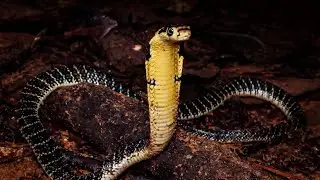
Gold King Cobra In Singapore: Singapore Nature 2020
Автор: Christian Bassett
Загружено: 2020-07-14
Просмотров: 18110
Описание:
I filmed this magnificent gold king cobra on the edge of the forest in Singapore at about 2 am. After a non eventful night searching for snakes with my friend Shan, mother nature decided to give us this wonderful gift. It was truly a special occasion. The snake looked to be up to 4 meters in length. I first located it on the floor, after which it quickly climbed a tree.
The king cobra (Ophiophagus hannah), also known as the hamadryad, is a venomous snake species in the family Elapidae, endemic to forests from India through Southeast Asia. It is threatened by habitat destruction and has been listed as Vulnerable on the IUCN Red List since 2010. It is the world's longest venomous snake. Adult king cobras are 3.18 to 4 m (10.4 to 13.1 ft) long. The longest known individual measured 5.85 m (19.2 ft). It is the sole member of the genus Ophiophagus. It preys chiefly on other snakes and occasionally on some other vertebrates, such as lizards and rodents. It is a highly venomous and dangerous snake when agitated or provoked that has a fearsome reputation in its range, although it is typically shy and avoids confrontation with humans when possible. The king cobra is a prominent symbol in the mythology and folk traditions of India, Sri Lanka and Myanmar. It is the national reptile of India.
The head of a mature snake can be quite massive and bulky in appearance. Like all snakes, it can expand its jaws to swallow large prey items. It has proteroglyph dentition, meaning it has two short, fixed fangs in the front of the mouth, which channel venom into the prey. These are behind the usual "nine-plate" arrangement typical of colubrids and elapids, and are unique to the king cobra.[citation needed] The king cobra typically weighs about 6 kg (13 lb). A captive one at the London Zoo grew to 5.71 m (18.7 ft) before being euthanised upon the outbreak of World War II. The heaviest wild specimen was caught at Royal Island Club in Singapore in 1951, which weighed 12 kg (26 lb) and measured 4.8 m (16 ft). An individual kept at Bronx Zoo weighed 12.7 kg (28 lb) and was 4.4 m (14 ft) long in 1972.
The king cobra is not considered aggressive. It usually slinks off when disturbed, but is known to aggressively defend incubating eggs and attack intruders rapidly. When alarmed, it raises the front part of its body, extends the hood, shows the fangs and hisses loudly. When biting, it retains its grip for up to eight minutes.Wild king cobras encountered in Singapore appeared to be placid, but reared up and struck in self defence when cornered. The hiss of the king cobra is a much lower pitch than many other snakes and many people thus liken its call to a "growl" rather than a hiss.
It can be easily irritated by closely approaching objects or sudden movements. When raising its body, the king cobra can still move forward to strike with a long distance, and people may misjudge the safe zone. It can deliver multiple bites in a single attack. The king cobra's venom consists of cytotoxins and neurotoxins, including alpha-neurotoxins and three-finger toxins. It can deliver up to 420 mg venom in dry weight per bite. The toxins affect the victim's central nervous system, resulting in severe pain, blurred vision, vertigo, drowsiness, and eventually paralysis. If the envenomation is serious, it progresses to cardiovascular collapse, and the victim falls into a coma. Death soon follows due to respiratory failure. The affected person can die within 30 minutes of envenomation. Ohanin, a protein component of the venom, causes hypolocomotion and hyperalgesia in mammals.Large quantities of antivenom may be needed to reverse the progression of symptoms.
A polyvalent antivenom produced by the Thai Red Cross Society can effectively neutralize venom of the king cobra. In Thailand, a concoction of turmeric root has been clinically shown to create a strong resilience against the venom of the king cobra when ingested. Proper and immediate treatments are critical to avoid death. Successful precedents include a client who recovered and was discharged in 10 days after being treated by accurate antivenom and inpatient care.
In Southeast Asia and Singapore, the king cobra is critically threatened foremost by habitat destruction owing to deforestation. It is also threatened by poaching for its meat, skin and for use in traditional Chinese medicine.
#kingcobra #goldkingcobra #singaporesnakes #singaporenature #singaporewildlife #snakes #cobras
Playlist:
Nuages - Still
Videography:
Christian Bassett
Camera:
Sony FDR-AX 700 4K Camcorder
Повторяем попытку...

Доступные форматы для скачивания:
Скачать видео
-
Информация по загрузке: