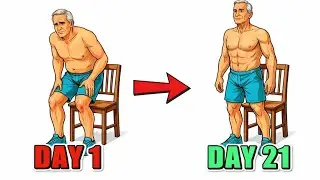
( Over 60? 5 Essential Exercises to Quickly Build Stronger Glutes)|
Автор: junior wellness
Загружено: 2026-01-14
Просмотров: 53
Описание:
After the age of sixty, the conversation about strength quietly shifts from performance to independence, and nowhere is this shift more biologically important than in the gluteal muscles. These muscles sit at the center of human movement, not as something dramatic or visible, but as a deep structural support system that allows the body to rise from a chair, maintain balance while walking, and protect the spine from unnecessary strain. From a scientific perspective, the glutes act as a primary bridge between the upper and lower body, transferring force efficiently so that joints and smaller muscles are not overburdened. As aging progresses, muscle fibers naturally decrease in size and responsiveness, a process known as sarcopenia, and the glutes are particularly vulnerable because daily life no longer challenges them the way it once did. Long periods of sitting send a powerful neurological message to the brain that these muscles are no longer essential, and the body, always efficient, begins to allocate resources elsewhere.
What is remarkable is how reversible this process can be. The nervous system remains adaptable well into later life, and when glute muscles are intentionally engaged, the brain quickly relearns how to recruit them. This reactivation improves not only strength but also proprioception, the body’s internal sense of position and control. Scientifically, this means improved communication between sensory receptors in the muscles and the motor cortex in the brain. Functionally, it means fewer missteps, more confidence while walking, and a reduced fear of falling. Independence is preserved not through dramatic effort, but through restoring these quiet conversations within the body.
There is also a deeper structural implication. Weak glutes force the lower back, knees, and hips to compensate, altering movement patterns in subtle but harmful ways. Over time, this compensation increases joint stress and accelerates wear, which is why back and knee pain become so common after sixty. Strengthening the glutes redistributes load more evenly, allowing the skeleton to align as it was biologically intended. This is not about adding years to life, but about adding stability to each movement within those years. The body begins to feel safer to itself, and pain often decreases not because anything was fixed directly, but because balance was restored.
From a reflective standpoint, glute strength represents something almost philosophical about aging. It reminds us that the body does not suddenly fail; it slowly adapts to how we ask it to live. When movement becomes smaller, the body becomes cautious. When movement becomes intentional again, the body responds with quiet resilience. Building glute strength after sixty is therefore not an act of resistance against time, but an act of cooperation with biology, honoring how the human body was designed to move, support itself, and remain capable even as the years advance.
Повторяем попытку...

Доступные форматы для скачивания:
Скачать видео
-
Информация по загрузке: