Update To The Stabilizing Offshore Wind Energy Platform Video (Results Included!)
Автор: MHL Media
Загружено: 2024-05-13
Просмотров: 258
Описание:
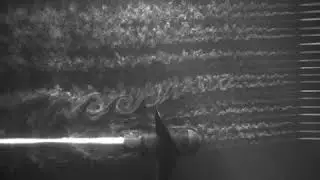
An update to the prior video on Stabilizing Offshore Wind Energy Platform Using Energy Harvesting Tuned Inerter Dampers, including results from the testing.
Approximately 80% of the world's offshore wind resources are in deep sea above 60m, where the fixed-bottom turbines are not a viable option. The US government set a target to install 15 GW of floating offshore wind capacity by 2035. However, technology challenges exist since the floating wind turbines are subjected to complicated loads from wind, current, and waves. The platform vibrations significantly reduce fatigue life. Instead of taking the collocated water power as a foe, we propose the joint development of offshore wind and wave energy, combining marine energy structures to leverage the strengths of both while mitigating their weaknesses. Such hybrid wind-wave energy technologies will reduce the Levelized Cost of Energy (LCOE) and enhance competitiveness through both multi-functional infrastructure sharing and augmented electricity production.
Our project introduces dual-functional Tuned Inerter Dampers (TIDs) retrofitted inside the offset columns of semi-submersible offshore wind platforms. The TIDs, inspired by the tuned mass dampers (TMD) used to reduce vibrations in skyscrapers and the J dampers used in some vehicle suspensions, double as a wave energy converter. It captures energy from both wind and wave-induced vibrations of the floating platform and reduces excessive motions, thus decreasing fatigue on structural components. Our design seeks to exploit the kinetic energy of the sea and improve the stability of floating turbines within a hybrid wave-wind system, thereby increasing energy efficiency and cost-effectiveness.
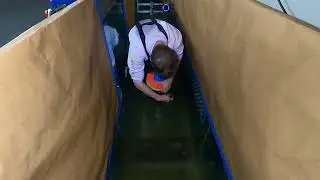
The research team conducted an initial test in the wave tank at the University of Michigan's Marine Hydrodynamics Lab (MHL) with a 1:50 scale semi-submersible platform to assess vibration reduction in heave and pitch motions. This preliminary test lays the groundwork for subsequent enhancements, including the integration of a generator, driving us toward our goal of a stable offshore wind platform with wave energy harvesting capacity.
This journey is made possible through the collaboration with GE Global Research Center and Virginia Tech under the support of the National Offshore Wind Research and Development Consortium (NOWRDC).
For additional information about this project please contact Professor Lei Zuo ([email protected]).
Повторяем попытку...

Доступные форматы для скачивания:
Скачать видео
-
Информация по загрузке: