Crucial for back health and injury prevention! Do you know about the MULTIFIDUS MUSCLE?
Автор: Dr. Lori B
Загружено: 2026-01-21
Просмотров: 663
Описание:
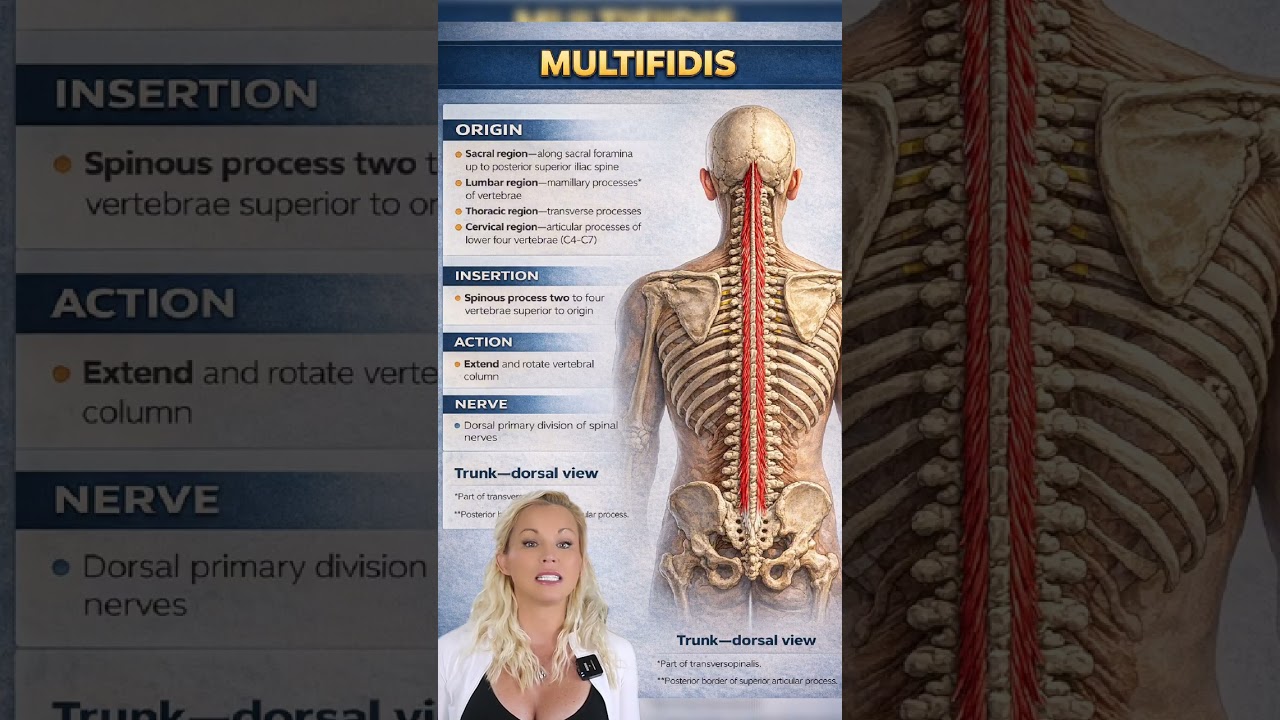
Possibly the most under-appreciated muscle in the human body and one of my absolute favorites!!!! The Multifidus muscle is a deep spinal stabilizer, acting like "guide wires" for each vertebra. We are talking about the spine, your back, a place where more than 80% of people will have at least short term disabling pain for some part of their lifetime. This muscle has control over your vertebrae like a puppet on a string. Therefore it helps by enabling precise, segmental spinal movement for patterns that include extension, side-bending and rotation, while also providing crucial postural support. Because it is so often NOT TRAINED PROPERLY or cared for, it is notorious for shrinking (atrophy) with the onset of back pain. Problems with the multifidus hinder core function. Surprisingly, the MULTIFIDUS is essential for pure trunk rotation, working with other muscles to prevent unwanted movements and protecting the body from injury or painful movement patterns. The Multifidus has been found to be highly related to the recovery potential of our backs and has been a source of study to optimize both function and recovery in astronauts.
THE MULTIFIDUS is a series of short muscles spanning 2-3 vertebrae at a time (per each segment of muscle). The muscle allows for fine-tuned, individual spinal segment control, unlike larger muscles that move the whole spine. This is one of the deepest back muscles, lying directly against the spine and providing crucial stability directly to the vertebrae and working with the transverse abdominis as well as deep stabilizers to the core to protect us (and more specifically our backs) from injury.
The multifidus is continuously active in upright postures, supporting your spine and maintaining alignment during daily activities and even yoga poses.
Pure Rotation Assistant: When you rotate your trunk, the multifidus contracts to resist unwanted trunk flexion, allowing for a purer, more controlled axial rotation. The multifidus is often atrophied in people with chronic low back pain, even when pain subsides, highlighting its role in back health. Body building inthusiasts typically admire the muscle for how it's fibers run diagonally from the transverse process of one vertebra to the spinous process of another, resembling a "Christmas tree" or pine boughs on our lower back.
Trigger points in the multifidus can mimic sciatic pain, leading to misdiagnosis, and can decrease core function. Studies, including those with astronauts (mentioned earlier) show it can be effectively re-trained and recover, even after significant disuse, demonstrating its adaptability. I stress these last matters because of it's crucial role in our back health. So many people seem to verbalize issues with back pain, injury and disfunction of the back; AND YET, how often do people care about specific back training, the muscles of the back and the rehab that goes into it. Sometimes it seems like one of the "out of sight and out of mind" topics. With more than 80% of people suffering from disabling back pain, maybe we should care a lot more about muscles like the multifidus. Interested in your thoughts???
#anatomy #coreexercises #education
Повторяем попытку...
Доступные форматы для скачивания:
Скачать видео
-
Информация по загрузке: