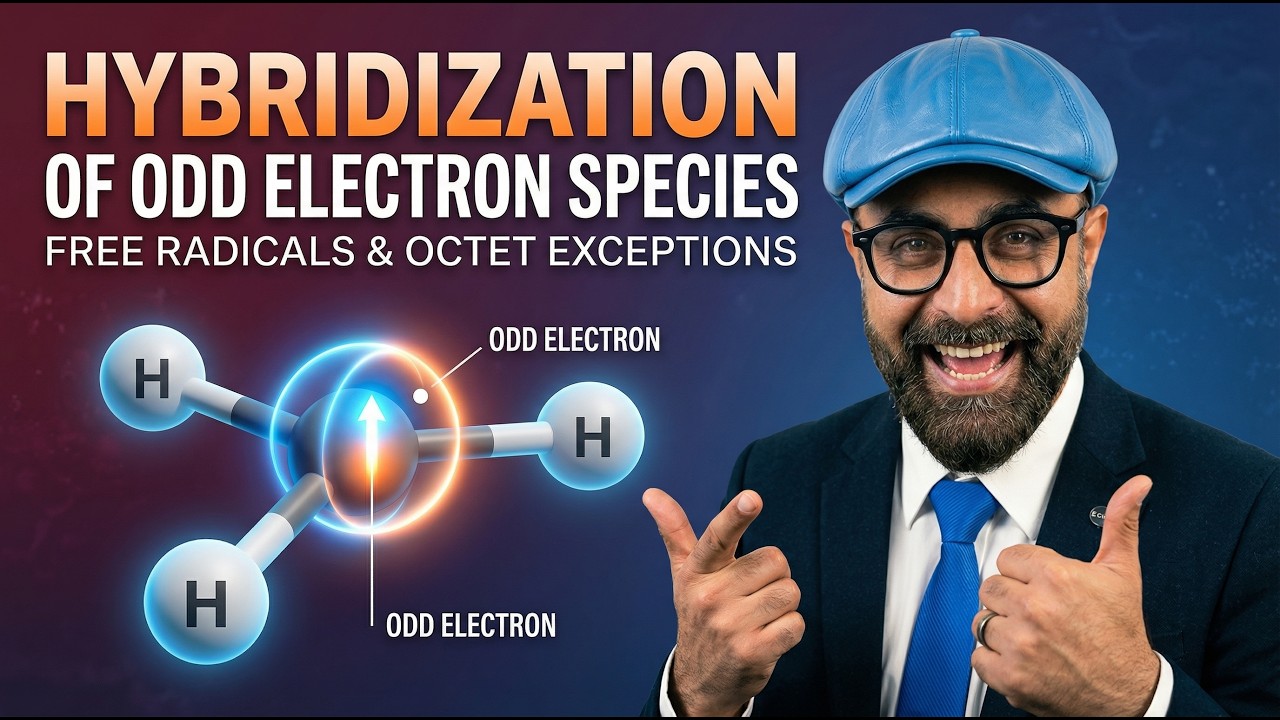
L-3: hybridization of odd electron species
Автор: ChemZap
Загружено: 2021-09-03
Просмотров: 2076
Описание:
0:00-2:12 introduction of odd electron Species
2:13-2:36 Method for the determination of hybridization of odd electron species
2:37-4:36 Method (I) (a)
4:37-7:37 Method (I) (b)
7:38-9:04 Method (II) ( Example-I)
9:04-10:38 Method (II) ( Example-II)
#Hybridization of CH3 free radical an odd electron species
#Hybridization of CF3 free radical an odd electron species
#Hybridization of ClO2 free radical an odd electron species
Hybridization of ClO3 free radical an odd electron species
#bigbangcgemistry
#Hybridization of odd electron species
#Hybridization of odd electron molecules
Odd electron #bigbangchemistry # Bigbang chemistry# Hybridization
Hybridization trick: • L-1:EASY TRICK| HOW TO CALCULATE HYBRIDIZA...
Bent’s Rule: • L-2:BENT'S RULE|Sp3d-Hybridization| Easy t...
NEET important Topic: • L-1:EASY TRICK| HOW TO CALCULATE HYBRIDIZA...
There are a number odd electron molecules whose total number of valence electrons is an odd number. It is not possible for all of the atoms in such a molecule to satisfy the octet rule. An example is nitrogen dioxide. Each oxygen atom contributes six valence electrons and the nitrogen atom contributes five for a total of seventeen.
Having an odd electron in a molecule guarantees that it does not follow the octet rule, because the rule requires eight electrons (or two for hydrogen) around each atom.
The most commonly encountered stable species that exist with an odd electron are nitrogen oxides, such as nitric oxide (NO) and nitrogen dioxide (NO2), both of which are free radicals and disobey the octet rule.
Molecules in which the no of electron present is odd are called odd elctron molecules . In these molecules while writing there lewis structure an electron is left alone and the odd electron systems are generally found in nature of those of nitrogen ie no2. Also most of the odd electon systems exist in nature as dimers.
Odd-Electron Molecules There are a number of molecules whose total number of valence electron is an odd number. It is not possible for all of the atoms in such a molecule to satisfy the octet rule. An example is nitrogen dioxide (NO2).
Повторяем попытку...
Доступные форматы для скачивания:
Скачать видео
-
Информация по загрузке: