L-1:EASY TRICK| HOW TO CALCULATE HYBRIDIZATION| WITH LOTS OF EXAMPLES
Автор: ChemZap
Загружено: 2021-08-28
Просмотров: 210
Описание:
#NEET2021
HYBRIDIZATION
#sp
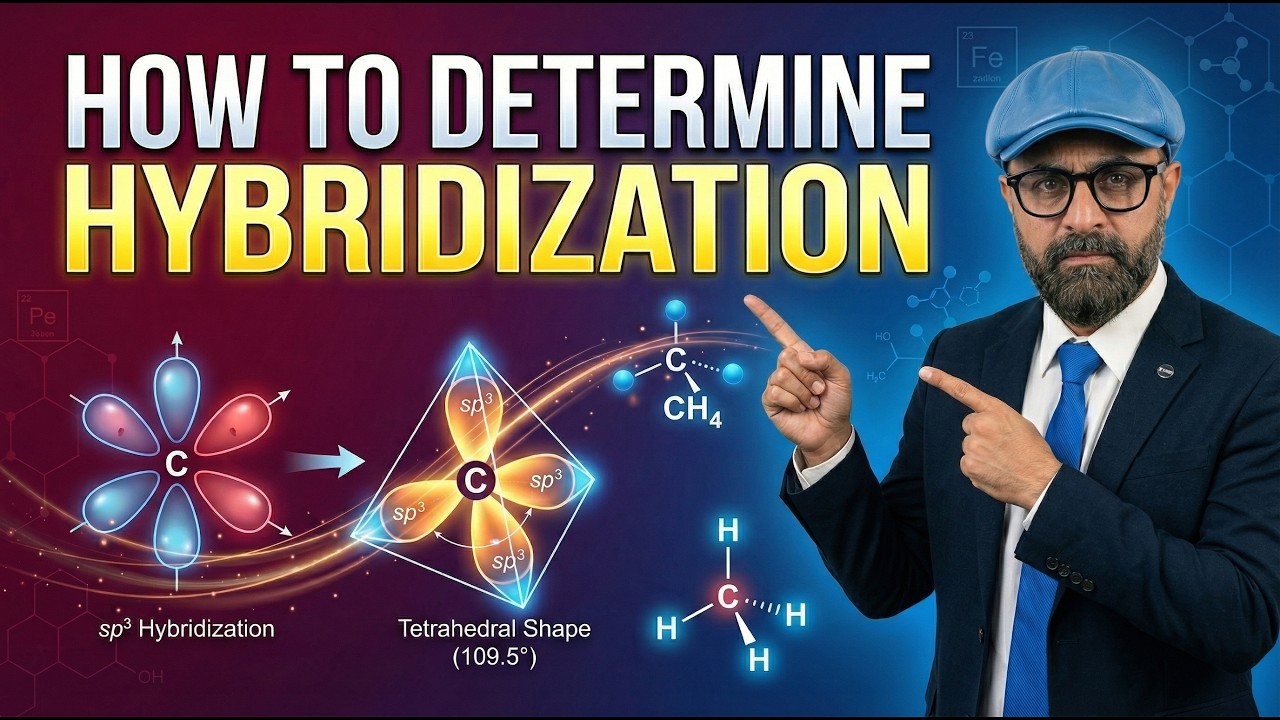
VSEPR theory is simple but remarkably powerful model for predicting molecular geometries and bond angles. While working out the shapes of molecules from this theory, it must be remembered: The theory was developed extensively by Gillespie as the Valence Shell Electron Pair Repulsion theory. This may be summarized as: The shape of the molecule is determined by repulsions between all of the electron pairs present in the valence shell.
Lone pair lone pair repulsion lone pair bond pair repulsion , bond pair ,bond pair repulsion. The magnitude of repulsions between bonding pairs of electrons depends on the electronegativity difference between the central atom and the other atoms. Double bonds cause more repulsion than single bonds, and triple bonds cause more repulsion than a double bond. Effect of Lone Pairs: Molecules with four electron pairs in their outer shell are based on a tetrahedron. In CH4 there are four bonding pairs of electrons in the outer shell of the C atom, and the structure is a regular tetrahedron with bond angle H – C – H of 109°28’. In NH3 and N atom has four electron pairs in the outer shell, made up of three bond pairs and one lone pair. Because of the lone pair, the bond angle H – N – H is reduced from the theoretical tetrahedral angle of 109°28’ to 107°28’. In H2O the O atom has four electron pairs in the outer shell. The shape of the H2O molecule is based on a tetrahedron with two corners occupied by bond pairs and the other two corners occupied by lone pairs. The presence of two lone pairs reduces the bond angle further to 104°27’. It is the mathematically fabricated concept that is introduced to explain the geometry and shapes of the covalent molecules of polyatomic ions containing covalent bonds. Thus hybridization may precisely be defined as the phenomenon of mixing up (or merging) of orbitals of an atom of nearly equal energy, giving rise to entirely new orbitals equal in number to the mixing orbitals and having same energy contents and identical shapes For hybridization to occur, it is necessary for the atom to satisfy the following conditions: 1. Orbitals on a single atom only would undergo hybridization. 2. There should be very little difference of energy level between the orbitals mixing to form hybrid orbitals. 3. Number of hybrid orbitals generated is equal to the number of hybridizing orbitals. 4. The hybrid orbitals assume the direction of the dominating orbitals. For example, if s and p orbitals are to hybridize, the s orbital having no directional character, does not contribute towards the direction when p orbitals determine the directional character of the hybrid orbitals. 5. It is the orbitals that undergo hybridization and not the electrons. . This theory was proposed by Linus Pauling, who was awarded the Noble Prize for Chemistry 1954. Atoms with unpaired electrons tend to combine with other atoms which also have unpaired electrons. In this way, the unpaired electrons are paired up, and the atoms involved, all attain a stable electronic arrangement. This is usually a full shell of electrons . Two electrons shared between two atoms constitute a bond. The number of bonds formed by an atom is usually the same as the number of unpaired electrons in the ground state, i.e. the lowest energy state. However, in some cases the atom may form more bonds than this. This occurs by excitation of the atom . when electrons which were paired in the ground state are unpaired and promoted into suitable empty orbitals. This increases the number of unpaired electrons, and hence it increases number of bond which can be formed. Heitler and London believed that electron cloud of the valence orbital on one atom ‘overlaps’ the electron cloud of the other bonding atom to form a covalent linkage. The theory of ‘maximum overlap’, affords an excellent interpretation of covalent bond formation. The essential conditions for the overlap of electron waves of orbitals are:
The orbitals entering into combination must have only one electron or unpaired electron.i.e.the no of covalent formed by an atom of an element is always equal to the no of unpaired electron. II-The atoms with valence or bonding orbital (half-filled) should approach sufficiently close to one another with the axis of their orbitals in proper alignment. i.e. • The strength of a covalent bond depends upon the extent of overlapping. Greater the overlapping between the atomic orbitals stronger is the bond formed between the two atoms.
A stronger bond has, therefore, a shorter bond length. • Since the overlapping of atomic orbitals involves a release of energy, it must produce a stabilizing effect on the system. The merger or overlapping of the atomic orbitals halts at a stage when the atomic nuclei have come close enough to exercise a repulsive force on one another, which exactly balances the force of merger. This equilibrium distance at which the two atomic nuclei are now held is called the Bond length.
Повторяем попытку...
Доступные форматы для скачивания:
Скачать видео
-
Информация по загрузке:


