Undying Spirits Korean Shamanism - Muism
Автор: Synara Now
Загружено: 2025-10-16
Просмотров: 41
Описание:
From the misty mountains of prehistory to the glowing skyline of modern Seoul, Korean Shamanism (Muism) stands as one of the world’s oldest and most resilient living spiritual traditions. It has survived colonization, modernization, and religious suppression, adapting at every turn while remaining rooted in Korea’s mythic origins and communal heart.
Ancient Origins
Muism traces its lineage back to Korea’s founding myth. The first kingdom, Gojoseon, was said to have been founded by Dangun, the divine child of a heavenly god and an earthly mother. This legend enshrines shamanic ideas of harmony between heaven, earth, and humanity—core principles that still define Muism today. Early shamans were seen as descendants of gods, mediating between the human world and the spirit realm. Before written religion or organized temples, Koreans turned to shamans for rain, healing, protection, and communication with ancestors. Muism was—and remains—a religion of the people, grounded in nature, emotion, and everyday life.
Mudang and the Gut Ritual
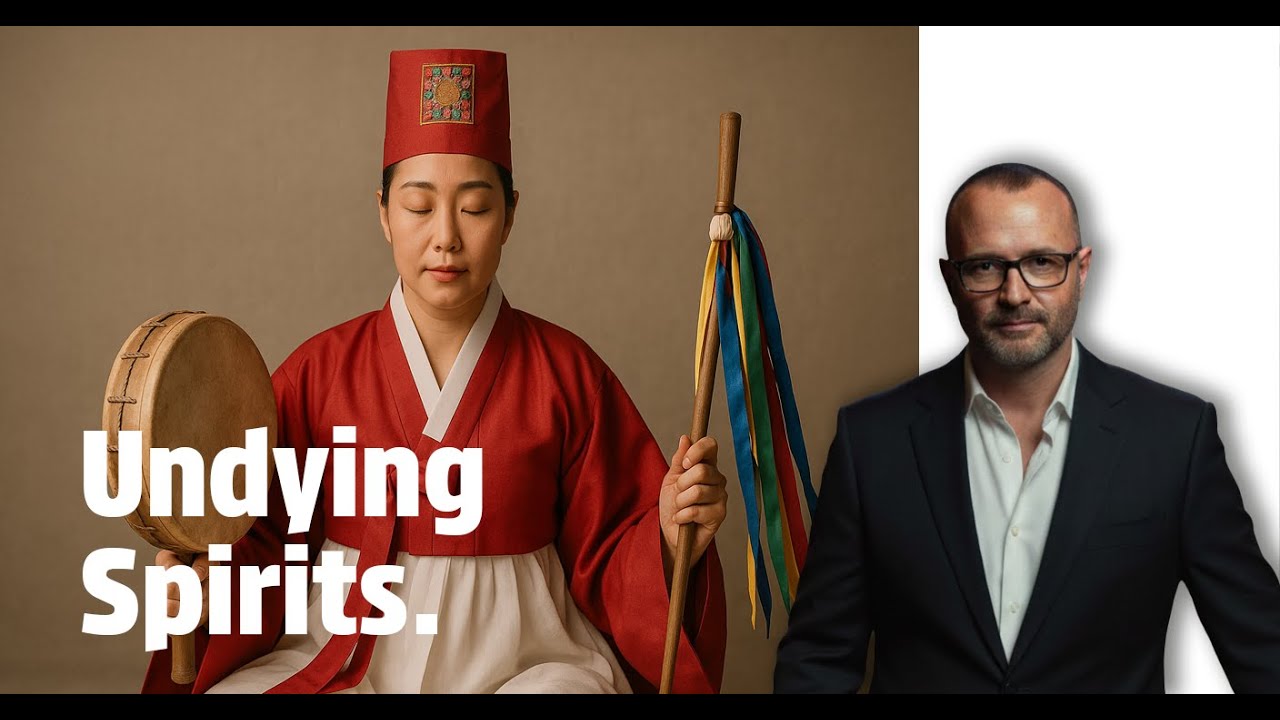
At the center of Muism are the mudang, most often women, who act as channels between humans and the spirits. Their rituals, called gut, are dazzling ceremonies that combine song, dance, drumming, costume, and offerings to appease divine beings or ancestral ghosts. A gut may bless a newborn, guide a soul to the afterlife, or heal the sick. Some mudang enter trances, allowing deities to speak through them, while others perform symbolic storytelling and dance. One of the best-known rites features the Tale of Princess Pari, a shamanic myth about guiding lost souls to peace. Through these vibrant performances, shamans provide not only spiritual service but emotional catharsis—a communal form of therapy centuries before psychology existed.
Blending with Other Traditions
Muism’s survival owes much to its adaptability. When Buddhism arrived in the 4th century, Koreans embraced both traditions seamlessly. Shamanic deities found parallels in Buddhist bodhisattvas, and many mudang still display Buddhist icons on their altars. The 7th-century monk Wonhyo even taught that truth could exist in all paths, reflecting Korea’s syncretic spirit. Later, during the Joseon Dynasty (1392–1910), Confucianism became state orthodoxy, and officials denounced shamanism as superstition. Yet despite bans and taxes, Muism persisted underground—because when misfortune struck, even the elite quietly sought the mudang’s help.
The Donghak Revolution and Cheondoism
In the 19th century, shamanic ideas inspired new reformist movements. Choe Je-u, a visionary scholar, founded Donghak (“Eastern Learning”) after a divine revelation from Haneullim, the Heavenly Lord of Korean belief. Choe’s teachings blended shamanism, Buddhism, Confucian ethics, and Daoist philosophy, declaring that divinity resides within all people. His movement called for equality and moral renewal, uniting peasants in a massive 1894 uprising. Though Choe was executed, his ideas survived in Cheondoism, an official religion that still honors Hananim (Heavenly God) and maintains rituals echoing ancient gut ceremonies.
Modern Decline and Revival
Under Japanese colonial rule and during South Korea’s rapid modernization, shamanism was ridiculed as primitive. Yet, remarkably, it endured. Since the 1980s, Muism has experienced a vibrant revival, with scholars, artists, and the government recognizing it as an essential part of national heritage. Certain regional gut rituals have been declared Intangible Cultural Properties, preserving them as both performance art and sacred tradition. Today, an estimated 200,000 mudang practice across South Korea—from rural shrines to high-rise apartments. Muism’s influence is visible in film, K-pop, fashion, and contemporary art. Even some Korean Christian revivals unconsciously mirror shamanic ecstatic prayer and spirit possession.
A Living Bridge Between Worlds
Muism’s power lies in its ability to evolve while staying true to its essence: the belief that the spirit world is real, present, and deeply intertwined with daily life. It celebrates connection—between the living and the dead, humanity and nature, tradition and modernity. For many Koreans, it offers a spiritual authenticity that neither modern religion nor technology can replace.
From Dangun’s divine birth to Seoul’s neon-lit shrines, Muism tells a story of endurance, transformation, and identity. It’s not a relic of superstition but a mirror of Korea’s soul—mystical yet modern, ancient yet alive. Today, as shamans drum beneath skyscrapers and mountain spirits linger in the wind, Muism continues to remind us that spirituality, like Korea itself, is ever-changing yet eternal.
Повторяем попытку...
Доступные форматы для скачивания:
Скачать видео
-
Информация по загрузке: