Chimes of Freedom
Автор: Mamen Wilson
Загружено: 2020-05-04
Просмотров: 446
Описание:
Throughout 1963, Dylan worked on a novel and a play. A number of publishers were interested in signing Dylan to a contract, and at one point, City Lights (a small but prestigious company specializing in poetry) was strongly considered. However, as Dylan worked on his book at a casual pace, his manager, Albert Grossman, decided to make a deal with a major publisher.
Macmillan's senior editor, Bob Markel, said, "We gave [Dylan] an advance for an untitled book of writings … The publisher was taking a risk on a young, untested potential phenomenon." When Markel met with Dylan for the first time, "there was no book at the time … The material at that point was hazy, sketchy. The poetry editor called it 'inaccessible.' The symbolism was not easily understood, but on the other hand it was earthy, filled with obscure but marvelous imagery … I felt it had a lot of value and was very different from Dylan's output till then. [But] it was not a book."
It would be years before Dylan finished his book, but the free form poetry experiments that came from it eventually influenced his songwriting. The most notable example came in a six-line coda to a poem responding to President John F. Kennedy's assassination (which took place on November 22, 1963):
the colors of Friday were dull / as cathedral bells were gently burnin / strikin for the gentle / strikin for the kind / strikin for the crippled ones / an strikin for the blind
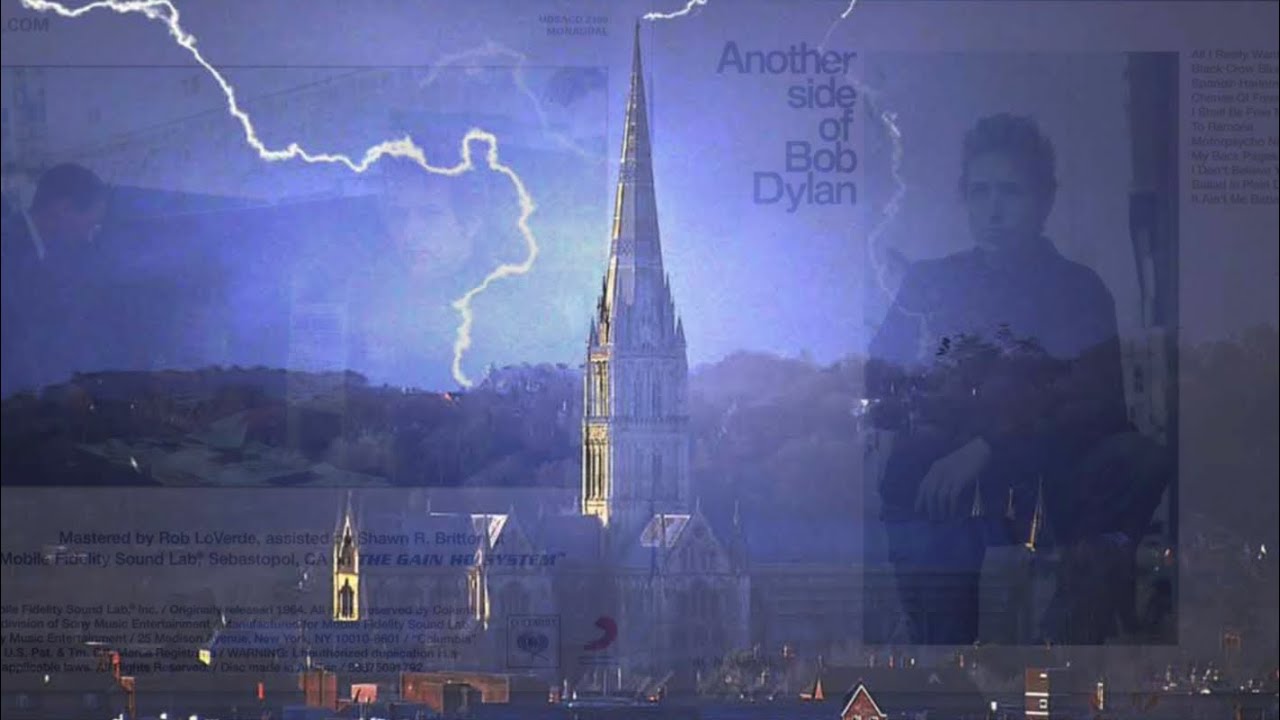
This refrain would soon appear in a very important composition, "Chimes of Freedom", and, as biographer Clinton Heylin writes, "with this sad refrain, Dylan would pass from topical troubadour to poet of the road."
Some commentators and Dylan biographers have assessed the song as one of Dylan's most significant compositions, and critic Paul Williams has described it as Dylan's Sermon on the Mount.
It was influenced by nineteenth century French siymbolist Arthur Rimbaud, specially the poem Vowels this harmony between words created starling visions specially when it came to exalting the humanity of the innocent,people who were treated unjustly. You can also see an analogy to the hallucinatory poetic vision to willian Blake, populate with biblical images, or a transposition of Sakespeare’s King Lear.
(From the book Bob Dylan The story behind every track All The songs)
A lo largo de 1963, Dylan trabajó en una novela y una obra de teatro. Varios editores estaban interesados en firmar un contrato con Dylan, y en un momento, City Lights (una pequeña pero prestigiosa empresa especializada en poesía) fue muy considerada. Sin embargo, mientras Dylan trabajaba en su libro a un ritmo casual, su gerente, Albert Grossman , decidió hacer un trato con una editorial importante.
El editor principal de Macmillan, Bob Markel, dijo: "Le dimos a [Dylan] un adelanto para un libro de escritos sin título ... El editor estaba arriesgando un fenómeno potencial joven y no probado". Cuando Markel se reunió con Dylan por primera vez, "no había libro en ese momento ... El material en ese momento era nebuloso, incompleto. El editor de poesía lo calificó de" inaccesible ". El simbolismo no se entendía fácilmente, pero por otro lado era terroso, lleno de imágenes oscuras pero maravillosas ... Sentí que tenía mucho valor y era muy diferente de la producción de Dylan hasta entonces. [Pero] no era un libro. "
Pasarían años antes de que Dylan terminara su libro, pero los experimentos de poesía de forma libre que surgieron de él eventualmente influyeron en su composición. El ejemplo más notable vino en una coda de seis líneas de un poema que respondía al asesinato del presidente John F. Kennedy (que tuvo lugar el 22 de noviembre de 1963):
los colores del viernes eran aburridos / como las campanas de la catedral se quemaban suavemente / golpeaban para los gentiles / golpeaban para los amables / golpeaban para los lisiados / tocaban para los ciegos
Este estribillo aparecería pronto en una composición muy importante, " Campanadas de libertad ", y, como escribe el biógrafo Clinton Heylin, "con este estribillo triste, Dylan pasaría de trovador tópico a poeta del camino".
"Chimes of Freedom" de Bob Dylan es una canción típica de su período rebelde, de la que se sirvió mucho en Another Side of Bob Dylan . Fue escrito en 1964 y está influenciado por la poesía simbolista de Arthur Rimbaud. Su tema reflexiona sobre la injusticia del trato a las personas oprimidas, mientras cita el trueno retumbante como llorar por ellos.
" Mr. Tambourine Man " comparte un nicho con esta canción, siendo la otra canción de Dylan influenciada por la poesía de Rimbaud y también escrita aproximadamente al mismo tiempo.
Algunos los comentaristas y los biógrafos de Dylan han evaluado la canción como una de las composiciones más significativas de Dylan, y el crítico Paul Williams la describió como el Sermón del Monte de Dylan .
Fue influenciado por el simbolista francés del siglo XIX Arthur Rimbaud, especialmente el poema Vowels.
Повторяем попытку...

Доступные форматы для скачивания:
Скачать видео
-
Информация по загрузке:





![[Playlist] 존 바에즈 대표곡 모음](https://imager.clipsaver.ru/uk8MWF_G7zQ/max.jpg)