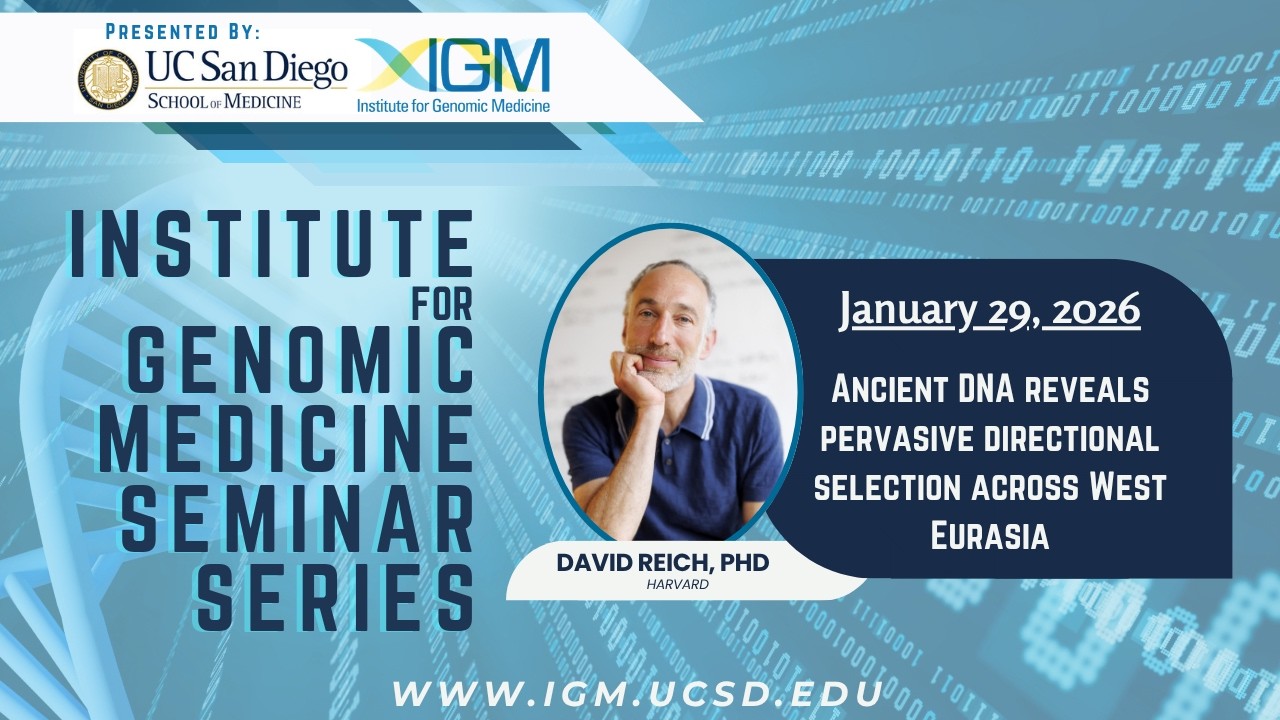
IGM Seminar Series: Dr. David Reich, PhD - January 29th, 2026
Автор: IGM UCSD
Загружено: 2026-03-05
Просмотров: 20
Описание:
"Ancient DNA reveals pervasive directional selection across West Eurasia" - Dr. David Reich, January 29th, 2026 @ IGM Seminar Series, UC San Diego.
Ancient DNA has transformed our understanding of the past by revealing previously unknown populations and migrations, but its potential to reveal as much about biology as history has not been realized because estimating the frequencies of alleles with enough precision to detect significant shifts over time requires large sample sizes, and because it has been unclear how to distinguish subtle allele frequency shifts due to population structure and widespread impacts of non-adaptive purifying or stabilizing selection, from genuine cases of directional selection. We present a method for detecting natural selection in ancient DNA time-series data by leveraging a consistent trend in allele frequency change over time. By applying this to 15836 West Eurasians who lived over the past 18000 years and 6438 contemporary people, we find an order of magnitude more genome-wide significant signals than previous studies: 479 independent loci with 99% probability of selection. Previous work showed that classic hard sweeps driving advantageous mutations to fixation have been rare over the broad span of human evolution, but in the last ten millennia, many hundreds of alleles have been affected by strong directional selection: sustained rises in frequency in a direction that increases fitness in carriers. Discoveries include an increase from ~0% to ~20% in 4000 years for the major risk factor for celiac disease at HLA-DQB1; a rise from ~0% to ~8% in 6000 years of blood type B; and fluctuating selection at the TYK2 tuberculosis risk allele rising from ~2% to ~9% from ~5500 to ~3000 years ago before dropping to ~3%. We identify instances of coordinated selection on alleles affecting the same trait, with the polygenic score today predictive of body fat percentage decreasing by around a standard deviation over ten millennia. We also identify selection for combinations of alleles that are today associated with lighter skin color, lower risk for schizophrenia and bipolar disease, slower health decline, and increased measures related to cognitive performance (scores on intelligence tests, household income, and years of schooling). These traits are measured in modern industrialized societies, so what phenotypes were adaptive in the past is unclear. We estimate selection coefficients at 9.7 million variants, enabling study of how Darwinian forces couple to allelic effects and shape the genetic architecture of complex traits.
Повторяем попытку...
Доступные форматы для скачивания:
Скачать видео
-
Информация по загрузке: