Lecture 8: Beam–Specimen Interactions and the Interaction Volume in SEM
Автор: Science Tech Engineering and Math with Dr. Tiwari
Загружено: 2026-02-13
Просмотров: 9
Описание:
In this lecture, we complete the resolution framework of scanning electron microscopy by examining the third and often dominant limiting factor: the interaction volume.
In Lecture 7, we established that SEM resolution depends on probe size and pixel size. However, even a perfectly focused probe and optimal sampling cannot overcome the physics of what happens once electrons enter the specimen. From that moment, beam–specimen interactions determine how the signal is generated and from where it originates.
We begin at the atomic scale by distinguishing between the two fundamental scattering processes:
• Elastic scattering — direction changes without significant energy loss
• Inelastic scattering — energy transfer from the incident electron to the specimen
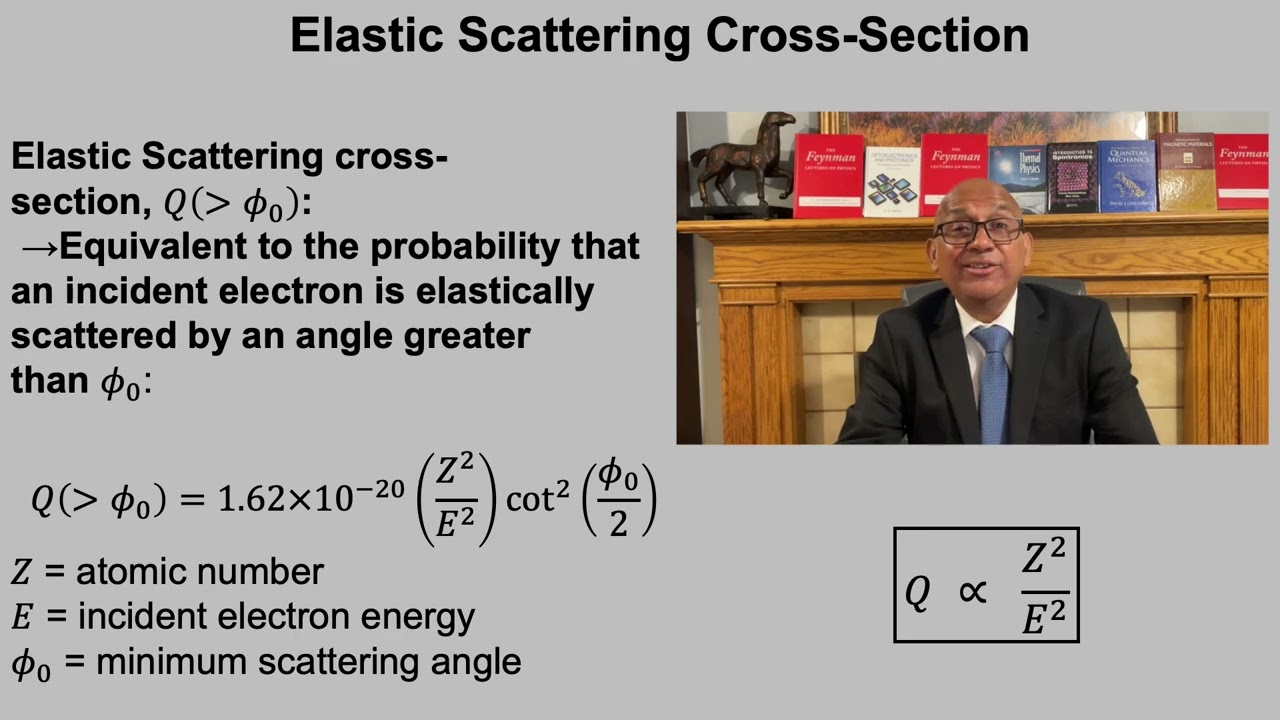
Elastic scattering is dominated by interactions with atomic nuclei. It causes beam spreading, lateral broadening of the probe with depth, and generation of backscattered electrons (BSE). The probability of elastic scattering increases strongly with atomic number (approximately proportional to Z²) and decreases with increasing beam energy. This explains why heavy elements appear brighter in BSE images and why higher accelerating voltages increase penetration depth.
We introduce the concept of the elastic mean free path, which describes how frequently electrons are deflected inside a material and directly influences interaction volume size.
In contrast, inelastic scattering governs signal generation. Energy transferred to the specimen can produce:
• Secondary electrons (SE)
• Characteristic X-rays (basis of EDX/EDS analysis)
• Auger electrons
• Phonon excitations and local heating
By placing elastic and inelastic processes side by side, we clarify their distinct roles:
elastic scattering controls beam spreading and interaction volume geometry,
while inelastic scattering controls what signals are generated.
We then introduce the interaction volume — the characteristic teardrop-shaped region beneath the specimen surface where scattering events occur. Its size depends on:
• Accelerating voltage
• Atomic number
• Density
Higher beam energies increase penetration depth. Higher atomic number and density confine the interaction volume closer to the surface.
A crucial insight of this lecture is that different signals originate from different depths within this interaction volume:
• Secondary electrons: ~1–5 nm (extremely surface sensitive, high-resolution topography)
• Backscattered electrons: tens to hundreds of nanometers (Z-contrast, compositional imaging)
• X-rays: up to microns (compositional analysis, lower spatial resolution)
• Auger electrons: ~1–2 nm (extreme surface sensitivity)
We define and interpret two important measurable coefficients:
• Backscattered coefficient (η): number of BSE divided by incident electrons
• Secondary electron coefficient (δ): number of SE divided by incident electrons
We examine the monotonic relationship between η and atomic number, which produces Z-contrast in BSE imaging. We also discuss why the slope of η vs Z flattens at high Z, reducing contrast between heavy elements.
By the end of this lecture, students understand that SEM resolution is fundamentally limited by three coupled factors:
• Probe size (electron optics)
• Pixel size (sampling)
• Interaction volume (beam–specimen physics)
Improving one factor cannot compensate for limitations in the others. True high-resolution SEM requires coordinated optimization of optics, sampling, and beam–specimen interaction conditions.
This lecture provides the physical foundation for interpreting SEM contrast correctly and for understanding the limits of compositional and surface analysis.
📌 Course: MSE 3011 – Structural Analysis of Materials
🎓 Instructor: Prof. Ashutosh Tiwari, University of Utah
#MaterialsScience
#StructuralAnalysis
#ElectronMicroscopy
#SEM
#BeamSpecimenInteraction
#BackscatteredElectrons
#SecondaryElectrons
#InteractionVolume
#MaterialsCharacterization
#Nanomaterials
#EngineeringEducation
#UniversityOfUtah
#MSE3011
Повторяем попытку...
Доступные форматы для скачивания:
Скачать видео
-
Информация по загрузке: