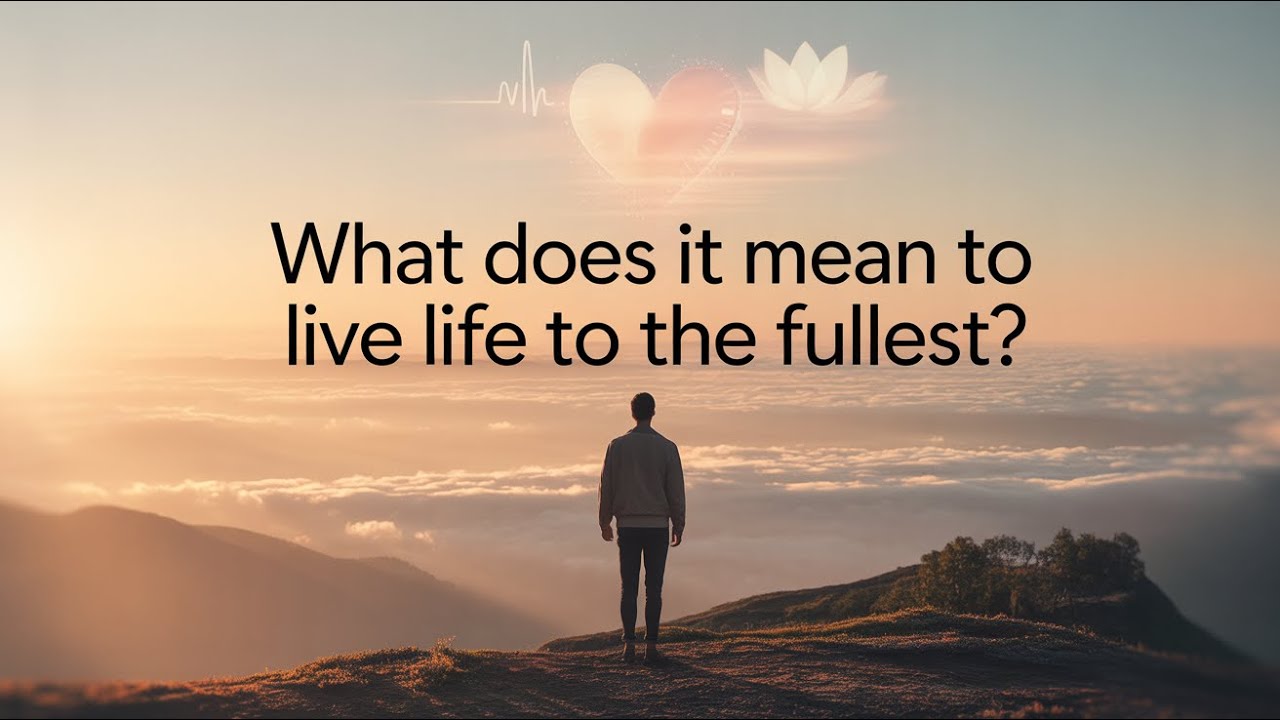
What Does It Mean To Live Life To The Fullest?
Автор: Bond & Bondage Helpline
Загружено: 2026-02-15
Просмотров: 58
Описание:
In a world obsessed with hustle culture, bucket lists, and endless self-improvement, we’ve lost sight of what it truly means to live fully. This video dives beyond social media slogans and motivational clichés—into the deep psychological and philosophical roots of a meaningful life.
Drawing from existential psychology, mindfulness research, and contemplative philosophy, we’ll explore how to live with intention, presence, and compassion—without chasing endless pleasure or external validation.
What You’ll Learn:
🌱 The difference between hedonic and eudaimonic well-being (Ryan & Deci, 2001)
🧘 How mindfulness rewires the brain for presence and emotional regulation (Kabat-Zinn, 1990; Khoury et al., 2013)
💡 Why values-based living (ACT Therapy) builds true fulfillment, not avoidance of pain
❤️ How connection and compassion predict lifelong happiness (Harvard Study of Adult Development)
💀 Why reflecting on mortality can awaken purpose, meaning, and gratitude
This is not a motivational speech—it’s a synthesis of empirical psychology, existential philosophy, and spiritual insight. By the end, you’ll understand that living life to the fullest isn’t about doing more—it’s about being more: more awake, more loving, more intentional.
Mindfulness, Eudaimonia, Positive Psychology, Existential Psychology, Acceptance and Commitment Therapy, Thich Nhat Hanh, Viktor Frankl, Loving-Kindness, Harvard Adult Development Study, Meaning vs Pleasure, Purpose, Self-Determination Theory, Psychological Flexibility, Well-Being, Personal Growth
#Mindfulness #Psychology #MeaningfulLife #Eudaimonia #ACT #Meditation #Existentialism #PositivePsychology #Purpose #Compassion #SelfGrowth
References:
Deci, E. L., & Ryan, R. M. (2000). The "what" and "why" of goal pursuits: Human needs and the self-determination of behavior. Psychological Inquiry, 11(4), 227–268.
Fredrickson, B. L., et al. (2008). Open hearts build lives: Positive emotions, induced through loving-kindness meditation, build consequential personal resources. Journal of Personality and Social Psychology, 95(5), 1045–1062.
Fredrickson, B. L., et al. (2013). A functional genomic perspective on human well-being. Proceedings of the National Academy of Sciences, 110(33), 13684–13689.
Gloster, A. T., et al. (2017). Psychological flexibility mediates the relation between self-concealment and mental health. Journal of Contextual Behavioral Science, 6(2), 141–147.
Hayes, S. C., Strosahl, K. D., & Wilson, K. G. (1999). Acceptance and Commitment Therapy: An experiential approach to behavior change. Guilford Press.
Kabat-Zinn, J. (1990). Full Catastrophe Living: Using the Wisdom of Your Body and Mind to Face Stress, Pain, and Illness. Delacorte.
Kashdan, T. B., & McKnight, P. E. (2009). Origins of purpose in life: Refining our understanding of a life well lived. Current Directions in Psychological Science, 18(6), 289–292.
Killingsworth, M. A., & Gilbert, D. T. (2010). A wandering mind is an unhappy mind. Science, 330(6006), 932.
Khoury, B., et al. (2013). Mindfulness-based therapy: A comprehensive meta-analysis. Clinical Psychology Review, 33(6), 763–771.
Pyszczynski, T., Greenberg, J., & Solomon, S. (2004). Why do people need self-esteem? A theoretical and empirical review. Psychological Bulletin, 130(3), 435–468.
Routledge, C., & Juhl, J. (2010). Death awareness enhances the enjoyment of life’s small pleasures. Personality and Social Psychology Bulletin, 36(8), 1132–1140.
Ryff, C. D., & Keyes, C. L. (1995). The structure of psychological well-being revisited. Journal of Personality and Social Psychology, 69(4), 719–727.
Waldinger, R. J., & Schulz, M. S. (2010). What's love got to do with it? Social functioning, perceived health, and daily happiness in married octogenarians. Psychology and Aging, 25(2), 422–431.
Yalom, I. D. (1980). Existential Psychotherapy. Basic Books.
Повторяем попытку...
Доступные форматы для скачивания:
Скачать видео
-
Информация по загрузке: