How Does a Strain Gage Load Cell Work?
Автор: Micro-Measurements - a VPG Brand
Загружено: 2025-05-23
Просмотров: 8835
Описание:
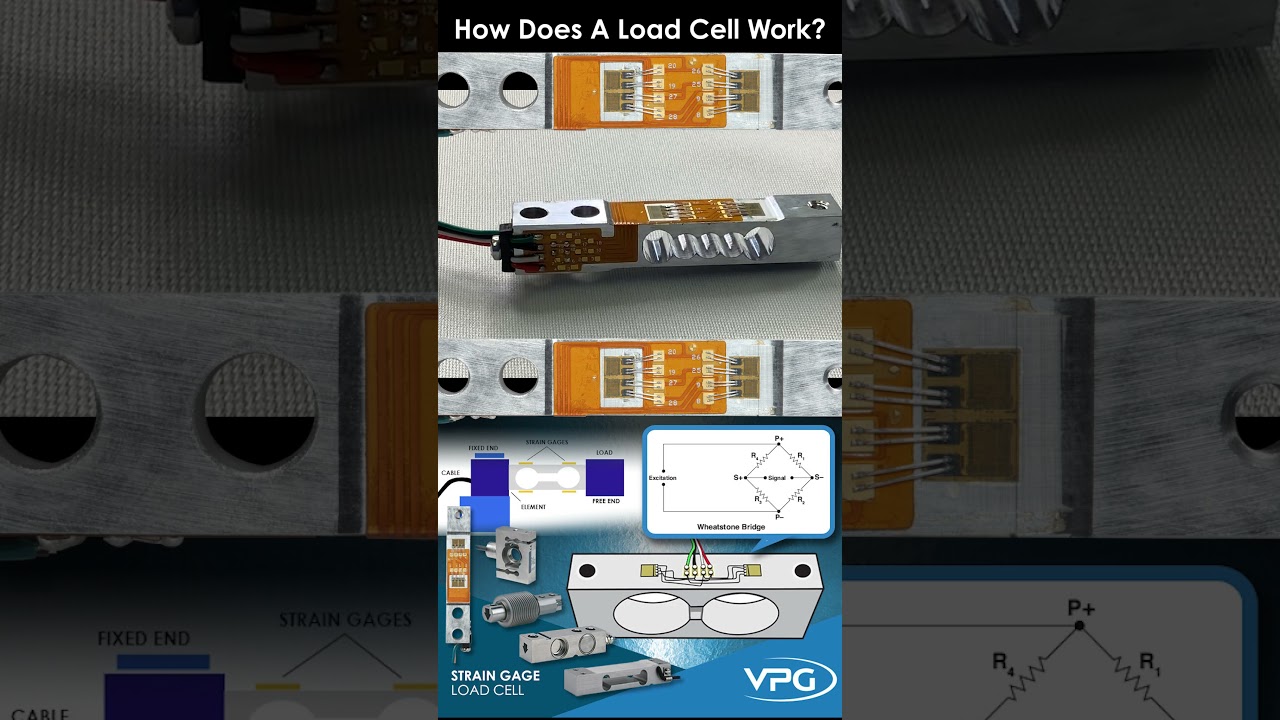
At the heart of most high-precision force measurement systems is the strain gage-based transducer, which is a mechanical component that converts force into an electrical signal.
When force is applied to the load cell, it causes minute deformations in its structure. Strain gages, bonded to specific regions of the load cell, detect these deformations as changes in electrical resistance. These resistance changes are typically measured using a Wheatstone bridge circuit, producing a voltage (or sometimes current) output proportional to the applied force. This output can be analog or digitized, depending on the design.
Load cells come in various types to suit different applications:
🔹 Tension Load Cells measure pulling forces (forces that try to stretch or separate).
🔹 Compression Load Cells measure pushing forces (forces that compress or squeeze).
🔹 Shear Load Cells detect forces that are applied off-axis, creating internal sliding.
Each type is engineered with a specific geometry and sensing orientation to match its application, providing the ability to weigh nearly anything from micrograms to megatons!
Повторяем попытку...
Доступные форматы для скачивания:
Скачать видео
-
Информация по загрузке: