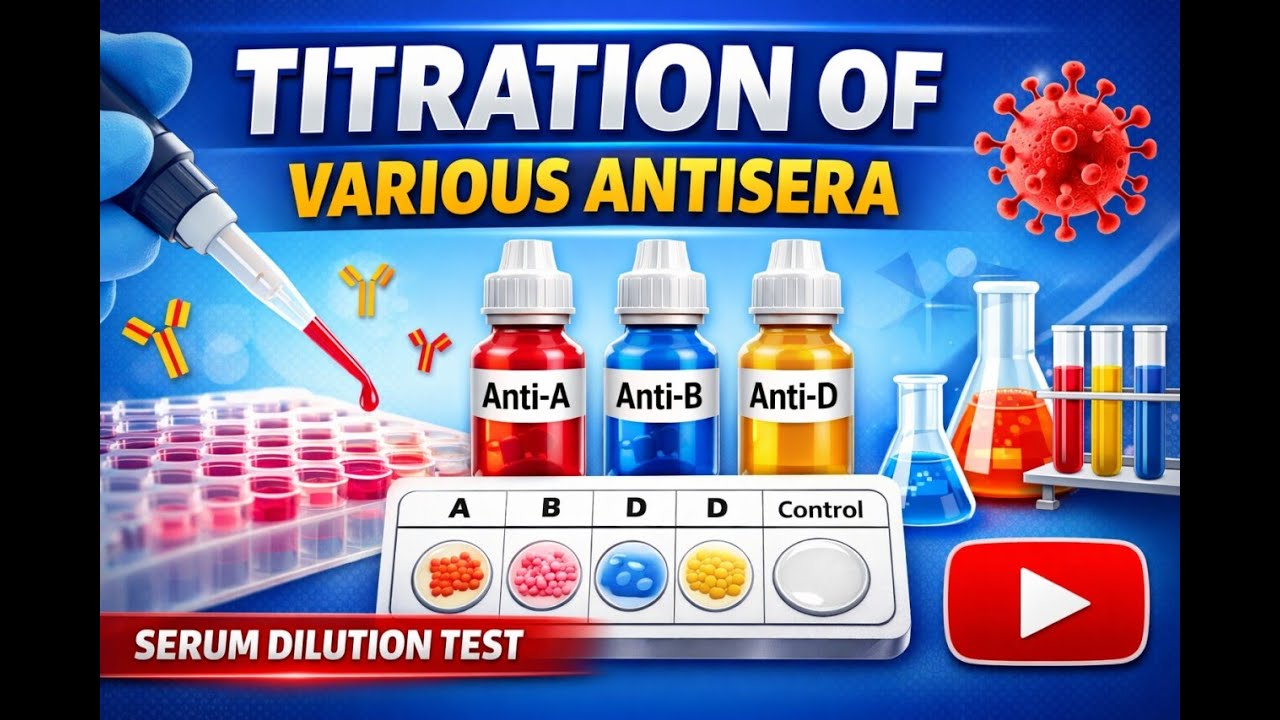
Titration of Various Antisera | Principle, Procedure & Interpretation
Автор: Fakirsir
Загружено: 2026-01-21
Просмотров: 43
Описание:
TITRATION OF VARIOUS ANTISERA
Definition
Titration of antisera is a laboratory procedure used to determine the highest dilution of an antiserum that still produces a visible antigen–antibody reaction (agglutination or precipitation).
This dilution is called the antibody titre.
________________________________________
Purpose / Importance of Antisera Titration
• To determine strength (potency) of antisera
• To standardize antisera before use
• To ensure accuracy in serological tests
• To compare different batches of antisera
• To avoid false positive or false negative results
________________________________________
Principle
When antiserum is serially diluted and reacted with a known antigen, the highest dilution showing a positive reaction represents the titre of that antiserum.
Antigen–antibody reaction is observed as:
• Agglutination (clumping)
• Precipitation
• Hemolysis (in some systems)
________________________________________
Types of Antisera Commonly Titrated
1. Blood Group Antisera
o Anti-A
o Anti-B
o Anti-AB
o Anti-D (Rh)
2. Bacterial Antisera
o Widal antisera (O & H)
o Brucella antisera
o Weil-Felix antisera
3. Viral Antisera
o Dengue antisera
o Hepatitis antisera
4. Other Antisera
o ASO (Anti-streptolysin O)
o CRP antisera
________________________________________
Materials Required
• Specific antiserum to be tested
• Known antigen (RBC suspension or bacterial antigen)
• Normal saline
• Test tubes or microtiter plate
• Micropipettes / droppers
• Water bath / incubator (if required)
• Centrifuge (for blood grouping antisera)
________________________________________
General Procedure for Titration of Antisera
Step 1: Preparation of Serial Dilutions
• Label test tubes (1:2, 1:4, 1:8, 1:16, 1:32, etc.)
• Add equal volume of saline to each tube
• Add antiserum to the first tube
• Perform two-fold serial dilutions
________________________________________
Step 2: Addition of Antigen
• Add equal volume of specific antigen to each tube
o RBC suspension for blood group antisera
o Bacterial antigen for Widal, Brucella, etc.
________________________________________
Step 3: Incubation
• Incubate at room temperature or 37°C as required
• Time varies from 15 minutes to 2 hours
________________________________________
Step 4: Observation
• Observe for agglutination or precipitation
• Record the last tube showing visible reaction
________________________________________
Result Interpretation
• The highest dilution showing positive reaction is the titre of antiserum
• Example:
o Agglutination seen up to 1:64
o No reaction at 1:128
o Titre = 1:64
________________________________________
Specific Examples
________________________________________
1. Titration of Blood Group Antisera (Anti-A / Anti-B)
Antigen: Known A or B red cells (2–5% suspension)
Procedure Highlights
• Serial dilution of antisera
• Add RBC suspension
• Centrifuge gently
• Observe for agglutination
Result
• Highest dilution with agglutination = antibody titre
________________________________________
2. Titration of Widal Antisera
Antigens Used
• Salmonella Typhi O & H antigens
Procedure
• Serial dilution of antisera
• Add bacterial antigen
• Incubate at 37°C for 16–18 hours
Significance
• Used to standardize antisera for enteric fever diagnosis
________________________________________
3. Titration of Brucella Antisera
• Similar serial dilution method
• Positive reaction = granular agglutination
• Used for diagnosis of brucellosis
________________________________________
4. ASO Antisera Titration
• Detects antibodies against streptolysin-O
• Helps in diagnosis of rheumatic fever
• Titre above normal indicates recent streptococcal infection
________________________________________
Precautions
• Use clean and dry glassware
• Prepare accurate dilutions
• Use fresh antigen
• Avoid contamination
• Read results under proper lighting
• Do not shake tubes vigorously
________________________________________
Sources of Error
• Improper dilution
• Weak or expired antiserum
• Incorrect antigen concentration
• Wrong incubation conditions
________________________________________
Clinical & Laboratory Significance
• Ensures quality control of antisera
• Improves diagnostic accuracy
• Essential in blood bank and microbiology labs
• Helps in standardization of serological reagents
________________________________________
Conclusion
Titration of antisera is a fundamental immunological technique used to determine the potency of antibodies. Proper titration ensures reliability, reproducibility, and accuracy of serological tests in clinical and diagnostic laboratories.
Повторяем попытку...
Доступные форматы для скачивания:
Скачать видео
-
Информация по загрузке: