What does PPC do?
Автор: Alexandra - Applied Linguistics
Загружено: 2024-04-17
Просмотров: 45
Описание:
This is the fourth instalment of the series (video 4/5).
Here, we are going to explain the benefits of plurilingual and pluricultural competence (PPC).
Key points (with references):
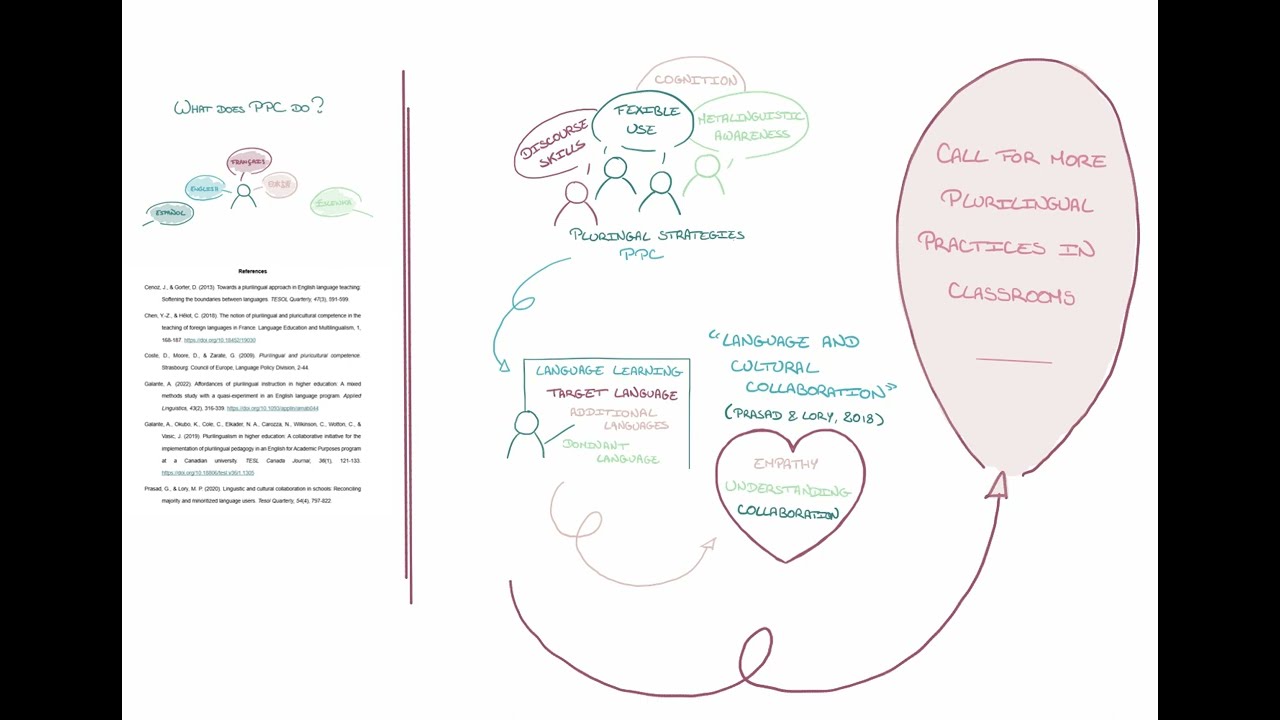
Supporting learners’ PPC by using plurilingual approaches in the language classroom can greatly benefit them (Galante, 2019).
PPC allows speakers to use their whole linguistic repertoire instead of being constrained to strictly monolingual forms of speech (Coste et al., 2009).
Flexible language use and plurilingual practices helps improve discourse skills (Cenoz & Gorter, 2013).
Flexible language use also helps improve speakers’ linguistic and metalinguistic awareness (Coste et al., 2009; Cenoz & Gorter, 2013).
Plurilingual instruction does not hinder the acquisition of the target language (Galante, 2022).
PPC allows learners to learn and use new languages without hindering their proficiency in their dominant language (Chen & Hélot, 2018).
Plurilingual activities help learners to develop empathy and relatability, making them more open-minded and accepting of other languages and cultures (Galante, 2022).
“Language and cultural collaboration (LCC)” presents the plurilingual repertoires of students, teachers, and parents as useful and essential learning tools. LCC creates a virtuous circle of social understanding and celebration of cultural and linguistic diversity, where students from various backgrounds can collaborate with each other no matter their linguistic or cultural differences (Prasad & Lory, 2018).
References (in APA 7th, or as close as YouTube allows):
Cenoz, J., & Gorter, D. (2013). Towards a plurilingual approach in English language teaching: Softening the boundaries between languages. TESOL Quarterly, 47(3), 591-599.
Chen, Y.-Z., & Hélot, C. (2018). The notion of plurilingual and pluricultural competence in the teaching of foreign languages in France. Language Education and Multilingualism, 1, 168-187. https://doi.org/10.18452/19030
Coste, D., Moore, D., & Zarate, G. (2009). Plurilingual and pluricultural competence. Strasbourg: Council of Europe, Language Policy Division, 2-44.
Galante, A. (2022). Affordances of plurilingual instruction in higher education: A mixed methods study with a quasi-experiment in an English language program. Applied Linguistics, 43(2), 316-339. https://doi.org/10.1093/applin/amab044
Galante, A., Okubo, K., Cole, C., Elkader, N. A., Carozza, N., Wilkinson, C., Wotton, C., & Vasic, J. (2019). Plurilingualism in higher education: A collaborative initiative for the implementation of plurilingual pedagogy in an English for Academic Purposes program at a Canadian university. TESL Canada Journal, 36(1), 121-133. https://doi.org/10.18806/tesl.v36i1.1305
Prasad, G., & Lory, M. P. (2020). Linguistic and cultural collaboration in schools: Reconciling majority and minoritized language users. Tesol Quarterly, 54(4), 797-822.
Повторяем попытку...
Доступные форматы для скачивания:
Скачать видео
-
Информация по загрузке: