ycliper

Популярное

Музыка Кино и Анимация Автомобили Животные Спорт Путешествия Игры Юмор

Интересные видео

2025 Сериалы Трейлеры Новости Как сделать Видеоуроки Diy своими руками

Топ запросов

смотреть а4 schoolboy runaway турецкий сериал смотреть мультфильмы эдисон
Скачать

Parliamentary vs Presidential system of government (Polity)

Автор: Study Glows

Загружено: 2020-03-30

Просмотров: 78705

Описание: In this video I have explained the Difference between Presidential and Parliamentary systems of Government. Indian Polity Lecture 21.

Presidential System of Government
In a presidential system, the head of the government leads an executive, that is distinct from the legislature. Here, the head of the government and the head of the state are one and the same. Also, a key feature is that the executive is not responsible to the legislature.

Features of the presidential system

The executive (president) can veto acts by the legislature.
The president has a fixed tenure and cannot be removed by a vote of no-confidence in the legislature.
Generally, the president has the power to pardon or commute judicial sentences awarded to criminals.
The president is elected directly by the people or by an electoral college.
--------------------------------------------------------------

Parliamentary System of Government
India chose a parliamentary form of government primarily because the constitution-makers were greatly influenced by the system in England. Another reason the founding fathers saw was that the parliamentary model would only work to accommodate the varied and diverse groups within our population. Also, the strict separation of powers in the presidential system would cause conflicts between the two branches, the executive and the legislature, which our newly-independent country could ill-afford.

There are more parliamentary forms of government in the world than there are presidencies. In this system, the parliament is generally supreme and the executive is responsible to the legislature. It is also known as the Cabinet form of government, and also ‘Responsible Government’.

Features of the parliamentary system

Close relationship between the legislature and the executive: Here, the Prime Minister along with the Council of Ministers form the executive and the Parliament is the legislature. The PM and the ministers are elected from the members of parliament, implying that the executive emerges out of the legislature.
Executive responsible to the legislature: The executive is responsible to the legislature. There is a collective responsibility, that is, each minister’s responsibility is the responsibility of the whole Council.
Dual executive: There are two executives – the real executive and the titular executive. The nominal executive is the head of state (president or monarch) while the real executive is the Prime Minister, who is the head of government.
Secrecy of procedure: A prerequisite of this form of government is that cabinet proceedings are secret, and not meant to be divulged to the public.
Leadership of the Prime Minister: The leader of this form of government is the Prime Minister. Generally, the leader of the party that wins a majority in the lower house is appointed as the PM.
Bicameral Legislature: Most parliamentary democracies follow bicameral legislature.
No fixed tenure: The term of the government depends on its majority support in the lower house. If the government does not win a vote of no confidence, the council of ministers has to resign. Elections will be held and a new government is formed.
 -----------------------------------------------------------------
For pdf, click on the link: https://studyglows.com/pdf/

Telegram link: https://t.me/study_glows

Follow Siddhant Agnihotri on Facebook:
  / siddhant.agnihotri.121  

Follow Rashi Singhal on Facebook:
  / urmi.singhal  

Rashi Singhal Study Glows:
  / rashi-singhal-study-glows-574385636372783  

Sid_E Connect:
  / sid_e-connect-686107645100756  
-----------------------------------------------------------------
#UPSC #IAS #Polity

Не удается загрузить Youtube-плеер. Проверьте блокировку Youtube в вашей сети.
Повторяем попытку...
Parliamentary vs Presidential system of government (Polity)

Поделиться в:

Доступные форматы для скачивания:

Скачать видео

  • Информация по загрузке:
Скачать аудио

Похожие видео

Federal and Unitary form of government | Indian Polity Lecture 22

Federal and Unitary form of government | Indian Polity Lecture 22

Indian vs American Supreme Court: Indian Polity (UPSC) | Lecture 49

Indian vs American Supreme Court: Indian Polity (UPSC) | Lecture 49

President's Election in India & USA (Explained) | President Election Process | UPSC Prelims & Mains

President's Election in India & USA (Explained) | President Election Process | UPSC Prelims & Mains

Centre State Relations: Important Commissions |  Indian Polity Lecture 26

Centre State Relations: Important Commissions | Indian Polity Lecture 26

Ракетный удар США по россиянам? / Взрывы в столице

Ракетный удар США по россиянам? / Взрывы в столице

Fundamental Duties: Article 51A of the Indian Constitution | Polity Lecture 19

Fundamental Duties: Article 51A of the Indian Constitution | Polity Lecture 19

Parliamentary and Presidential Form of Government | Indian Polity with Mind map  #mindmaps

Parliamentary and Presidential Form of Government | Indian Polity with Mind map #mindmaps

Basic Structure of Constitution & Keshwanand Bharti Case  I @vikasdivyakirti

Basic Structure of Constitution & Keshwanand Bharti Case I @vikasdivyakirti

Parliamentary forums of the Indian Constitution | Indian Polity Lecture 46

Parliamentary forums of the Indian Constitution | Indian Polity Lecture 46

Forms Of Governments | UPPCS | BPSC | OPSC | StudyIQ PCS

Forms Of Governments | UPPCS | BPSC | OPSC | StudyIQ PCS

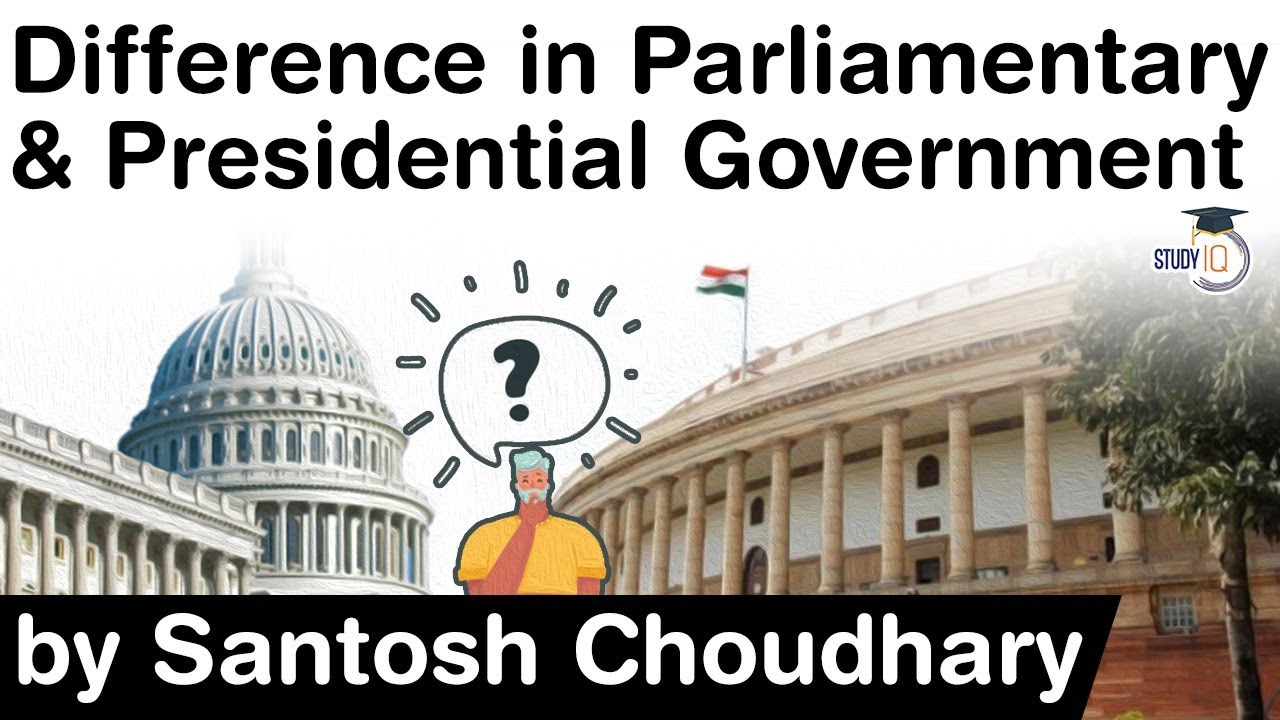
Difference in Parliamentary and Presidential form of Government explained #UPSC #IAS

Difference in Parliamentary and Presidential form of Government explained #UPSC #IAS

Types of hours, motions & resolutions during the working sessions of Parliament | Polity Lecture 39

Types of hours, motions & resolutions during the working sessions of Parliament | Polity Lecture 39

Fundamental Duties in Indian Constitution (Explained) | Indian Polity for UPSC Prelims & Mains 2022

Fundamental Duties in Indian Constitution (Explained) | Indian Polity for UPSC Prelims & Mains 2022

US Presidential Election : Concept Talk by Dr. Vikas Divyakirti

US Presidential Election : Concept Talk by Dr. Vikas Divyakirti

Role and need of Rajya Sabha of Indian Constitution | Indian Polity Lecture 44

Role and need of Rajya Sabha of Indian Constitution | Indian Polity Lecture 44

Right to Equality: Article 14-18 of the Indian Constitution, Indian Polity Lecture 11

Right to Equality: Article 14-18 of the Indian Constitution, Indian Polity Lecture 11

L43: Merits & Demerits of Parliamentary System / Indian vs British Model | Indian Polity for UPSC

L43: Merits & Demerits of Parliamentary System / Indian vs British Model | Indian Polity for UPSC

Directive Principles of State Policy- DPSP : Part 4 (Article 36-51) | Polity Lecture 18

Directive Principles of State Policy- DPSP : Part 4 (Article 36-51) | Polity Lecture 18

Funds of India - Consolidated, Contingency and Public Fund | Indian Polity Lecture 42

Funds of India - Consolidated, Contingency and Public Fund | Indian Polity Lecture 42

⚡️Срочно! ПОРТНИКОВ с НЕОЖИДАННЫМ ПРОГНОЗОМ о конце войны. ФИНАЛ ПЕРЕГОВОРОВ УДИВИТ всех. БУНТ в РФ?

⚡️Срочно! ПОРТНИКОВ с НЕОЖИДАННЫМ ПРОГНОЗОМ о конце войны. ФИНАЛ ПЕРЕГОВОРОВ УДИВИТ всех. БУНТ в РФ?

© 2025 ycliper. Все права защищены.


  • Контакты
  • О нас
  • Политика конфиденциальности


Контакты для правообладателей: [email protected]