Atomic Structure || Solid State Physics || Basic Electronics || Electronics Components
Автор: ElectroTech CC
Загружено: 2020-05-15
Просмотров: 2009
Описание:
#Electrotechcc #automicstructure #solidstatephysics
Atomic Structure || Solid State Physics || Basic Electronics || Electronics Components
Solid State Physics
Matter: Anything which has mass and occupies space
1. Gas: Atoms are separated from each other by comparatively large distances
2. Liquid: Atoms are closer but are still arranged haphazardly
3. Solid: Atoms are the closest and take on an orderly 3-dimensional geometric pattern Crystal lattice
Forms of Matter: two types
• Element:
o Substance which cannot be broken down any further by chemical methods into a simpler substance
o For example, Copper, Oxygen, Bromine, Aluminium, Silicon, Geremanium, and Uranium etc…
o They are identified by such properties as colour, density and melting temperature etc…
o Till today, 106 elements have been discovered.
• Compound:
o Substance which consists of more than one element in chemical combination
o For example, Water (Hydrogen + Oxygen), Sodium Carbonate (Sodium + Carbon + Oxygen)
Molecule:
Smallest particle of a substance that retains all the characteristic properties of the original substance
Atomic Structure:
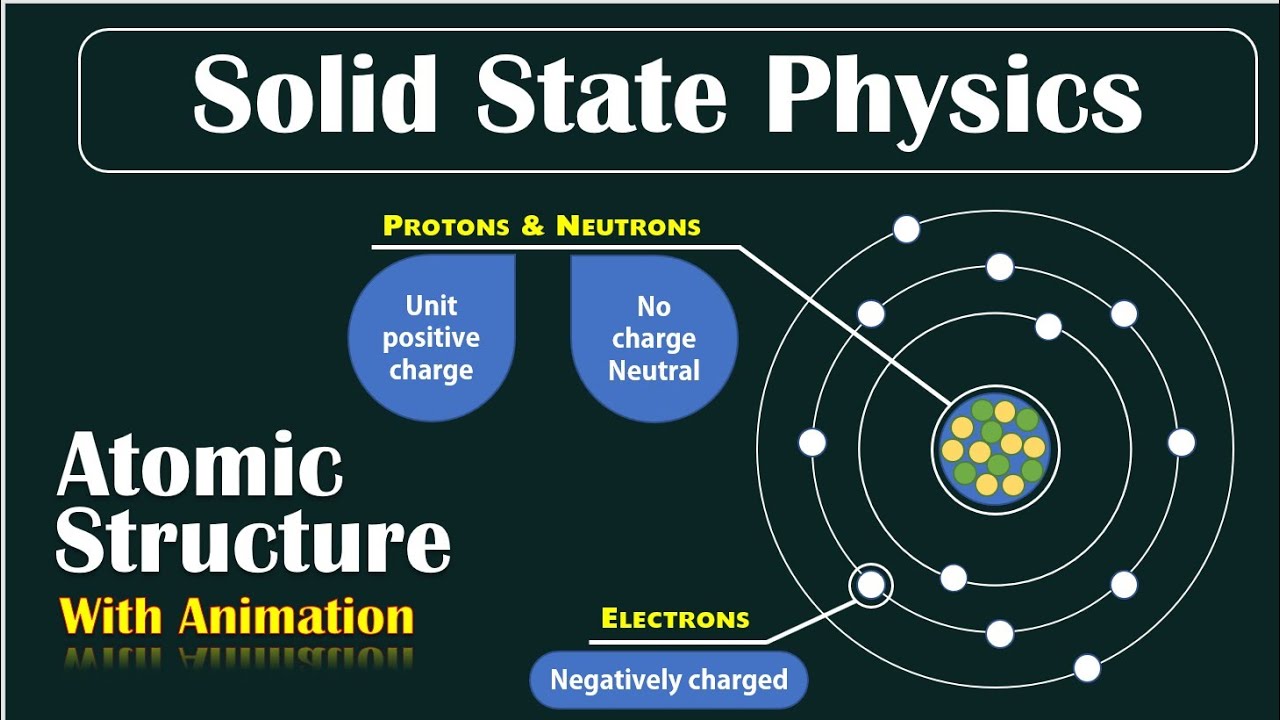
Atomic model was proposed by Niels Bohr in 1913
“An Atom is composed of negatively charge electrons moving in fixed circular or elliptical orbits around a heavy positively charged nucleus made up of protons and neutrons”
Nucleus:
Central core part of atom, contains protons and neutrons
Protons carries a unit positive charge
Neutrons has no charge i.e. it is electrically neutral
Weight of proton = 1840 * Weight of electron
Electrons:
Negatively charged tiny particles whirling around the nucleus in different elliptical orbits at fantastic speeds
Number of electrons in each orbit is fixed
An electron carries a unit negative charge but has negligible mass
Centripetal force = mv2/r necessary to keep electrons rotating round the nucleus is supplied by the force of attraction between their opposite charges as given by Coulombs’ Law
Atomic Number (Z):
• It is equal to the number of Protons (or Electrons) contained in an atom
• For example,
o Hydrogen (H) atom has one proton in the nucleus, hence for hydrogen Z=1
o Carbon (C) atom Z =6
o Copper (Cu) atom Z =29
o Silicon (Si) atom Z =14
o Germanium (Ge) atom Z =32
Atomic Mass Number (A):
• Total number of protons and neutrons contained in the nucleus of an atom
• For example, Si has 14 protons and 14 neutrons in its nucleus, hence it’s a = 28
Electron Orbits or Shells:
• According to Planck’s Quantum theory,
o An electron cannot revolve around the nucleus in the any arbitrary orbit but in only certain define discrete and fixed orbits
o Orbits are designated by alphabetical letters K, L, M, N, O, P etc…
o Orbits are also known by their principal quantum number “n” which can have values of
n =1 for K shell,
n =2 for L shell and so on.
o Number of electrons in each shell = 2n2, n = 1 for K shell, so number of electrons =2
o Number of electrons in L shell = 2n2, n=2 for L shell, so number of electrons = 8
• Each electronic orbit is associated with a certain define amount of energy.
• Electron does not radiate out any energy while revolving in its orbit
• It does radiate out some definite energy when jumping from one orbit to another
o If E2 and E1 are the energies corresponding to the two orbits before and after the jump, the frequency of the emitted radiation is given by the relation
E2-E1 = hf or ΔE = hf
Where h = Planck’s constant = 6.625 x 10⁻³⁴ Js
Valence Electrons:
• Most of the atoms of different elements do not have their outermost shells completely filled
o i.e. they do not have eight electrons in their outermost orbit
o The electrons occupying the outermost orbit of an atom are called Valence electrons
o Valence electrons are highly active in the sense that they are always ready to chemically combine with other elements.
o Elements which have one or two valence electrons are good conductors of electricity, these valence electrons are responsible for forming atomic bonds
o The number of valence electrons in an atom also determines the valency of the element whose atom it is
o For example, boron is trivalent, Si and Ge are tetravalent i.e. they have 4 valence electrons each.
Orbital Energy:
• Total energy (both kinetic and potential) possessed by an electron when it revolves in the nth orbit of an atom with atomic number Z
En = -13.6 Z2 /n2 eV
Total energy of electron is negative i.e. it is a binding energy
Total energy is inversely proportional to the square of the principal quantum number
Binding energy of electron is less when they revolve in higher orbits
Total energy of the electron varies as Z2
My channel publishes videos that focus on Electronics Concept. If that sounds like it could be helpful for you, please join me!
Повторяем попытку...
Доступные форматы для скачивания:
Скачать видео
-
Информация по загрузке:


![Цепи Маркова — математика предсказаний [Veritasium]](https://image.4k-video.ru/id-video/QI7oUwNrQ34)


![Почему снежинки такие разные? [Veritasium]](https://image.4k-video.ru/id-video/nQ5_Ecw5Opk)



![What is a Plasma? Is it the 4th State of Matter? - [5]](https://image.4k-video.ru/id-video/WVYJQucn2yU)