Vitrification - all the supercool kids are doing it: cryoprotectants and flash freezing
Автор: the bumbling biochemist
Загружено: 2021-07-21
Просмотров: 863
Описание:
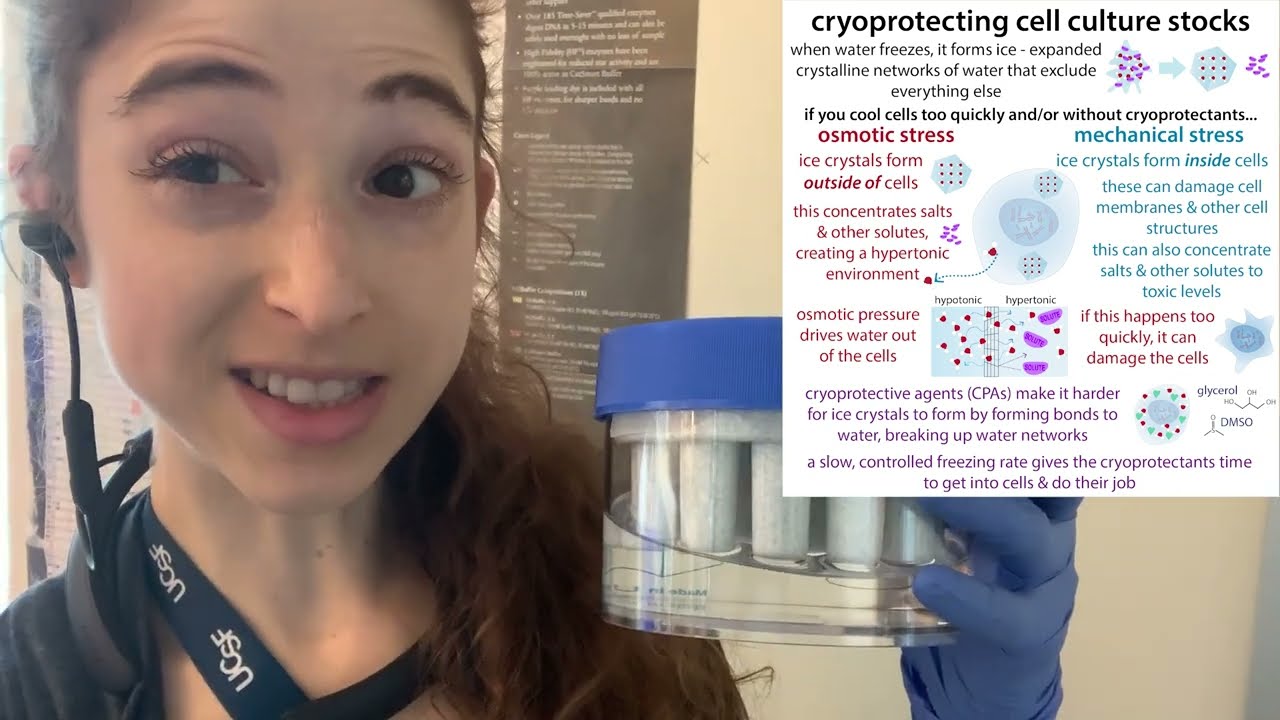
At the end of a protein purification, you often are really exhausted and want to take a nap - but first you have to prepare your protein samples for their nap! You need to get them all snuggled up with cryoprotectants like glycerol, and then knock them out with flash-freezing in liquid nitrogen before the ice monsters can attack! (Water ice crystals form and harm your protein). That’s right - you need to vitrify your samples! The concepts are really similar to what you might do to prevent ice from forming in pipes, so I thought I’d pipe in with a “supercool” video.
for full text & figures see accompanying blog post:
If you you imagine a molecular “prom dance” - in a liquid the dancers are free to glide around & swap dance partners - they just can’t leave the dance hall. But in a solid the molecules can only stand in place and do that awkward sway thing with their partner(s). The difference between them is that in a solid the molecules don’t have the energy to “un-hug” their dance partners and go find someone else. What the molecules really want to do is leave the dance hall all together (escape as a gas) but that requires making their way to the exit without having new dance partners ask for a dance. So that takes a lot of energy.⠀
⠀
The stronger the partners are hugging the more energy is needed to un-hug and water’s really huggy because the oxygen doesn’t share fairly - it hogs electrons, making it partly positive & the H’s partly negative - and opposites attract so they like to hang with oxygens from other water molecules.⠀
⠀
Molecules would rather be on their own (where they have more entropy (randomness/disorder - basically they can move more ways and this makes them happier), but if they have to be there, and they have to get stuck in the super slow dance of solid-ness they’d rather be stuck with dance partners they like. So if they have “advance warning” that a slow song is coming they can link up to their preferred partners and doing so generates a rigid orderly arrangement of molecules we call a crystal. ⠀
⠀
And that linking-upness may require pushing out the “noncool kids.” So with slow freezing you end up freezing with different “cliques” in different areas of the dance hall - a “heterogeneous” mix instead of the nice evenly-distributed molecular crowd that we call a “homogenous solution”. And if you’re dealing with water, the molecules literally get “pushed” because water expands when it freezes (even if the water’s inside pockets & channels of your protein!)⠀
⠀
But if you can switch on the slow song without that advance warning, the molecules get stuck in place - this is the principle behind “flash freezing” And if you add cryoprotectants like glycerol that act like “dance chaperones” that break up the dance partners and make it harder for partners to find each other, you buy yourself more time⠀
⠀
In a solid, molecules are “stuck in place” & only have enough energy to vibrate (as opposed to liquids where they can slide around & gases where they can go wherever they want). In some solids (like ice & diamonds), the molecules are arranged in an orderly lattice, & we call this a crystal or crystalline solid⠀
⠀
But going doing that whole liquid to crystal thing (crystallization) takes a lot of coordination - It requires nucleation. Kinda like an unplanned flash mob dance - you need “trendsetting” molecules to freeze together in the “right” orientation (nucleate) to form a “seed” & then others join in & those others have to be able to find that seed & get there before they run out of energy themselves.⠀
⠀
So if you don’t want a crystal to form you can⠀
make them too tired to find each other - molecular movement requires energy - and heat is a form of energy - so if you lower the temperature, you sap their energy so they’re “stuck with swaying in place”⠀
not give them enough time to find each other (cool it really quickly)⠀
make it harder to get there - use viscous (syrupy) liquids that are hard to move through⠀
make it harder to find each other - add cryoprotectants like glycerol that act as “dance chaperones,” breaking the molecules up and making it harder to “find Waldo” - the “costliest” part of crystallization is that initial trend-setting (nucleation) - so that’s what you really really want to make it hard to do⠀
make them like each other less - how much molecules like each other versus the liquid their in or other molecules around depends on things like the pH and salt concentration of the liquid - we often take advantage of this - but in the opposite way - in protein crystallography: https://bit.ly/gettingcrystals
⠀
But for normal protein work, I don’t want the proteins linking together either. Instead I want to “freeze” them in place - basically just take away their energy - I want them to be as much like how they are now when I wake them up as possible. So what I want is a disordered, amorphous solid. We call this a glass & the process of forming it is vitrification ⠀
Повторяем попытку...

Доступные форматы для скачивания:
Скачать видео
-
Информация по загрузке:








![Пожалуй, главное заблуждение об электричестве [Veritasium]](https://imager.clipsaver.ru/6Hv2GLtnf2c/max.jpg)