Cryoprotecting, flash freezing, and storing protein samples: cryoprotectants, vitrification, etc.
Автор: the bumbling biochemist
Загружено: 2022-03-10
Просмотров: 3663
Описание:
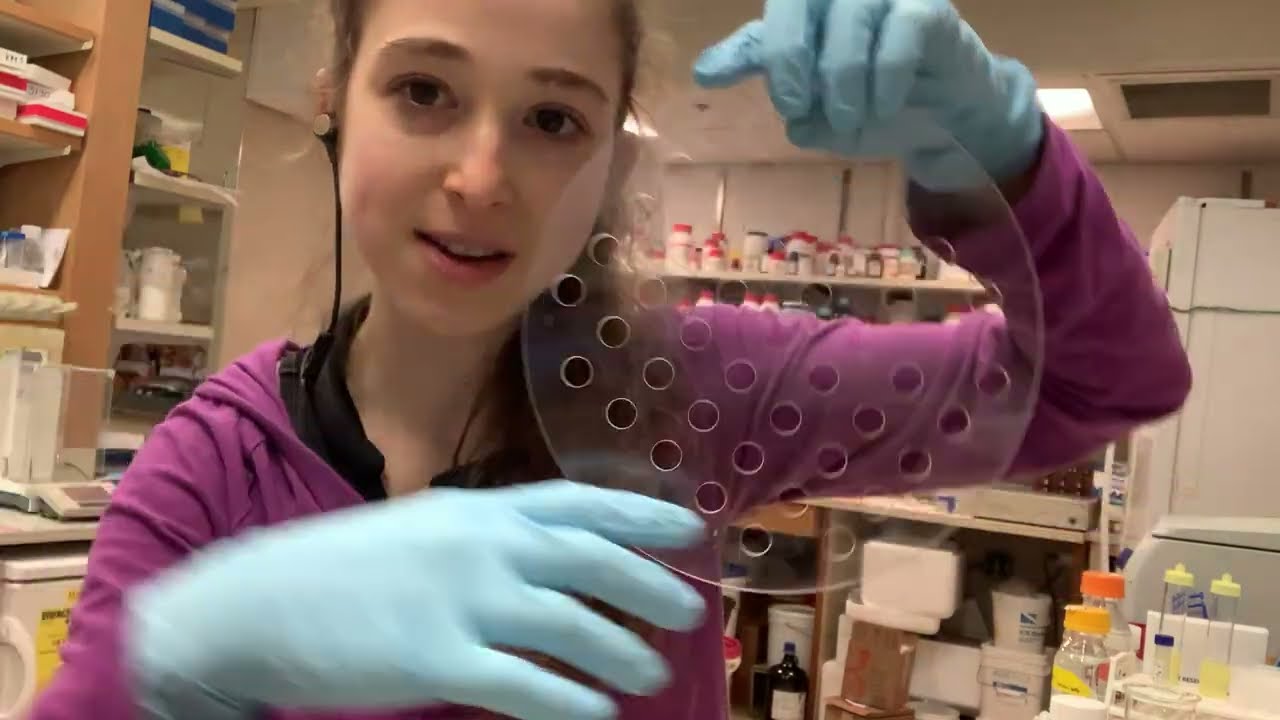
At the end of a protein purification, you often are really exhausted and want to take a nap - but first you have to prepare your protein samples for their nap! You need to get them all snuggled up with cryoprotectants like glycerol, and then knock them out with flash-freezing in liquid nitrogen before the ice monsters can attack! (Water ice crystals form and harm your protein). That’s right - you need to vitrify your samples! blog (with full text & figures) is here: https://bit.ly/cryoprotectantsandvitr...
In a solid, molecules are “stuck in place” & only have enough energy to vibrate (as opposed to liquids where they can slide around & gases where they can go wherever they want). In some solids (like ice & diamonds), the molecules are arranged in an orderly lattice, & we call this a crystal or crystalline solid
But going doing that whole liquid to crystal thing (crystallization) takes a lot of coordination - It requires nucleation. Kinda like an unplanned flash mob dance - you need “trendsetting” molecules to freeze together in the “right” orientation (nucleate) to form a “seed” & then others join in & those others have to be able to find that seed & get there before they run out of energy themselves.
So if you don’t want a crystal to form you can
make them too tired to find each other - molecular movement requires energy - and heat is a form of energy - so if you lower the temperature, you sap their energy so they’re “stuck with swaying in place”
not give them enough time to find each other (cool it really quickly)
make it harder to get there - use viscous (syrupy) liquids that are hard to move through
make it harder to find each other - add cryoprotectants like glycerol that act as “dance chaperones,” breaking the molecules up and making it harder to “find Waldo” - the “costliest” part of crystallization is that initial trend-setting (nucleation) - so that’s what you really really want to make it hard to do
make them like each other less - how much molecules like each other versus the liquid their in or other molecules around depends on things like the pH and salt concentration of the liquid
I don’t want the proteins linking together either. Instead I want to “freeze” them in place - basically just take away their energy - I want them to be as much like how they are now when I wake them up as possible. So what I want is a disordered, amorphous solid. We call this a glass & the process of forming it is vitrification
The glass transition temperature (Tg) is the range of temperatures in which a glass can form & it’s lower than the freezing temperature (when you go liquid to crystal). So in order to get to it you have to quickly skip past the freezing point to get to a supercooled state (which you can do because of the coordination required for crystallization). Cryoprotectants help because they lower the freezing point & raise the Tg (so you have less time in “danger zone” between them) - this is because now, if it wants to form a crystal the water molecules must “push away” the glycerol molecules in between them before they can link together in their exclusive “clique.”
We saw cryoprotectants at work a while back when we looked at why salt is used to prevent ice forming on roads. Salt is good at that because freezing point depression is a “colligative property” meaning it depends “only” on the number of dissolved particles, not their identity.
But we don’t want to oversalt our proteins when we freeze them because that could mess up the protein interactions. Thankfully there are alternatives. Small polyols (chemicals with multiple -OH groups) like glycerol fit the bill and thus are commonly used as cryoprotectants.
Glycerol is what I use when I’ve finished purifying a protein with a series of chromatography steps (much more in prior posts like http://bit.ly/bbproteinchromatography). After the final step (typically size exclusion chromatography (SEC), which separates proteins by size) I concentrate my protein using one of those spin ultrafiltration thingies I talked about before. I use glycerol as my cryoprotectant because it’s water-like so it’s not a big shock to my protein - but it’s less sticky than water. Some proteins, especially some enzymes, need high glycerol concentrations, but I use 10% for most of my stuff. Glycerol is super viscous (syrupy) - this helps it cushion proteins, but makes it really hard to pipet. So instead I pipet from a 50% or 80% glycerol stock.
And then I “flash freeze” them - and remember, when I say I freeze my proteins I’m not really freezing them - my proteins are way too cool to do that to - instead I “supercool” them before I store them away for safe keeping in the -80°C freezer by dunking tubes of protein in liquid nitrogen to race through the freezing point & outrun ice formation.
Повторяем попытку...
Доступные форматы для скачивания:
Скачать видео
-
Информация по загрузке: