A matter of critical deconstruction or critically taking stock?
Автор: The British Association of Lecturers in EAP
Загружено: 2023-05-05
Просмотров: 549
Описание:
This talk was part of the 2023 BALEAP Biennial Conference at the University of Warwick.
Whatever else can be said about it, compared to many of the other subjects in the academy, EAP as the discipline we now internationally recognize is still very young, with most contemporary writers appearing to agree that the period from its birth to the present generally only represents a timeframe of a scant six decades (e.g., Anthony, 2018; Basturkmen, 2020; Bell, 2022; 2016; Charles & Pecorari, 2016; De Chazel, 2014; Ding & Bruce, 2017).
In those sixty years, however, it must also be acknowledged that EAP has undoubtedly achieved a great deal. From its humble beginnings as a fairly small-scale offshoot of ESP, in more recent decades, EAP has arguably blossomed into a fully-fledged academic discipline in its own right, now boasting its own dedicated journals, its own particular meta-language, its own professional organizations, its own internationally-recognized ‘big names’ and its own particular communities of practice. When it is considered from these perspectives, and certainly when it is compared with the earlier and more precarious days of its existence, one could be forgiven for thinking that EAP has now ‘made it’ and that its future in the academy should remain bright.
And yet.
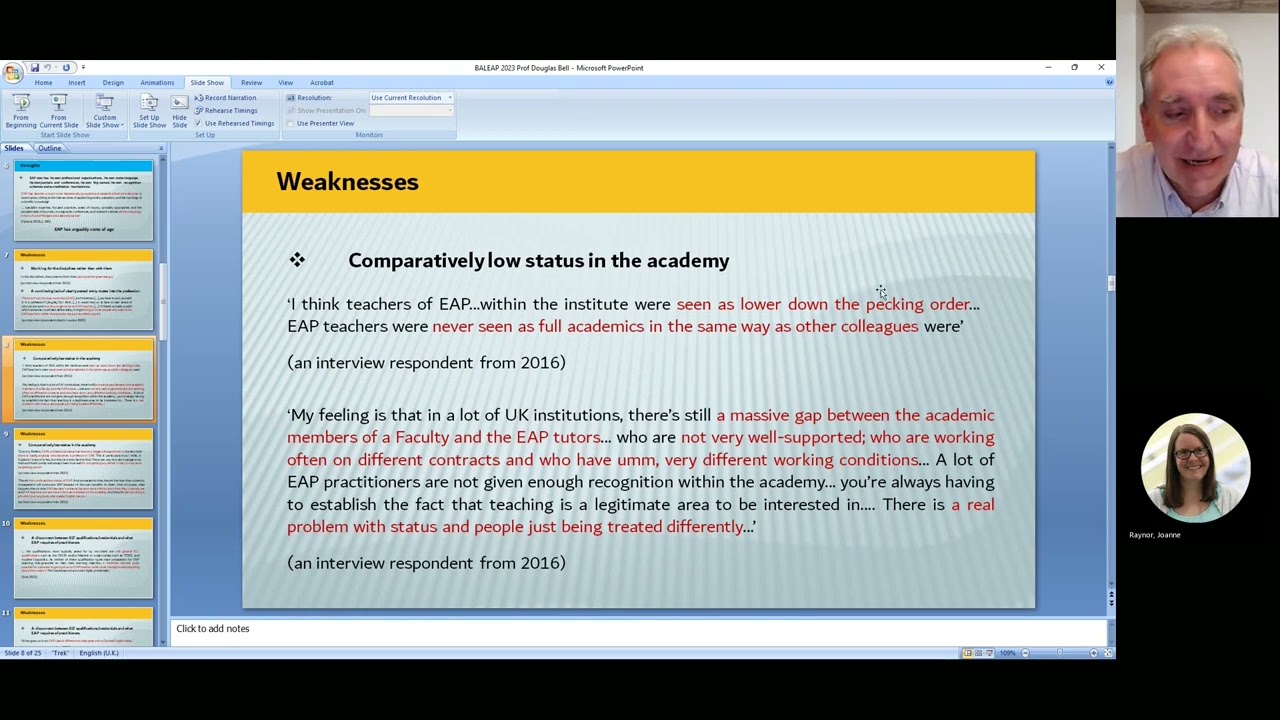
While it is undeniable that much has been achieved, the rise and international growth in demand for EAP has not been an entirely one-sided affair. The discipline still suffers from several inherent weaknesses, such as a lack of clearly signposted pathways into the profession as a whole, comparatively poor academic status for its practitioners, precarious job stability, limited opportunities for career progression and what seems to be an ever-widening gap between research and practice, to name but a few. Many of these issues are continuing to remain largely unaddressed and therefore unresolved, despite them having been identified as matters for professional concern since the earliest days following EAP’s emergence.
It must also be said that EAP as it has traditionally been practiced also now faces a range of new challenges and threats, such as the effects of neoliberalist attitudes to Higher Education in general, the emergence and steady proliferation of private providers, global economic and socio-cultural changes caused by the ongoing Covid-19 pandemic and, in some international contexts, politically motivated reforms impacting the ongoing status of English.
Drawing extensively on qualitative interview data gathered from internationally-recognized names from within the discipline, and representing two separate time periods a decade apart, this presentation therefore aims to provide a no-holds barred critical analysis of the current Strengths, Weaknesses, Opportunities and Threats facing EAP.
Along the way, it will be suggested that if EAP as an academic discipline is to continue to flourish, and if those involved in its delivery wish to safeguard their professional futures, then rather than engaging in critical deconstruction per se, its practitioners should instead be critically taking stock.
Повторяем попытку...
Доступные форматы для скачивания:
Скачать видео
-
Информация по загрузке: