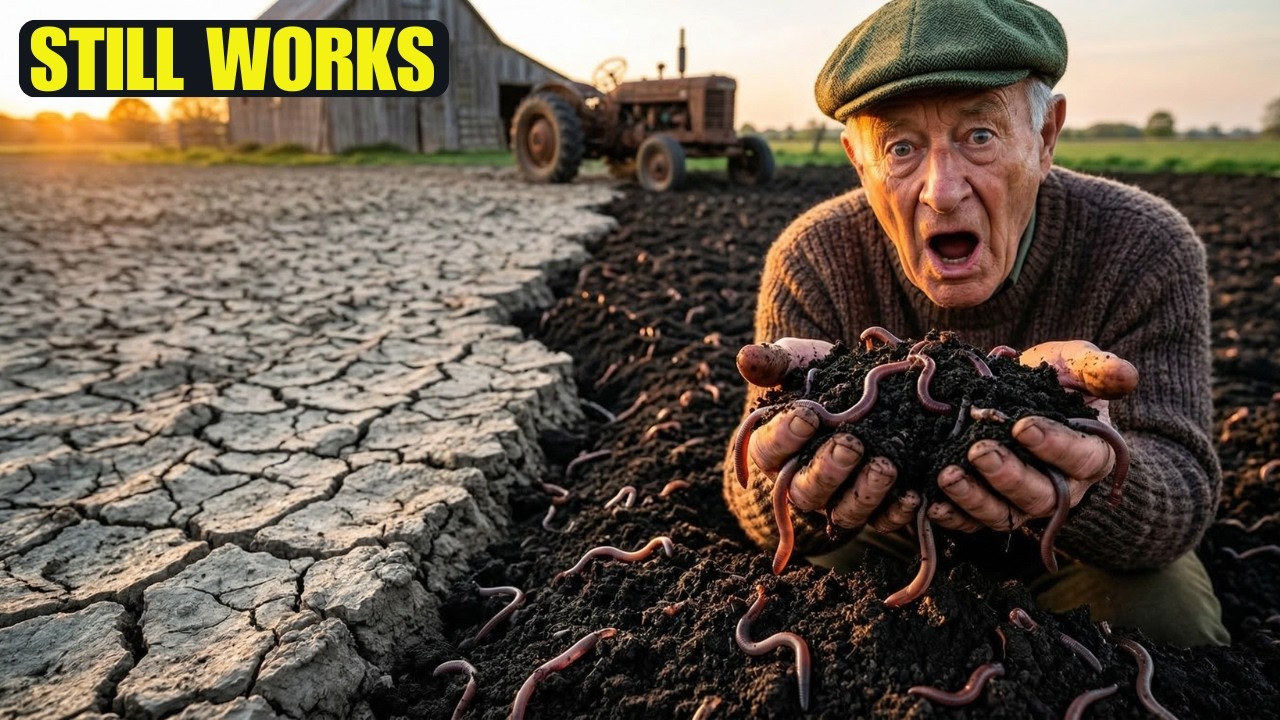
Better Than Fertilizer. Brings 1,000 Worms In 3 Days. Revives Dead Soil. Why Is It Hidden?
Автор: DTD History Radio
Загружено: 2026-03-15
Просмотров: 4195
Описание:
Better Than Fertilizer. Brings 1,000 Worms In 3 Days. Revives Dead Soil. Why Is It Hidden?
In 1881, Charles Darwin published the last scientific work of his life. He had spent 40 years on it. Not on evolution. Not on natural selection. On earthworms.
The Formation of Vegetable Mould Through the Action of Worms was Darwin's conclusion after four decades of careful observation: that earthworms are the most consequential animals on the surface of the Earth. That every inch of productive topsoil on the planet has passed through the body of an earthworm. That without them, agriculture is chemistry — and eventually, nothing at all.
Modern industrial agriculture ignored him completely.
Here is what happened instead.
After World War II, nitrogen manufacturing plants that had been built to produce explosives were repurposed. The Haber-Bosch process — the same chemistry that made artillery shells — was turned into synthetic nitrogen fertilizer. Suddenly, you could spray nitrogen onto any soil and get a crop. You didn't need biology. You didn't need earthworms. You didn't need decomposing organic matter or microbial communities that had taken thousands of years to build. You just needed the bag from the ag co-op and a check.
For the first decade, the yields were extraordinary.
Nobody asked what was happening underneath.
What was happening underneath is now documented across hundreds of peer-reviewed studies.
Long-term application of synthetic chemical fertilizers significantly decreases soil bacterial diversity. A 2022 study in Frontiers in Microbiology found that prolonged chemical fertilization suppresses the activity of key soil microbial functional genes — the biological machinery that makes soil alive. A 2023 Nature study confirmed that the effect varies by cropping system but is consistent: the longer the chemical dependence, the poorer the underground biology.
The earthworms went first.
The USDA Natural Resources Conservation Service classifies a count of 100 earthworms per square meter as good agricultural soil. Studies of chemically intensive farmland regularly find fewer than 5 earthworms per square meter. A 2021 ScienceDirect study modeled the estimated decline in global earthworm population caused by pesticide residues alone — and the numbers are irreversible on any human timescale. A 2024 American Chemical Society study found that pesticide-treated seeds cause juvenile earthworms to gain 30–80% less body weight compared to controls in untreated soil. They don't die immediately. They just stop growing. Stop reproducing. Disappear slowly from fields that were once full of them.
Forty years of chemical farming. Topsoil that used to support 300 earthworms per square meter now supports three.
Sources: Charles Darwin — The Formation of Vegetable Mould Through the Action of Worms (1881) | USDA NRCS — Soil Quality Earthworm Indicators PDF | Frontiers in Microbiology 2022 — Long-term chemical fertilizer decreases soil bacterial diversity | Nature 2023 — Contrasting response of soil microbiomes to long-term fertilization | ScienceDirect 2021 — Estimated decline in global earthworm population caused by pesticide residue | ACS 2024 — Pesticide-treated seeds harm juvenile earthworm growth 30–80% | MDPI Horticulturae 2023 — Vermicompost auxins, cytokinins, gibberellins, humic acids | PMC 2024 — Humic acids modulate auxin and cytokinin pathways in wheat | Tandfonline 2024 — 50% vermicompost + 50% NPK: best crop outcomes | SCIRP — 10t/ha vermicompost equals 100% NPK program | ScienceDirect 2025 — AMF and earthworms synergistically increase soil carbon and nitrogen | GlobeNewswire October 2024 — Global fertilizer market $349B to $408.5B | Zion Market Research — Vermicompost market $1.84B (2024)
#vermicompost #wormcastings #soilhealth #earthworms #deadsoil #soilrevival #organicfarming #chemicalfertilizer #syntheticfertilizer #humussoil #CharlesDarwin #regenerativeagriculture #soilbiology #permaculture #foodforest #growingfood #soilmicrobiome #naturalfertilizer #worms #hiddenagriculture #sustainablefarming #gardeningtips #soildegradation #GMO #agribusiness #Bayer #Syngenta #organicgardening #selfsufficiency #homesteading
Повторяем попытку...
Доступные форматы для скачивания:
Скачать видео
-
Информация по загрузке: