Grażyna Bacewicz - String Quartet no. 5 (Silesian SQ)
Автор: Polish Scores
Загружено: 2022-10-29
Просмотров: 2331
Описание:
Grażyna Bacewicz - Piąty Kwartet Smyczkowy
Composed in 1955
Silesian String Quartet
Violin: Arkadiusz Kubica
Violin: Szymon Krzeszowiec
Viola: Łukasz Syrnicki
Cello: Piotr Janosik
0:00 - I. Moderato
8:19 - II. Scherzo (Fuga): Giocoso
11:33 - III. Corale: Largo
IV. Variations:
17:38 - 1. Allegro
18:57 - 2. Energico
19:49 - 3. Giocoso
20:21 - 4. Tempo: 63 - poco piu mosso
21:24 - 5. Tempo: 88 - con passione
22:23 - 6. Andante
24:05 - 7. Vivace
Bio
Grażyna Bacewicz (1909 - 1969) was born into a musical Lithuanian-Polish family in Łódź, Poland. Grażyna and her brothers and sister all learned the violin and the piano from their father [1]. She gave her first performance at age 7, began her conservatory education at age 10, and composed her first piano piece at age 11 [2]. She entered the Warsaw conservatory several years later at age 19. It was here that she became interested in literature and philosophy [1]. After graduating, following the advice of Karol Szymanowski and the generous cash flow of Ignacy Jan Paderewski, she went to study in Paris, which was a wellspring of musical culture at the time [2]. There, she studied with Nadia Boulanger. She would go to Poland to teach and return to Paris to study with Carl Flesch. Eventually, she wound up in Warsaw.
Bacewicz's musical life was often disrupted by a personal life which was difficult and complex and by the tempestuous forces of history that ceaselessly beat and batter the Polish nation. Her father was a Lithuanian, and, in 1920, the second Polish Republic seized control of Vilnius. Her father illegally crossed the border to Lithuania and hoped his family would follow him [1]. Bacewicz, who had visited and performed in Lithuania, hoped to work in Kaunas, but nobody accepted her applications [1]. For the sake of her career in music, she stayed in Poland [1]. During World War II, she and her husband stayed in Warsaw, where she participated in the underground movements that strove to keep Polish culture alive during the Nazi occupation [1]. In the aftermath of the Warsaw Uprising, the entire city was destroyed building by building, so Bacewicz, her husband, and her two-year-old daughter, Alina, fled the destruction [2]. They were held in Pruszków and were not deported to a labor camp only because they had a two-year-old [2]. She also suffered a heart-attack, but continued her work regardless [2]. She died in Warsaw at age 59.
Bacewicz's approach to music was starkly different than that of the romantics. She believed that "... music does not express anything; no ordinary emotions from human life. It simply expresses itself and its own affections." [3] She was also a pessimist and a believer in determinism, denying free will [4]. Her unique convictions about music and life affected her style, which is extremely aggressive and dark. Like all great artists, no matter how total their convictions, there is a kind of antinomic contrast in their output. Bacewicz's music too, expresses things antithetical to her own sense of herself, which she admitted while writing about the premiere her Sinfonietta (1935) [1]: "Frankly, I listened to that piece as though it weren’t mine at all, but written by some very wise composer. I can’t believe I wrote it. It's so extremely lively and cheerful and witty, with not a single second of waffle. I can’t understand, in truth, how such an embodiment of pessimism as myself could write such merry music" [5]. Though, of course, art often elucidates ideas and truths that the artist doesn't believe in. Regarding emotional expression in Bacewicz's music, as the popular (probably spurious) anecdote about Niels Bohr goes: it works even if you don't believe in it.
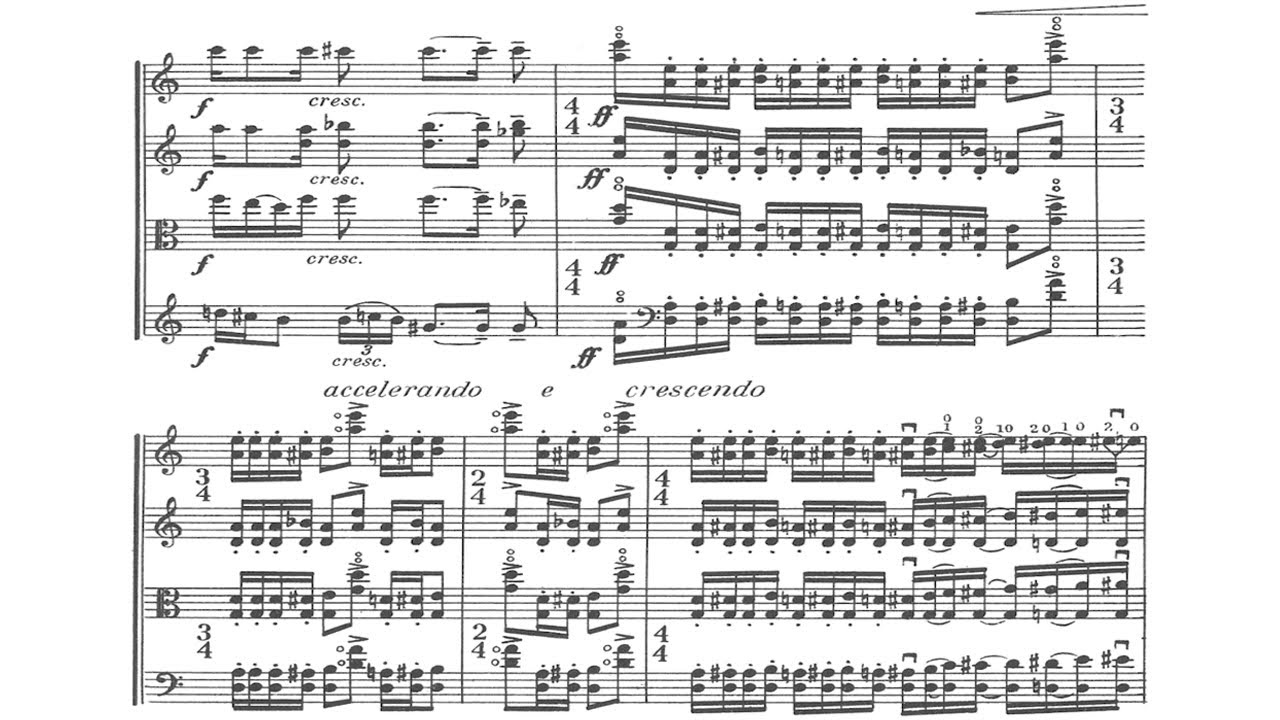
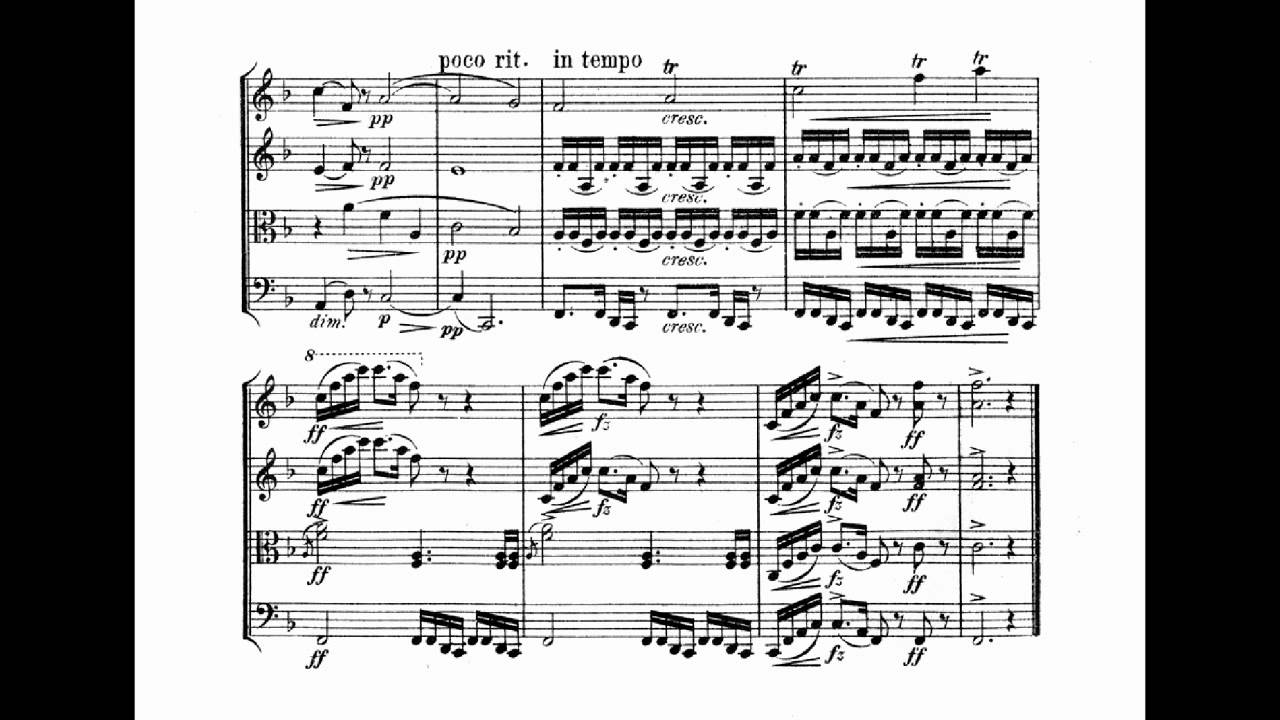
This piece is the last neo-classical String Quartet. The quartet makes full use of the different timbres that string instruments are capable of, using pizzicatos, glissandi, and harmonic notes throughout. Bacewicz will continue to experiment in this way all throughout her sonorist period though with much more vigor and focus.
Bibliography
[1] M. Gąsiorowska, "Grażyna Bacewicz - The Polish Sappho," Musicology Today, Vol. 16 pp 56-102. 2019.
[2] H. Chung, "Grażyna Bacewicz and Her Violin Compositions: From a Perspective of Music Performance," Doctoral Dissertation: Florida State University College of Music, 2011.
[3] S. Kisielewski, "Rozmowa z Grażyną Bacewiczówną", Tygodnik Powszechny, no. 9, p. 5, 1960.
[4] G. Bacewicz, letter to Tadeusz Ochlewski, 7th April 1950 [manuscript].
[5] J. Sendłak, "Z ogniem. Miłość Grażyny Bacewicz w przededniu wojny", Warsaw, Skarpa Warszawska, p. 409–410, 2018.
Повторяем попытку...
Доступные форматы для скачивания:
Скачать видео
-
Информация по загрузке:


![Grażyna Bacewicz - Divertimento for Strings / Divertimento na Smyczki (1965) [audio + score]](https://imager.clipsaver.ru/7GSBt6jG8qA/max.jpg)





![Caroline Shaw — Plan & Elevation (2015) [w/ score]](https://imager.clipsaver.ru/eIEI80LfaMk/max.jpg)


