How to find relatedness between species
Автор: Nikolay's Genetics Lessons
Загружено: 2022-06-03
Просмотров: 394
Описание:
Parts of a tree
A phylogenetic tree is an illustration depicting the hypothesized degrees of evolutionary relationship amongst a selected set of taxa (singular = taxon). The taxa are typically species, but can also be higher-level Linnaean groupings like genera or families. Alternatively, some phylogenetic trees depict relationships among individuals within a species (e.g., from geographically isolated populations). Regardless of their rank, the taxa depicted in a phylogenetic tree are often called terminal taxa, because they occur at the tips of the tree. They are sometimes referred to as "terminals" or "leaves."
Terminal taxa are connected by branches. The branches are the line segments that make up the tree. Branches come together at branching points called nodes. Each nodes represents a common ancestor shared by two or more terminal taxa.
The Relatedness of Taxa
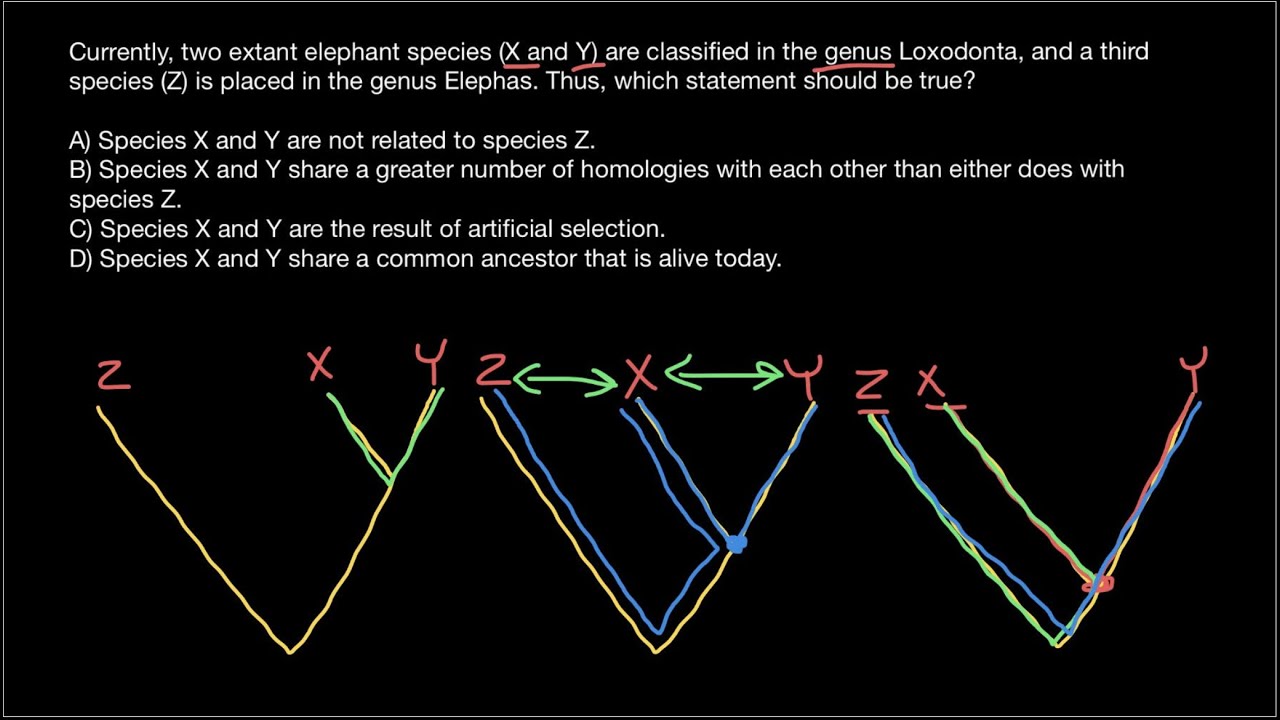
Remember that phylogenetic trees depict degrees of relationship among taxa. On a phylogenetic tree, more closely related terminal taxa are connected by shallower nodes (i.e., nodes nearer to the tips of the tree) and more distantly related terminal taxa are connected by deeper nodes (i.e., nodes nearer to the base of the tree).
Branches may be rotated about nodes without any change in the hypothesized relationships depicted on a tree diagram.
Problem:
Currently, two extant elephant species (X and Y) are classified in the genus Loxodonta, and a third species (Z) is placed in the genus Elephas. Thus, which statement should be true?
A) Species X and Y are not related to species Z.
B) Species X and Y share a greater number of homologies with each other than either does with species Z.
C) Species X and Y are the result of artificial selection.
D) Species X and Y share a common ancestor that is alive today.
Повторяем попытку...
Доступные форматы для скачивания:
Скачать видео
-
Информация по загрузке: