Falsifiable Experimental Test of the Universality of Gravitational Time Dilation
Автор: New Physics Project
Загружено: 2026-01-29
Просмотров: 55
Описание:
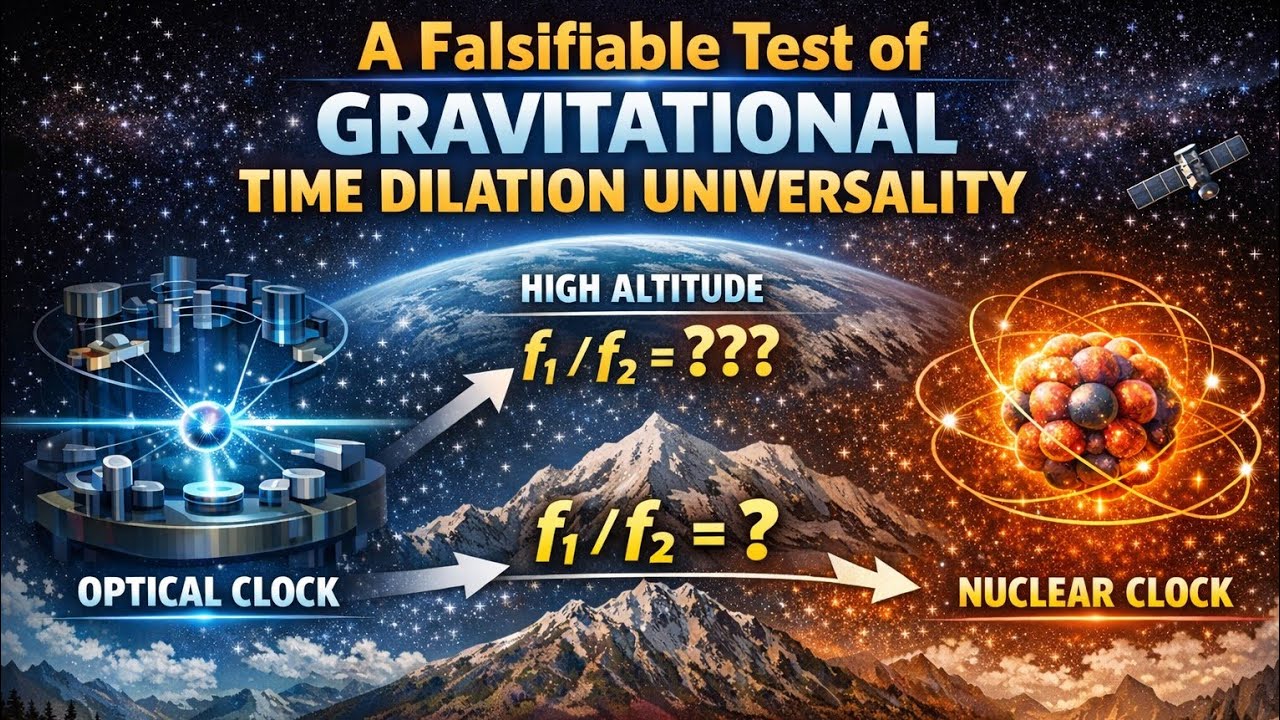
General Relativity (GR) predicts the universality of gravitational time dilation: while absolute clock rates depend on gravitational potential, the frequency ratio of any two perfectly colocated clocks must remain invariant when those clocks are transported together through different gravitational environments. This universality is a central and extensively tested consequence of relativistic gravitation.
A direct and falsifiable experimental test of this principle involves comparing clocks based on fundamentally different physical mechanisms—specifically, a nuclear clock and an optical atomic clock—operated at different altitudes. The two clocks are first colocated at a lower altitude, where their frequency ratio is measured with ultra-high precision. The same clocks are then relocated together to a higher altitude and the measurement is repeated under otherwise identical conditions. According to GR, the frequency ratios obtained at the two altitudes must agree within experimental uncertainty, as both clocks should experience identical gravitational time dilation.
Alternative theoretical frameworks predict a different outcome. If gravitational time dilation does not arise purely from spacetime geometry, but instead from interactions with a physical medium whose properties vary with gravitational potential, then clocks governed by different internal dynamics may respond differently to changes in altitude. In such models, the frequency ratio between nuclear and optical clocks could exhibit a systematic, altitude-dependent shift despite perfect colocation, thereby violating the universality predicted by GR.
Within this context, the Exploding Mass Defect Hypothesis proposes that the mass defect associated with nuclear processes and other energetic events is converted into a space-filling physical medium whose effective density varies in gravitational fields. According to this hypothesis, this medium may couple differently to nuclear transitions than to electronic transitions, leading to clock-dependent responses to gravitational potential.
Precision comparisons between nuclear and optical clocks across differing gravitational potentials therefore provide a clean and decisive experimental test. Invariance of the frequency ratio would further confirm the universality of gravitational time dilation as described by General Relativity, whereas a reproducible deviation would constitute direct empirical evidence for physics beyond the standard relativistic framework.
Повторяем попытку...
Доступные форматы для скачивания:
Скачать видео
-
Информация по загрузке: