#DemocratizingWork
Автор: Democratizing Work
Загружено: 2022-04-06
Просмотров: 171
Описание:
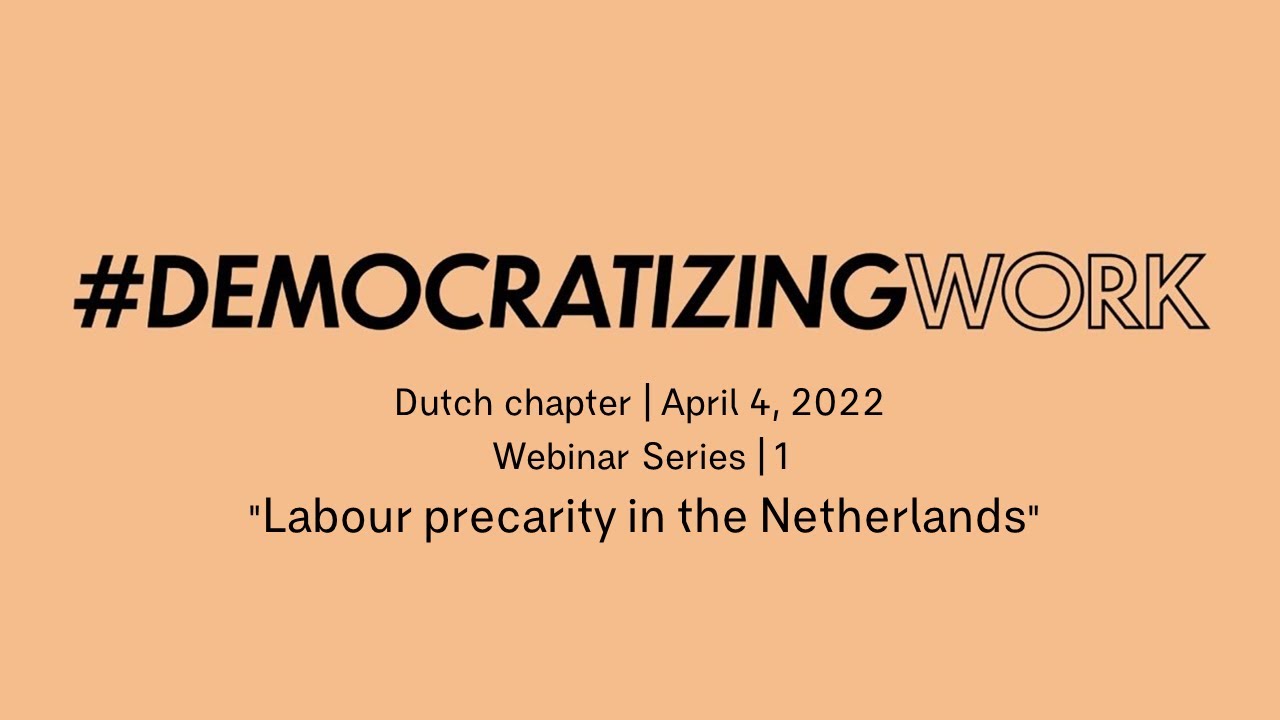
Organizers: Dutch chapter of #DemocratizingWork
Date & Time: April 4, 2022, 16.30-18.00
Over the last decades, the share of non-standard labour contracts (solo self-employment, interim works, platform-mediated work, part-time work…) in the Dutch labour market has grown exponentially, allowing employers to hire and dismiss workers in highly flexible ways, shifting part of the entrepreneurial risks to them to substantially reduce the cost of labour. As a result, a large share of workers in The Netherlands are today employed under highly precarious conditions. They are much less protected than what they used to be under standard employment, in terms of wage guarantee, permanent employment and the social security protection that comes with it. In this webinar, we will examine the forms and prevalence of this widely precarious workforce in the Netherlands, its origins, historical evolution and consequences. We will then discuss possible responses to precarization in view of democratizing work and labour relations.
Moderator: Tim Christiaens (Tilburg)
Speakers: Ronald Dekker (TNO), Valeria Pulignano (KU Leuven), Valeria Piro (University of Milan)
Dr Tim Christiaens is assistant professor of economic ethics at Tilburg University. He works currently on the impact of the digitalization of work on labour.
Dr Ronald Dekker is labour economist at TNO in the Netherlands. He mainly works on precarious labour and the economics of innovation.
Prof Valeria Pulignano is labour sociologist at KU Leuven in Belgium. She currently heads an ERC-funded research project on the theory and measurement of precariousness in labour relations.
Dr Valeria Piro is post-doctoral researcher at the University of Milan. She mainly studies workers’ political agency under precarious labour conditions.
More information on this page: https://www.nonextractivefuture.eu/20...
Повторяем попытку...
Доступные форматы для скачивания:
Скачать видео
-
Информация по загрузке: