The Local AI Hardware Mistake Everyone Makes
Автор: Manolo Remiddi
Загружено: 2026-05-18
Просмотров: 72473
Описание:
🤝 Join the Inner Circle: / discord
🔥 Companion Substack Article to this video: https://augmentedmind.substack.com/p/...
Cloud AI is powerful, convenient, and increasingly impossible to ignore. Local AI is private, controllable, and getting better fast. But treating this as a simple choice between “use the cloud” and “run everything locally” is a trap.
In this video, I break down the real strategy behind building a sovereign AI stack: using frontier cloud models where they are actually useful, running local AI where privacy and continuity matter, and separating risky agentic tools from your most important data.
This is not a purity contest. It is a systems design problem.
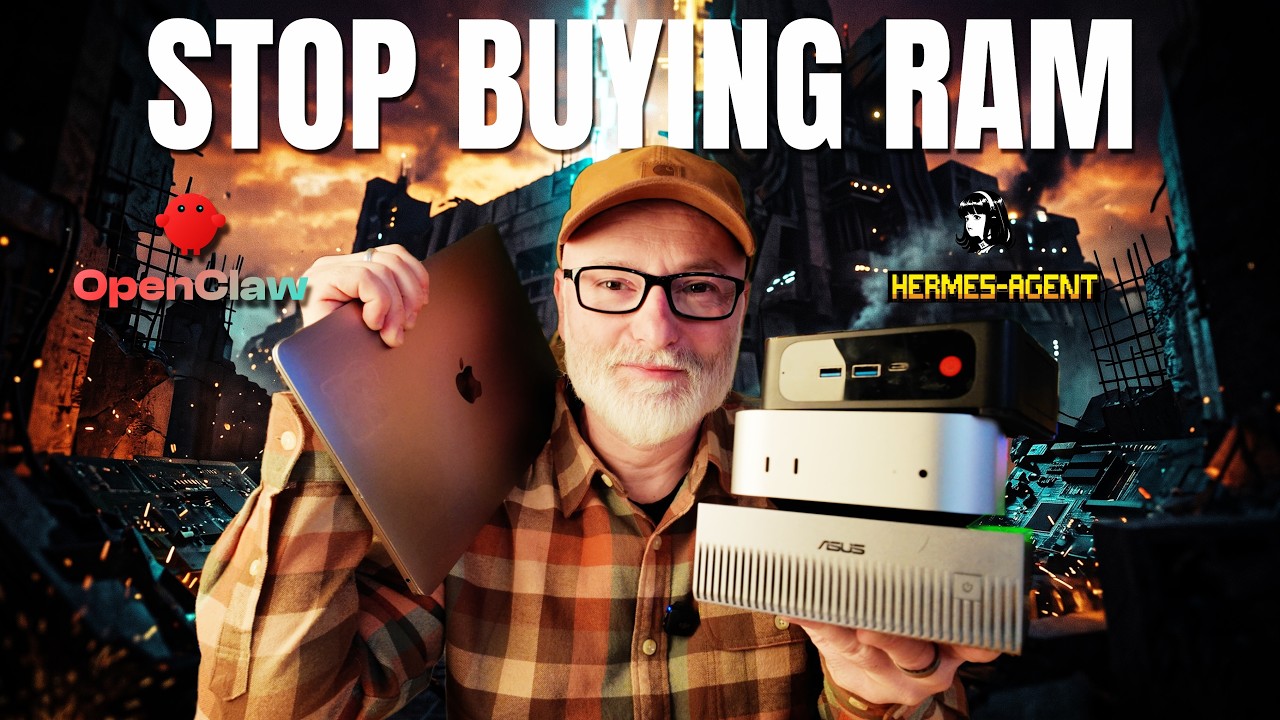
I’ll walk through my own hardware journey, from an M1 MacBook Air to multiple Mac Minis, sandboxed agents, local models, and a 128GB AI machine. More importantly, I’ll explain what each machine is for, why raw power is not the only thing that matters, and why token speed, RAM, stability, context window, and model architecture all change the experience.
We’ll also talk about why local AI is still not a full replacement for frontier models, how to use cloud models without becoming dependent on them, and why the future belongs to people who can design their own AI workflow instead of renting their intelligence layer from corporations forever.
If you are building your own AI stack, experimenting with local LLMs, vibe coding, or thinking seriously about AI sovereignty, join the Augmented Mind community on Discord:
/ discord
We are also building ResonantOS: a community-owned AI OS for people who want intelligence they can govern, extend, and trust.
⸻⸻⸻⸻
🚀 Build Your AI Creative Collaborator, an Augmentor, with ResonantOS Open (Free)
Architect an AI that remembers, aligns with your values, and tunes to your creative DNA.
http://resonantos.com/
⸻⸻⸻⸻
📬 Stay Connected
📝 Newsletter: http://augmentedmind.co/
🌐 Website: https://manoloremiddi.com/
💼 LinkedIn: / manoloremiddi
🤖 Augmentatism Philosophy: https://augmentatism.com/
🤝 Join the Inner Circle: / discord
🪐 Cosmodestiny Philosophy: https://cosmodestiny.com/
⸻⸻⸻⸻
📕 My Free eBook
The Last Human Teacher: A Survival Guide to the Age of AI and the TikTok Brain.
https://manoloremiddi.com/thelasthuma...
⸻⸻⸻⸻
🛠 Tools:
🎁 MiniMax Coding Plan 10% OFF for friends: https://platform.minimax.io/subscribe...
🧠 AI Voice: https://try.elevenlabs.io/gkb7rak7o4zi
🔍 AI Research: https://perplexity.ai/pro?referral_co...
💪 Ultrahuman Ring: https://www.ultrahuman.com/ring/buy/i...
🌐 VPN: https://refer-nordvpn.com/SOaIHsnlppb
✂️AI Video Editing: https://gling.ai/?via=manolo
📡 One free month of Starlink service! https://www.starlink.com/residential?...
[00:00] – Introduction: Moving away from big tech corporations and the journey toward local data sovereignty.
[01:36] – Overview of the hardware setup used throughout the video (laptops, desktops, mini PCs, and mobile devices).
[02:02] – The starting point: Running workflows on an M1 MacBook Air (16 GB RAM) and an M4 Mac Mini (32 GB RAM).
[02:40] – Isolating agentic workflows: Creating secure virtual machines to safely test open-source AI agents.
[03:41] – Architecture insights: Overcoming deterministic control hurdles in probabilistic AI worlds.
[05:25] – Introducing the base-model M4 Mac Mini (16 GB RAM / 256 GB SSD) as a dedicated control hub.
[06:23] – Showcasing a 128 GB RAM micro-supercomputer running an Nvidia-designed architecture.
[07:24] – The stability benefits of Nvidia systems versus the trade-offs of RAM speed and generation tokens.
[08:36] – Testing small-to-midsize open models: Comparing performance on Qwen 3.6 (35B) versus Qwen 27B.
[09:24] – Analyzing token-per-second metrics and real-world UI responsiveness.
[10:48] – Evaluating Google's Gemma 4 and managing multiple parallel model instances in a local ecosystem.
[12:00] – Cost considerations, hardware price trends, and optimization techniques within a set VRAM limit.
[13:00:00] – DeepSeek v4 architecture and matching cloud-based frontier models locally.
[14:01] – Rejecting binary choices: Strategies for building a balanced, hybrid cloud/local developer ecosystem.
[15:47] – Breaking code down into modular blocks that small, local models can successfully audit.
[16:25] – Analyzing high-end consumer hardware (RTX 5090) versus the unified memory approach of a Mac Studio.
[20:48] – Summary of hardware choices and final architectural thoughts.[
21:08] – Community update: Information on daily live calls, the Discord server, and upcoming Masterclasses on "vibe coding".
Повторяем попытку...
Доступные форматы для скачивания:
Скачать видео
-
Информация по загрузке: