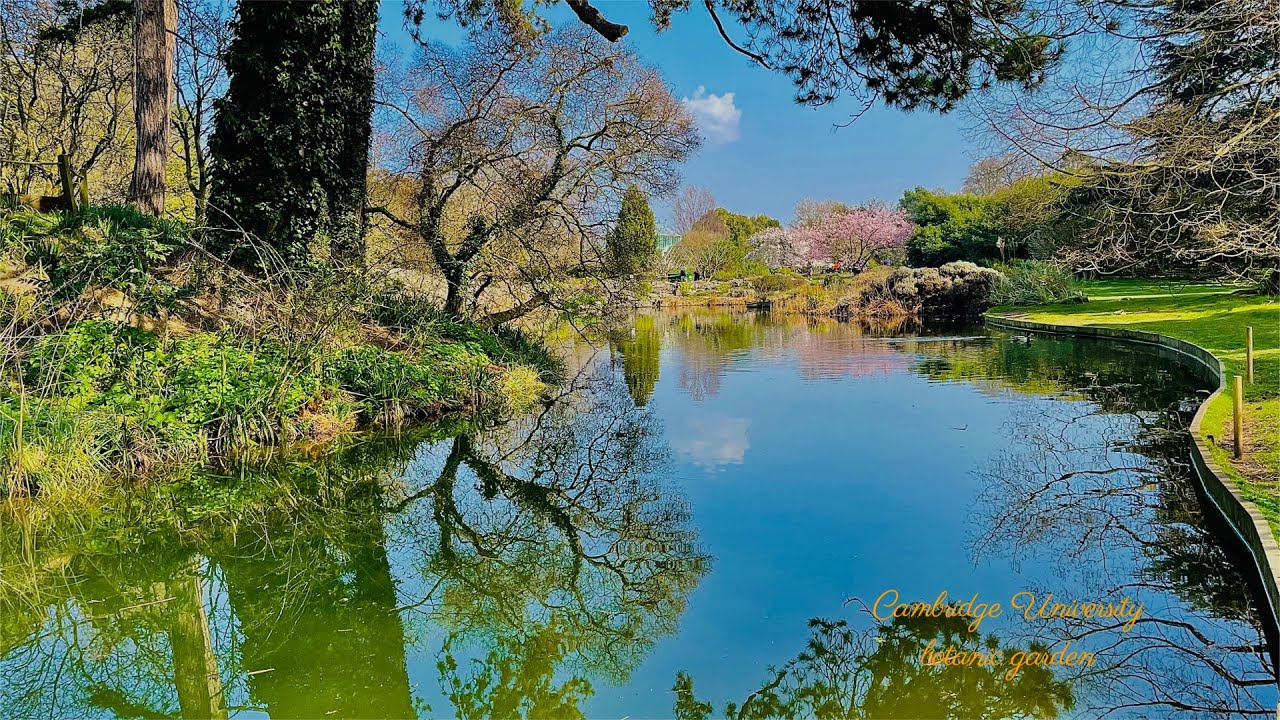
Spring in Cambridge University botanic garden 2022 ,the most beautiful season to visit
Автор: Fleur Fleur花花世界
Загружено: 2022-04-04
Просмотров: 788
Описание:
In 1825 John Stevens Henslow, Charles Darwin's teacher at Cambridge, succeeded Martyn as professor of botany and soon realized that a larger site, farther from the centre of Cambridge, was desirable for the Botanic Garden. In 1831 the University purchased the present site of about 40 acres to the south of the town on the Trumpington Road, and in 1846 the first tree was planted. It had been the intention to lay out the whole 40 acres as a Botanic Garden, but presumably funds were lacking, and in fact only 20 acres were planted, the remainder being let out as allotments.
The planning of the new Garden was carried out by Professor Henslow, assisted by young Cardale Babington.The land was flat and unpromising as a garden site, but the layout was planned with great skill, utilizing an old gravel pit to construct a lake with a high mound running into it. Trees and shrubs were planted according to their botanical sequence, a range of glasshouses was built in the 1860s, and a rock garden, one of the earliest of its kind in the country, was constructed about the same time. The Garden has also long been known for its many fine specimens of rare trees. By the 1870s the main features of the Garden had been developed and, it was ready to play its part in the great expansion of botanical teaching and research that was about to take place at Cambridge. During the early years of the 20th century much of the pioneer work of William Bateson, Charles Chamberlain Hurst, and Edith Rebecca Saunders on plant genetics was carried out at the Garden, and it was later used for researches on plant physiology by Frederick Blackman and George Edward Briggs, and on plant pathology by Frederick Tom Brooks and others.
On 25 July 2019, a new UK temperature record was set at 38.7C (101.7F) within the gardens, which exceeded the previous record of 38.5C (101.3F) set in Faversham on 10 August 2003.
Between 1954 and February 2022 the Botanic Garden was home to the Isaac Newton tree.The tree was a Flower of Kent grown from a cutting of the tree that dropped the apple that Newton claimed inspired him to produce his theory of gravity. The tree was blown down in Storm Eunice.
Garden features
Autumn colour garden
Bed of British native plants
Dry garden — demonstrates planting requiring reduced watering
Fen display
Genetics garden
Glasshouses, containing about 3,000 species, have been restored and almost entirely replanted to display global plant diversity, and comprise:
Continents Apart, comparing and contrasting the fire dependent, floristically rich plant communities of South Africa and SW Australia, once conjoined in the supercontinent Gondwana
Oceanic Islands, exploring the floral diversity peculiar to island archipelagos
Mountains, exploring how plants survive life in a cold climate
Tropical Rainforests, a hotbed of competition
Carnivores, displaying the diversity of traps in carnivorous plants
Arid Lands, displaying drought tolerant plants from continental Africa and the Americas, including many succulent and cactus species, and demonstrating the phenomenon of convergent evolution.
Life Before Flowers, full of ferns and filmy ferns.
Herbaceous borders
Garden Research Plots for various projects or growing single genera
Lake
National plant collections of:
Alchemilla
Bergenia
European Fritillaria
Lonicera
Ribes
Ruscus
Saxifraga
Species Tulips
Hardy Geraniums
Important scientific and research collections of:
Lavender
Rock gardens — for alpine plants
Limestone rock garden
Sandstone rock garden
Scented garden
Systematic beds — 144 island beds representing 80 families of flowering plants
Tree collection
Water garden
Winter garden (December to April)
Woodland garden — containing spring bulbs
Повторяем попытку...
Доступные форматы для скачивания:
Скачать видео
-
Информация по загрузке:





![Cambridge University Botanic Garden [Binaural Audio]](https://imager.clipsaver.ru/R2j2oeevcBk/max.jpg)