Cardiovascular Pathology, Pathology, USMLE Step 1 - Full Vignette with Extended Explanations
Автор: EndlessMedical.Academy
Загружено: 2026-01-02
Просмотров: 24
Описание:
A 54-year-old woman with a history of rheumatic heart disease and Wolff-Parkinson-White (WPW) pattern presents with intermittent palpitations and brief episodes of lightheadedness. Her exam reveals a diastolic murmur consistent with mitral stenosis, and echocardiography shows left atrial enlargement. Ambulatory monitoring reveals episodes of irregular tachycardia. What key considerations guide blood thinner recommendations for stroke prevention in this complex clinical scenario?
VIDEO INFO
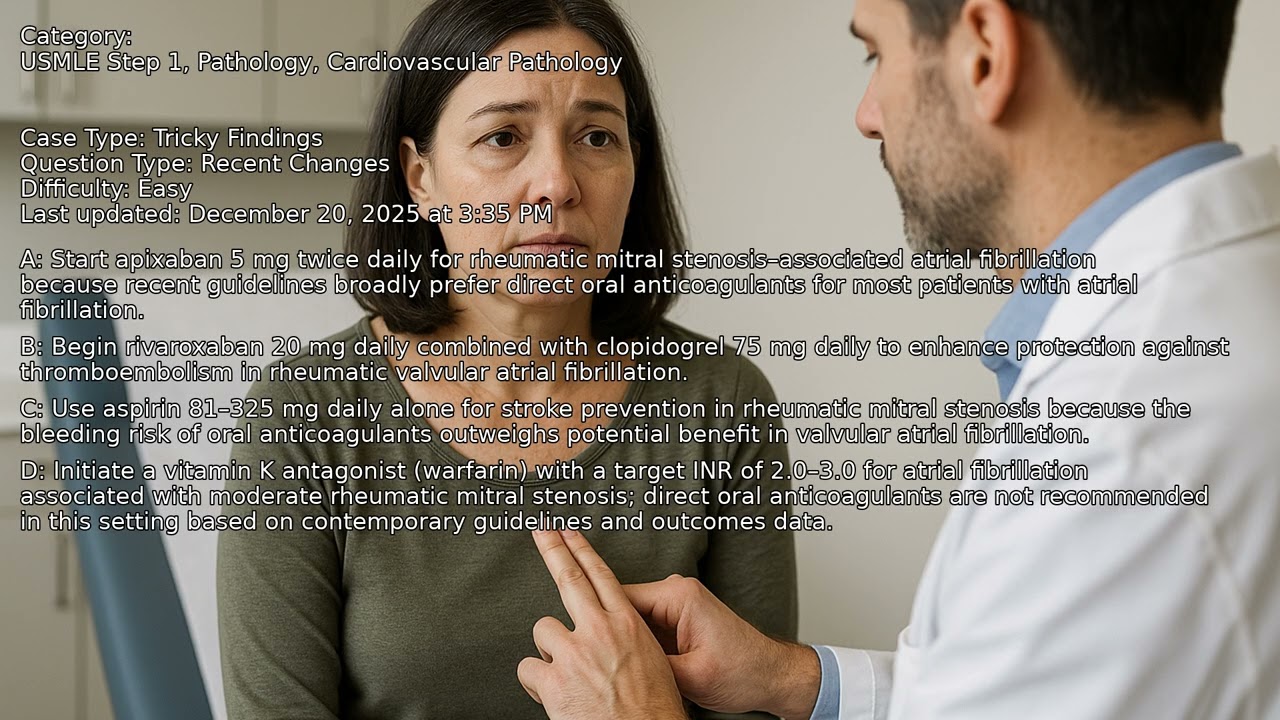
Category: Cardiovascular Pathology, Pathology, USMLE Step 1
Difficulty: Easy - Basic level - Suitable for medical students
Question Type: Recent Changes
Case Type: Tricky Findings
Explore more ways to learn on this and other topics by going to https://endlessmedical.academy/auth?h...
QUESTION
A 54-year-old woman with a history of rheumatic heart disease and Wolff-Parkinson-White (WPW) pattern on baseline ECG presents for outpatient follow-up about intermittent palpitations and brief lightheadedness at home over the last month. She is unemployed, previously worked in healthcare, and smokes 1 pack/day (10 pack-years). She denies alcohol or illicit drug use....
OPTIONS
A. Initiate a vitamin K antagonist (warfarin) with a target INR of 2.0-3.0 for atrial fibrillation associated with moderate rheumatic mitral stenosis; direct oral anticoagulants are not recommended in this setting based on contemporary guidelines and outcomes data.
B. Start apixaban 5 mg twice daily for rheumatic mitral stenosis-associated atrial fibrillation because recent guidelines broadly prefer direct oral anticoagulants for most patients with atrial fibrillation.
C. Use aspirin 81-325 mg daily alone for stroke prevention in rheumatic mitral stenosis because the bleeding risk of oral anticoagulants outweighs potential benefit in valvular atrial fibrillation.
D. Begin rivaroxaban 20 mg daily combined with clopidogrel 75 mg daily to enhance protection against thromboembolism in rheumatic valvular atrial fibrillation.
CORRECT ANSWER
A. Initiate a vitamin K antagonist (warfarin) with a target INR of 2.0-3.0 for atrial fibrillation associated with moderate rheumatic mitral stenosis; direct oral anticoagulants are not recommended in this setting based on contemporary guidelines and outcomes data.
EXPLANATION
Rheumatic mitral stenosis with documented atrial fibrillation falls under the valvular atrial fibrillation exception in which a vitamin K antagonist is recommended rather than a direct oral anticoagulant. Contemporary North American and European guidance specify that in moderate or greater rheumatic mitral stenosis, warfarin with an INR goal of 2.0-3.0 is the standard of care for stroke prevention. This stance is reinforced by high-quality randomized evidence showing inferior outcomes with rivaroxaban compared with vitamin K antagonists in rheumatic heart disease-associated atrial fibrillation. Her mitral valve area of 1.6 cm2, marked left atrial enlargement, and documented paroxysmal atrial fibrillation collectively justify oral anticoagulation with warfarin if atrial fibrillation recurs or becomes sustained.
The alternatives each miss a key principle. Start apixaban 5 mg twice daily extrapolates evidence from nonvalvular atrial fibrillation but contradicts the explicit exception for rheumatic mitral stenosis. Use aspirin 81-325 mg daily alone is inadequate for stroke prevention in atrial fibrillation and exposes the patient to embolic risk given her left atrial enlargement....
---------------------------------------------------
Our cases and questions come from the https://EndlessMedical.Academy quiz engine - multi-model platform. Each question and explanation is forged by consensus between multiple top AI models (GPT, Claude, Grok, etc.), with automated web searches for the latest research and verified references. Calculations (e.g. eGFR, dosages) are checked via code execution to eliminate errors, and all references are reviewed by several AIs to minimize hallucinations.
Important note: This material is entirely AI-generated and has not been verified by human experts; despite stringent consensus checks, perfect accuracy cannot be guaranteed. Exercise caution - always corroborate the content with trusted references or qualified professionals, and never apply information from this book to patient care or clinical decisions without independent verification.
Clinicians already rely on AI and online tools - myself included - so treat this book as an additional focused aid, not a replacement for proper medical education. Visit https://endlessmedical.academy for more AI-supported resources and cases.
This material can not be treated as medical advice. May contain errors.
---------------------------------------------------
Повторяем попытку...
Доступные форматы для скачивания:
Скачать видео
-
Информация по загрузке:


