Left Brain vs. Right Brain: The Scientific Truth Behind the Myth | Psychology & Biology
Автор: Tutor Consortium
Загружено: 2025-12-29
Просмотров: 2
Описание:
Welcome to Tutor Consortium! Today, we are dismantling one of the most pervasive myths in popular psychology: the idea that people are either "Left-Brained" (logical and analytical) or "Right-Brained" (creative and artistic). If you have ever excused your bad math grades by claiming to be "right-brained" or felt you weren't creative because you are "left-brained," this video is for you.
The Origin of the Myth We start by traveling back to the 1960s to the Nobel Prize-winning research of Roger Sperry and Michael Gazzaniga. Their work with "Split-Brain" patients—individuals who had their corpus callosum severed to treat severe epilepsy—revealed fascinating truths about how our hemispheres function independently. However, we explain how the media and pop culture took these specific medical findings and exaggerated them into the personality types we see in online quizzes today.
The Anatomy of Connection To understand the truth, we must understand the anatomy. We explore the Cerebrum, the Hemispheres, and crucially, the Corpus Callosum. This massive bundle of over 200 million nerve fibers acts as a superhighway, allowing the two sides of your brain to communicate instantly and constantly. We explain that in a healthy brain, one side never works alone.
Debunking the Personality Types We look at the hard data, including a landmark 2013 study from the University of Utah that analyzed over 1,000 brain scans. The verdict? There is no evidence that individuals have a dominant hemisphere that dictates their personality. We debunk the binary labels:
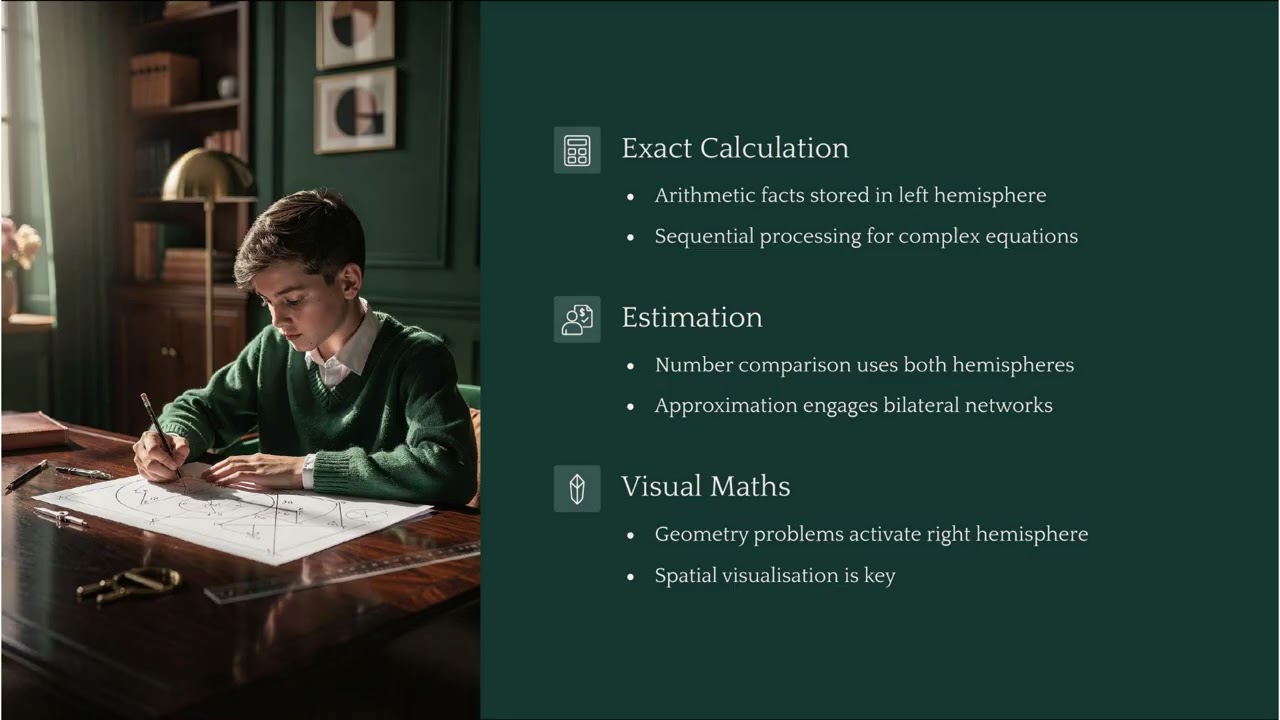
The "Logical" Left: While the left hemisphere typically houses Broca’s and Wernicke’s areas (language production and comprehension) and handles linear sequencing, it is not the sole proprietor of logic.
The "Creative" Right: While the right hemisphere is superior at face recognition, spatial awareness, and emotional intonation, it is not the only source of creativity.
The Real Science: Lateralization vs. Integration We clarify the difference between "Lateralization" (specialized functions) and "Dominance." We introduce the more accurate scientific model of Local vs. Global Processing:
The Left Hemisphere is better at processing details (local).
The Right Hemisphere is better at processing the big picture (global). We show how true creativity and complex problem-solving require "Whole Brain" thinking. For example, playing the piano requires the left brain to read the musical notation and the right brain to interpret the rhythm and emotional expression.
Why This Matters for Students Understanding that you are a "Whole Brain" thinker is empowering. We discuss the concept of Neuroplasticity—the brain's ability to rewire itself—and why labeling yourself limits your potential. Whether you are solving a quadratic equation or painting a portrait, you are using your entire brain.
Join us as we explore the nuance of neuroscience and separate the fact from the fiction. This lesson is perfect for High School Psychology (AP Psych), Biology, and anyone interested in how their mind actually works.
Mandatory Tutor Consortium: At Tutor Consortium, we believe in evidence-based education. We encourage students to move beyond limiting labels and embrace a holistic view of learning. Make sure to subscribe to the Tutor Consortium channel for more educational content that bridges the gap between complex science and classroom learning.
Visit our website for more resources: For detailed diagrams, psychology worksheets, and study guides on brain anatomy, visit us at: www.tutorconsortium.com
Повторяем попытку...
Доступные форматы для скачивания:
Скачать видео
-
Информация по загрузке: