Scalar Harmonic Resonator Update
Автор: Bogirish Ian
Загружено: 2025-12-25
Просмотров: 549
Описание:
This experiment explores a shared philosophical-physical idea found in the work of Nassim Haramein, Henry Lindner, and Tom Minderle (Tom Montalk) - a different way of understanding gravity.
Max Planck’s work on black-body radiation demonstrates that space is not empty - it is an energetically active, vibrating medium. In this experiment that medium is called the “substrate.”
Haramein proposes that every proton - and therefore all baryonic mass - contains a central microscopic, black-hole-like “sink,” continually exchanging energy with the substrate. If we assume the substrate field has extremely high intrinsic energy density - a vibratory “substance” now widely considered in mainstream astrophysics to be a plasma permeating 99.9999…% of the Universe - then stable protons may form as coherent standing-wave structures oscillating in harmony with the substrates' natural vibrational modes.
In this view, mass is not a disconnected solid particle, but a stable resonant pattern within the substrate. Multiple such resonant structures could collectively generate a localized low-pressure node, producing circulatory inflow/outflow patterns toward and around the center of mass. This style of flow - inward convergence and outward rebound - can scale hierarchically from protons to stars to galactic and universal structures, potentially explaining the toroidal and chiral flow patterns widely observed in Nature.
For gravity to emerge as a net inward pressure effect, let's consider a resonant structure (like a proton, atom, or macroscopic mass) to be in a phase-coherent alignment with the substrate around it - inflow arrives in-phase, and outflow leaves out of phase (incoherent to surroundings). Inflow reinforces the standing-wave structure, while outflow does not push back with equal force.
Two physical analogies can make this easier to visualize:
1 - When a flute draws in air in a coherent standing wave, the airflow exits as diffuse turbulence. It's the same air volume, but with different pressure effects.
2 - Imagine the substrate as a flowing ocean, where a proton is not a rock, but a self-maintaining whirlpool vortex. Water spirals inward so the vortex stays coherent, and water exits upward/outward as a diffuse mist, not a counter-force, so the vortex survives only because inflow is phase-organized and outflow is phase-dissipative.
Mass does not "pull" substrate inward — mass is a coherent boundary condition around which the substrate self-organizes. The resistance we feel when our bodies are on the Earth's surface, prevented from accelerating inward with the substrate, is perceived as weight. Inertia and gravity are thus two expressions of the same substrate-flow to mass coupling, so Inertia = Gravity.
From this model, the reason why the inflow pressure gradient is greater than outflow is because coherence is a pressure amplifier - only in-phase waves add and build pressure, out-of-phase waves cancel and disperse.
Henry Lindner shows that Einstein’s field equation becomes dramatically simpler if we treat space as a moving fluid. In his model, space (the substrate) itself accelerates toward the center of mass. Gravity is then not a force, nor curvature of “empty” space, but again simply the resistance of our bodies - made of substrate - when we are prevented from following that accelerative flow.
Tom Minderle provides a scalar-field (“Superpotential”) framework suggesting how electrical systems can alter substrate conditions by modifying boundary states - offering a testable approach into this hypothesis.
This combined model:
a) Avoids the paradoxes created by treating space as empty;
b) Avoids the narrative-heavy mathematical complexity of General Relativity;
c) Gives a simple, intuitive, experimentally addressable picture, where gravity is a consequence of how deeply a body is embedded in - and constrained by - a converging substrate flow that has a stronger inward pressure differential than outward.
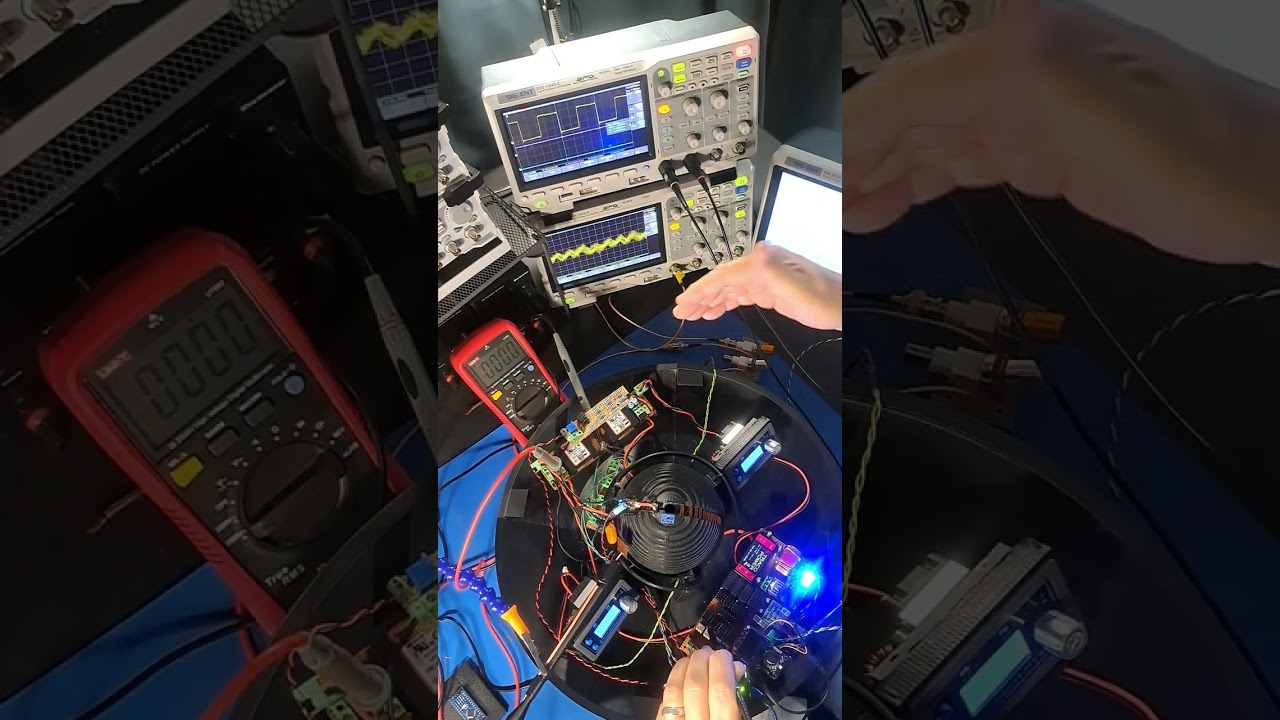
The SHR (Scalar Harmonic Resonator) is designed to test whether a locally engineered scalar pressure gradient - a controllable synthetic flow preference - can alter the surrounding substrate.
In this iteration it's designed to use a resonant DC HV spherical capacitor, MHz-rate electrical excitation, and pulsed hemisphere modulation - to attempt to shape substrate flow and determine whether a measurable upward vector or gravitational change can be produced.
This project is not a demonstration, it's an experiment. The goal is macroscopic results - to see if engineered electrical conditions can produce an unmistakable, observable upward force.
All information shared on this channel is open-source, so no information can or will be patented. This is for others to replicate, improve, or challenge the findings.
Повторяем попытку...
Доступные форматы для скачивания:
Скачать видео
-
Информация по загрузке:


![Как происходит модернизация остаточных соединений [mHC]](https://image.4k-video.ru/id-video/jYn_1PpRzxI)