The Locomotive That Ran on Asphalt to POWER a City
Автор: Legendary Locomotives
Загружено: 2026-01-12
Просмотров: 1736
Описание:
The Locomotive That SAVED a Frozen City
Subscribe: @legendarylocomotives
In January 1998, one of the worst ice storms in Canadian history brought southern Quebec to its knees. Freezing rain coated everything in thick layers of ice, collapsing power lines, snapping utility poles, and knocking out electricity for more than a million people. Entire towns went dark in sub-zero temperatures, and the government deployed thousands of soldiers just to prevent people from freezing in their own homes.
In the middle of this disaster was the town of Boucherville, just outside Montreal. City hall, emergency shelters, and municipal services were all without power, and the utility company had no idea when electricity would return. With no functioning grid and no timeline, the mayor, Francine Gadbois, made a desperate and unconventional decision.
She called Canadian National Railway.
Her idea was based on something she had seen years earlier in a remote mining town: using diesel-electric locomotives as emergency generators. These trains do not drive their wheels mechanically. Their diesel engines spin massive electrical generators, which normally feed power to traction motors. In other words, a freight locomotive is already a mobile power plant.
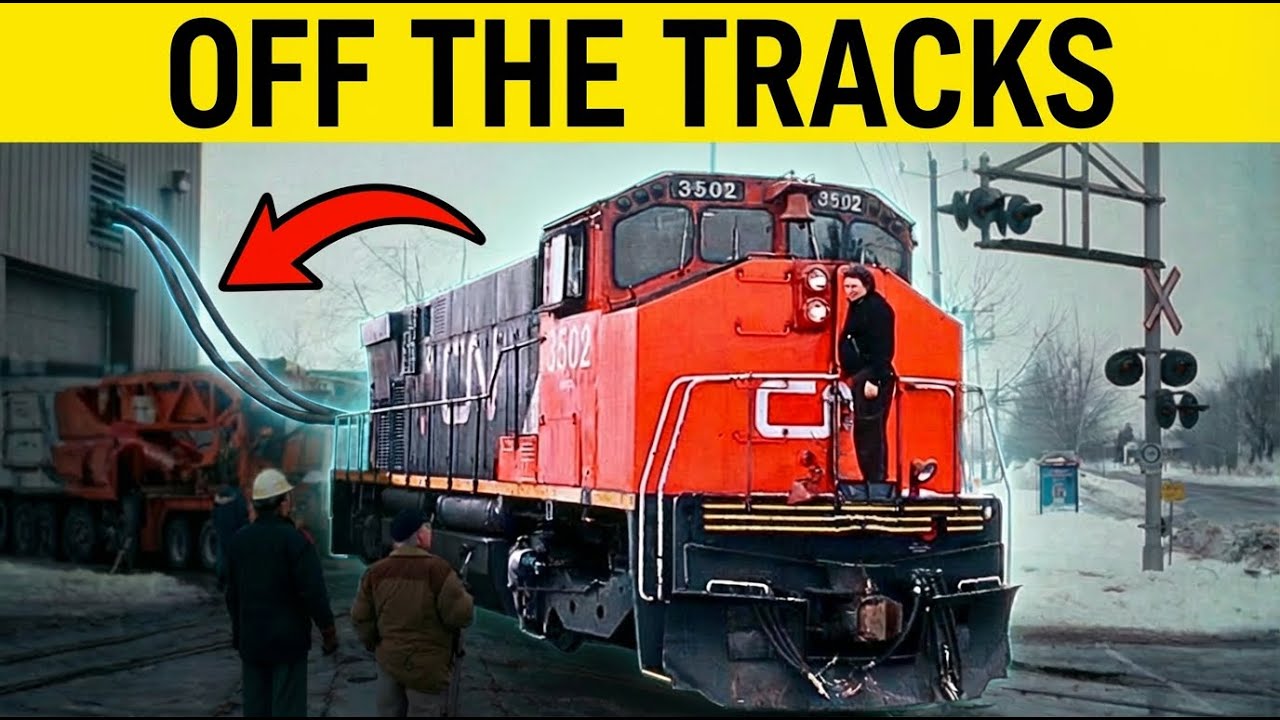
CN agreed to help. They sent locomotive 3502, a 2,000-horsepower MLW M-420 built in Montreal in 1973. The problem was that the locomotive was sitting on railway tracks hundreds of meters away from city hall. Running heavy power cables across icy streets wasn’t practical.
So crews did something almost unbelievable. They brought in a crane, lifted the locomotive off the rails, lowered it onto the street, and slowly drove it through the neighborhood on its steel wheels until it reached city hall. The wheels cut deep grooves into the asphalt, but no one cared. Electricity mattered more than pavement.
Once in place, engineers carefully set the engine speed so the generator would produce stable 60-hertz power — the same frequency used by the North American electrical grid. CN 3502 began feeding electricity directly into municipal buildings, keeping city hall and emergency operations running while the rest of the region remained frozen and dark.
A second locomotive was brought in as backup, and other towns used similar solutions. For days, freight trains quietly functioned as emergency power plants while utility crews rebuilt a shattered grid.
When power was finally restored, CN 3502 returned to normal service and was eventually scrapped years later. Today, only a small plaque in Boucherville remembers the train that, for a short time, became the most important machine in Quebec — a freight locomotive that kept a city alive when the power grid failed.
Повторяем попытку...
Доступные форматы для скачивания:
Скачать видео
-
Информация по загрузке: